
 Ziptone has once again mapped out how energy companies organize their accessibility. In the previous analysis from early 2023, that accessibility was under pressure. Pain points at the time were: hard-to-find phone numbers and no option to email. What is the current state of affairs?
Accessibility is a umbrella termIt starts with facilitating contact between the customer and the company via one or more channels. Subsequently, sufficient resources must be available within those channels – think of knowledgeable employees, good information, a customer portal, or a chatbot. Next come response time and other KPIs: how fast and well does the customer service work?
There are therefore many levers to pull, which is why it is not surprising that opinions are divided on how to organize accessibility. In any case, organizations must adhere to Article 6:230m paragraph 1 sub c of the Dutch Civil CodeThis article requires organizations to provide a telephone number and email address prior to entering into an agreement. In the overview of Ziptone In 2023, the KSF stated that that statutory provision added little to the accessibility of companies themselves. It is about good accessibility, but how that is organized is up to the organizations themselves, according to the KSF. The Consumers' Association, on the other hand, is of the opinion – even today – that companies could indeed look a bit more closely at the intent of that article of law.
Ziptone has once again mapped out the channel mix offered by energy companies. For the record, this concerns accessibility.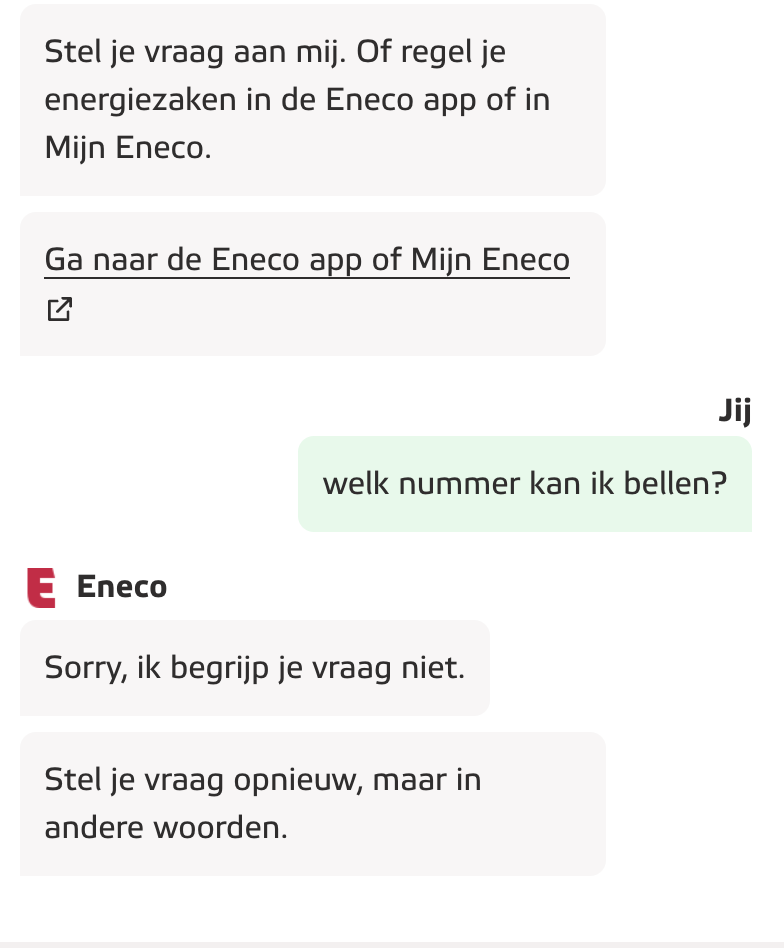 before and after, existing customers. Some energy companies discourage existing customers from calling, but are easily reachable by phone for new customers.
The phone number is easier to find than in 2023.
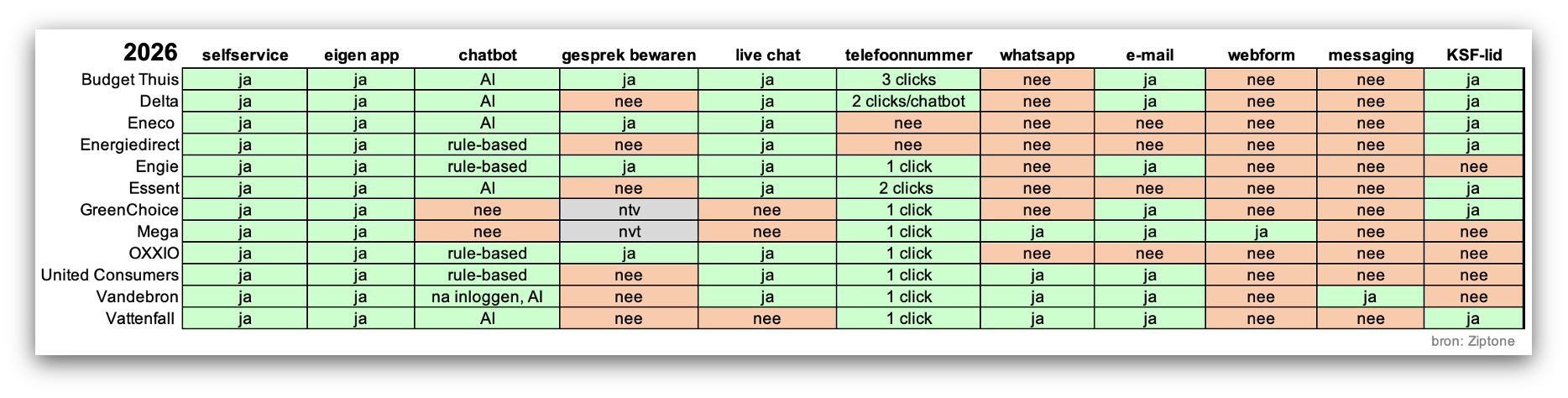
We start with good news. Of the twelve energy companies, there are seven where you can find the phone number after one click (usually: from the homepage to the customer service page). For three other companies, it takes two or three clicks.
Two of the twelve have made the customer service phone number unfindable for existing customers: Eneco and Energiedirect. At those companies, even the chatbot is configured for call deflection; In 2023, the Eneco bot still provided the (hidden) phone number.Eneco is reachable by phone, but only via a callback. Customers who do not want or understand this must therefore choose live chat, as emailing is also impossible. Eneco's phone number can also be found online. Anyone calling will still get a voicebot on the line, which in many cases pushes for a callback.
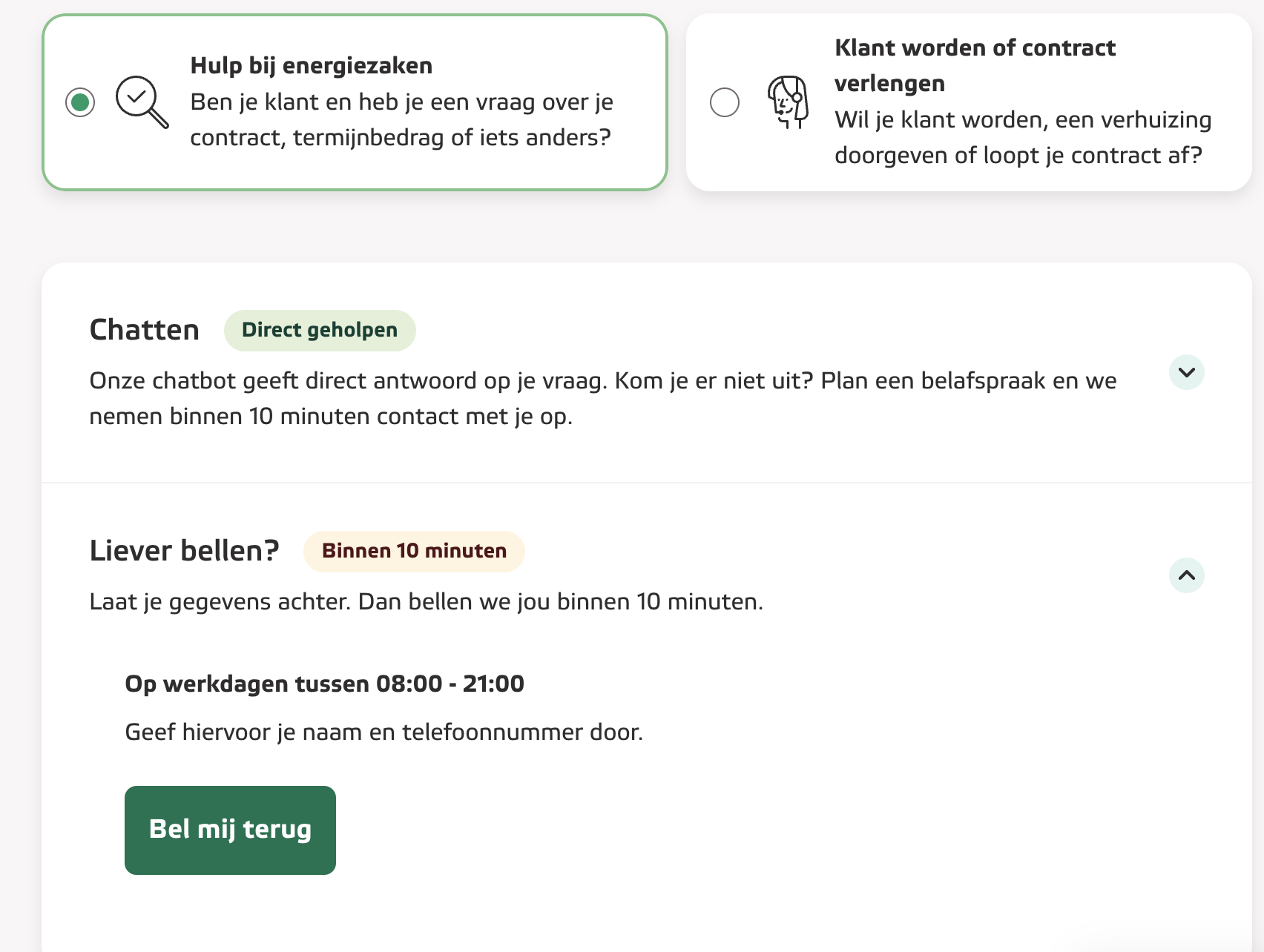
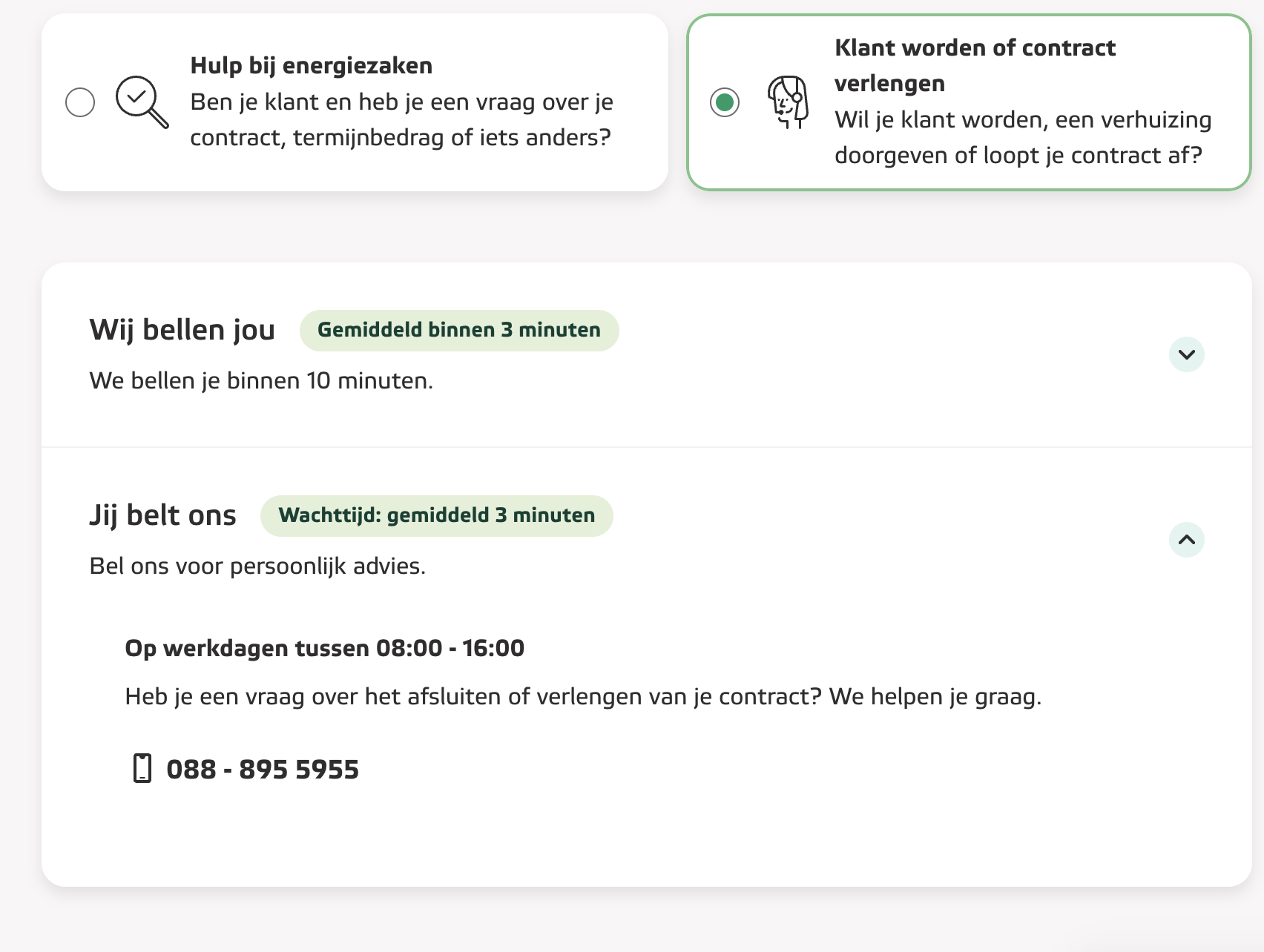
DELTA Energie has also tried to make the phone number harder to find: it is behind a tile with a difficult description: 'Click here if the information you are looking for is not available online.'
At most companies, customer service is available by phone during office hours. From nine to five is standard; however, Mega opts for limited opening hours (10:00-16:30), just like Vattenfall (closes at 15:00), while Oxxio continues working until 20:45 (callback only after 16:00). UnitedConsumers takes the crown with extended opening hours from eight to eight and on Saturdays from eight-thirty to five. Several companies are reachable on Saturdays—often for part of the day.
Some chatbots go painfully wrong.
Of the twelve energy companies examined, two do not have a chatbot on their website: Greenchoice and Mega. A third chatbot, Mick from Vandebron, is only available to logged-in customers. After providing an answer, Mick immediately asks for a rating (1 to 5 stars).
 We asked the ten available chatbots two questions. The first question was an advisory question about what happens to the monthly payment if you switch from gas, and the second question concerned what to do in the event of a death (see 'accountability' at the end of this article).
Buddy Budget Thuis could not make sense of either question: two loops, without an answer. Dina DELTA Energie does not respond or refers to customer service.
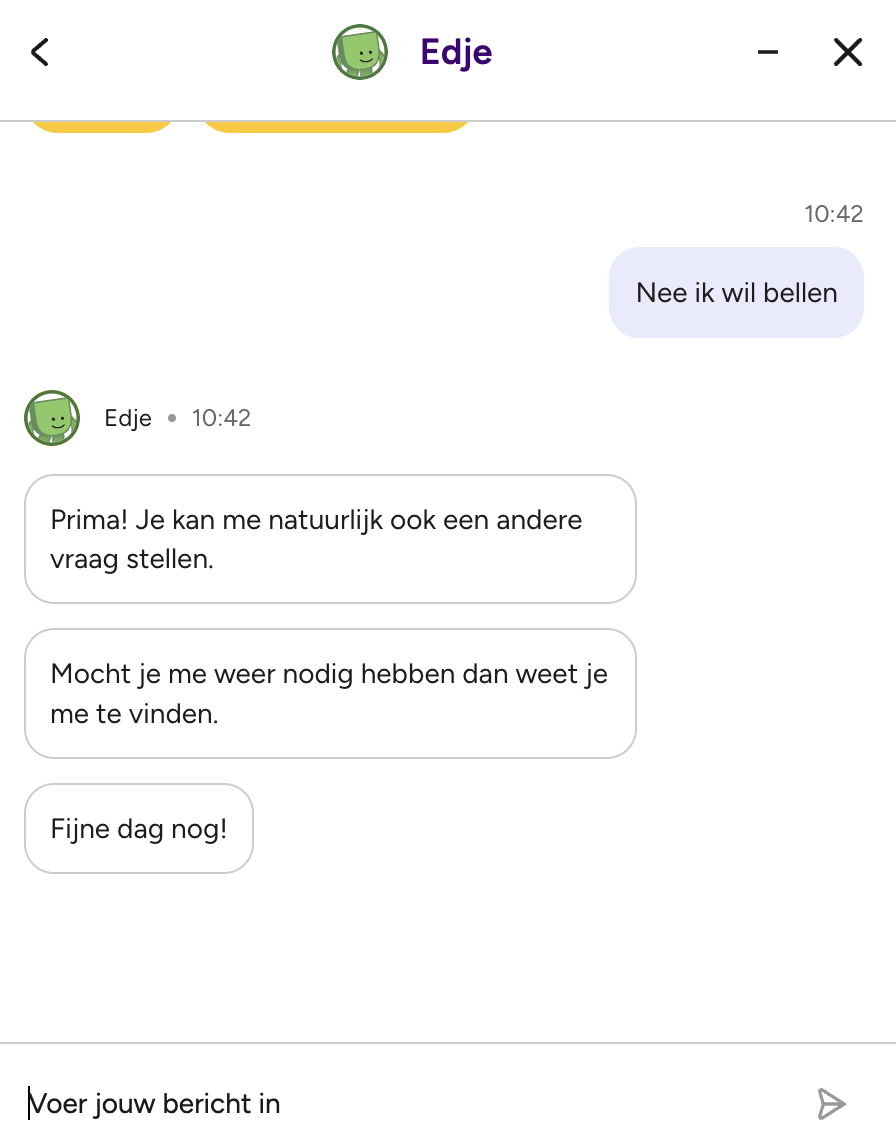
Eva The Eneco chatbot cannot help with the first question and offers a callback for the second question; so even in the event of a death, you cannot call directly. At Energiedirect, the chatbot understands Edje It doesn't work if you ask for a 'phone number'. Edje refers to the app and is rude on question 2: 'I don't understand your question' or 'have a nice day!'. The live chat indicated a waiting time of 30 minutes during our search. Also Robin Essent's representative does not answer either question, but furthermore, Robin cannot handle changes in the subject. The call cannot be renewed either; this leads to frustration quite quickly. Fortunately, you can still simply call Essent. And customers will soon be able to get help as well. at the head office in Den Bosch.
Slips
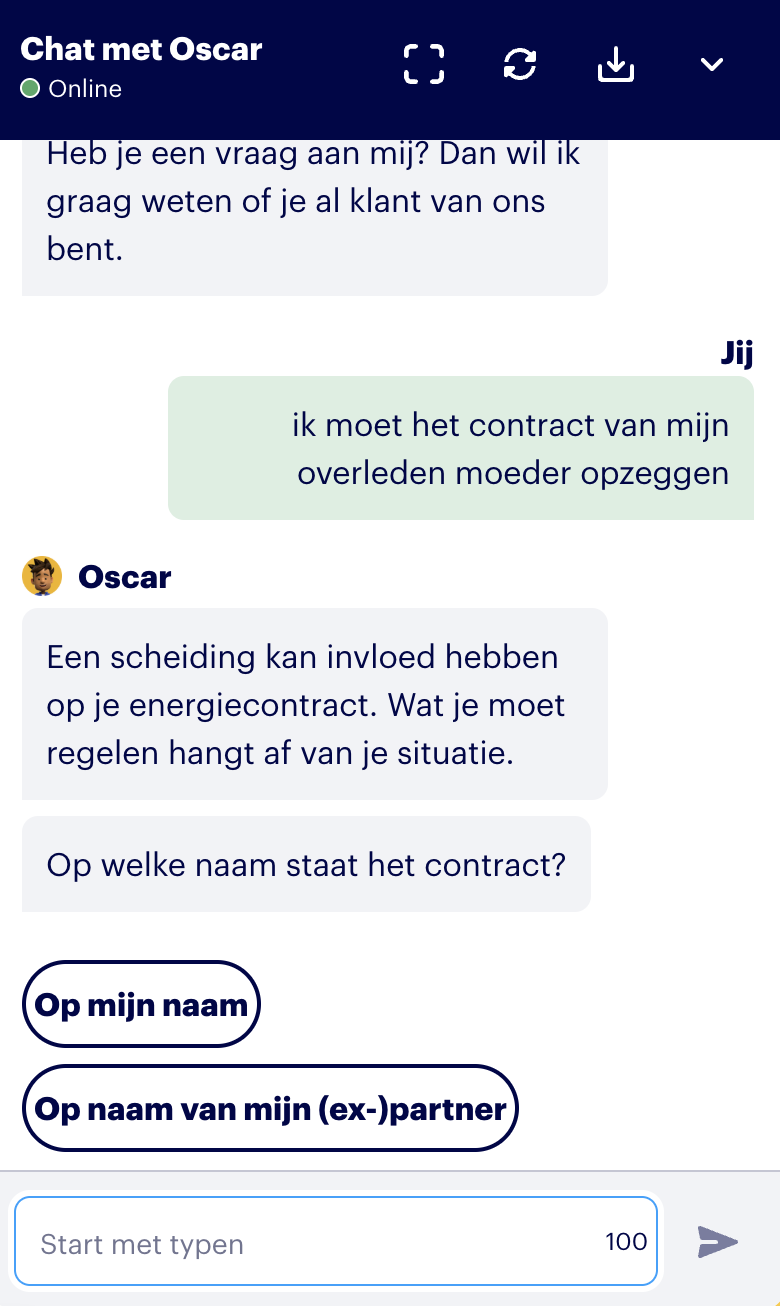 Oscar Oxxio makes a painful blunder: when asked 'I have to cancel my deceased mother's contract', Oscar replies 'A divorce can affect your energy contract. What you need to arrange depends on your situation'. If the question is phrased differently, it often goes right.
There is another way. The bot of Engie is rule-based and has a very limited understanding, but responds to the question regarding the death in a very appropriate manner. Mick from Vandebron and Nina Those from Vattenfall understand the questions and provide good and appropriate answers.
Several bots approached the question about 'getting off gas' as a cancellation request, while we were looking for advice. Bots rarely ask for clarification. Looking for the question behind the question is certainly not a core competency, not even for AI bots.
Some chatbots are extra customer-oriented
The chatbot interfaces offer various options. With four out of ten bots, you can email or download the conversation, which is handy if you want a paper trail; with the other six, this is not possible. With some bots, you can 'delete' the conversation in the interface and start over, although the buttons for doing so are not always very clear. Nowhere is it clearly indicated what happens to your conversation.
PuckPuck, the chatbot from UnitedConsumers, is the most classic chatbot: you cannot type in a question, because the free text field disappears from the interface as soon as the chatbot has loaded the selection buttons. You have to get stuck in the chat first before Puck presents the live chat option. You can, however, send the conversation with Puck via email.
At Nina With Vattenfall, escalation from the chatbot to live chat on the same screen is not possible; you have to switch to WhatsApp. If you don't have that, Nina is honest: then you have to choose another channel.
Based on the functioning of the chatbots, we find it justified to conclude that truly good work has rarely been delivered by the chatbot developers. We also wonder whether contact center managers have thoroughly tested their own chatbot.
Email: back from a break
In 2023, only two of the eleven energy companies offered an email option; four offered a web form. Nowadays, emailing is possible with eight of the twelve; Mega offers a web form in addition to email. The number of energy companies using web forms dropped from 4 to 1. At Budget Thuis, the email option is present, but hidden away in fine print, which also warns of a response time of 10 working days. At Engie, it is seven days; at Vattenfall, eight days. The DELTA Energie chatbot dutifully provides a list of email addresses when you ask for them.
Our conclusion: a clear improvement is visible here; several companies have reopened the email channel. In the past, there were frequent complaints about its labor-intensive nature and the high likelihood of follow-up questions. The email channel is possibly less labor-intensive now because GenAI can assist with answering.
Everyone on the app
All twelve energy companies have their own mobile app. Not every company is equally clear about this. Some companies display the logo of iOS or Android app stores, while with others you have to search for them yourself. Only UnitedConsumers gives customers the option to get in touch via WhatsApp without having to log in to the app; with the other apps, you need an account.
Specifics per energy company
Budget Home It engages in active but transparent channel management ('we help you immediately via chat or phone. Prefer to email? We will respond within 10 working days') and next to the phone number it says 'chatting is faster'. That looks friendlier than the choices made by Eneco and Energiedirect.
Eneco refuses to provide the customer service phone number; the bot consistently refers to a callback 'within ten minutes'. As a customer, you have no control in this situation. The phone number can be found online, however, and anyone calling it gets a voicebot that also pushes for a callback. It does engage the conversation if you mention 'death' and then transfers the call to an employee. Plus point: Eneco does provide the customer reviews on their own website. There, alongside extensive feedback from satisfied customers, criticism regarding, among other things, the emphatic channel steering can also be found.
Energy direct It says, 'Our service is entirely digital. You can come to me for the fastest answer to your question,' but the waiting time can run up to half an hour. Even if you raise sensitive topics, telephone contact is impossible, which hinders accessibility.
Engie It actively engages in expectation management, which is also a form of channel steering. The company states the response time for all channels (chat: 1 minute, telephone: 10 minutes, email: 7 days).
Also Greenchoice manages expectations. Phone: 5 to 10 minutes, email 10 working days. Essent is one of the companies that consistently report that it is busy and that waiting times are 'longer than you are used to from us.'
At Mega It is striking that the FAQs are not searchable. Since there is no chatbot either, you have to make do with the information Mega itself provides. On the other hand, there is self-service, a proprietary app, telephone, email, and WhatsApp; Mega may still have some room for improvement when it comes to eliminating reasons to call. Also with Vandebron The search function on the website does not work very well.
The conclusion of Ziptone: what stands out?
Our impression is that energy companies have worked on improving their accessibility when it comes to making contact channels available. Email is back. However, awkward, customer-unfriendly, and even inaccessible choices have not yet disappeared.
What does customer satisfaction research say?
In the Netherlands, energy companies (too) are continuously evaluated in various ways. Trustpilot scores are widely used, although they tend to be higher for companies that actively invite their customers. The figures from Trustpilot on the one hand and panel surveys on the other are sometimes at odds with each other.
More reliable in that respect are the ratings from one hundred thousand customers in the study. Most Customer-Friendly Company in the Netherlands by MarketResponseThe top scorers of 2025 include UnitedConsumers (8,02), Essent (7,63), Vattenfall (7,58), Greenchoice (7,53), and Budget Energie (7,49). In 2026, a shift was visible: UnitedConsumers remained at the top (8,14), but Pure Energie took second place with 8,13; Zonneplan scored 7,99; DELTA Energie 7,88, and ENGIE rounds out the top five with 7,80.
Accessibility is explicitly included by Keuze.nl, that the customer satisfaction score compiles based on app rating, response quality, and telephone accessibility. In that list, you encounter the same names at the top: UnitedConsumers (9,0), Pure Energie (8,3), Vattenfall (8,2), Energiek (7,9), and Essent (7,8), followed by Innova Energie (7,7), DELTA Energie (7,6), Energiedirect (7,3), Oxxio (7,1), Vandebron (7,1), and Coolblue Energie (7,1). A striking difference compared to the MarketResponse study: Budget Thuis, Eneco, Greenchoice, and Mega score below a six. Judging by the frontrunner (UnitedConsumers) on the one hand and one of the laggards (Eneco) on the other, an easy conclusion is lurking when it comes to channel choice and customer satisfaction.
Companies with only one or two channels make themselves more vulnerable in any case; at Energiedirect (where chat is the only live channel), the waiting time can run up to half an hour.
Meanwhile in Belgium – In Belgium, the Chamber of Representatives approved a on 17 July 2025 bill that sets requirements for the accessibility of energy suppliers. For all energy contracts concluded or renewed from January 1, 2026, suppliers must be reachable by telephone and email on weekdays, at least between 9 a.m. and 17 p.m., and without additional costs for the customer. Any telephone agreement with financial or contractual consequences must be confirmed in writing, by letter, email, or SMS. The law does, however, offer the possibility of offering contracts where telephone customer contact is not possible, provided that four conditions are met. The customer must then be informed clearly, unambiguously, and in writing in advance, private customers must give written consent, the contract must be offered unambiguously as a purely digital product, and the supplier must remain reachable by email. The customer must also be able to request a callback via the web portal within two working days, or at a later time of their choosing.
Consumers' Association: 'look at the intent of the law'
What can you expect regarding contact channels and accessibility of energy companies? The Consumers' Association considers the law clear: if you make a purchase, or in the case of an energy company, enter into a contract, there is a legal obligation for the provider to make a (manned) telephone number and email address easily findable on its website. Chatbots and WhatsApp can also be used, the Consumers' Association notes in response to questions from Ziptone, but not as a replacement for human contact via the telephone. The findability of energy companies' contact details was 'reasonable' (at least better than before) in the latest survey the Consumers' Association conducted on this in 2024, although there still significant pain points were identifiedThe union is outspoken about the chatbot: it is often more of a obstacle than an aid.
KSF: 'human support must be accessible when the situation calls for it'
When asked, the KSF considers it positive that the research shows an improvement in certain areas. “Organizations, regardless of the sector in which they operate, must of course comply with the legal requirements for contact options,” stated the trade association. It also believes that “within the legal framework, there must be sufficient room for organizations to make choices and structure customer contact in such a way that it aligns with customer needs and adds value for the customer, employee, and organization.”
At least as important as availability and findability is whether a customer is actually helped well via the chosen channel, says the KSF. “Channel steering can contribute to this, for example by directing customers to a channel where they can be helped better and faster. If that channel is not suitable at that moment or offers an insufficient solution, a customer must be able to easily switch to another channel. Human support must be accessible when the situation calls for it.”
Sources including the National Voice Monitor and recent research by the Consumers' Association show that the problem-solving capacity of automated customer contact does not yet always align with customer expectations. This underscores the importance of looking not only at the deployment but also at the quality of automated customer contact.
Within the 'From Bone to Better' project, KSF and the Amsterdam University of Applied Sciences are investigating how organizations can improve quality. This research is intended, among other things, to lead to a practical framework that helps organizations make informed choices. The framework will be presented at Shopping Today on October 8 and will also be the focus of a KSF roundtable at the Conversational Conference on September 17, according to KSF.
Accountability – We have mapped out which contact channels the 12 largest energy companies active in the Netherlands offer and how accessible they are. We have excluded social media channels such as X, Insta, or LinkedIn this time. We did not conduct a sample survey regarding waiting times across the various channels. However, we did examine how the chatbot (if present and as far as possible) answers two common questions: ''how do I adjust my monthly payment when I switch off gas'; and: 'I need to cancel my deceased mother's contract'. We assessed the response, using the criterion: was a usable answer provided? Furthermore, we checked whether chatbot conversations could be forwarded or downloaded. In addition, we determined how many clicks are required to find the customer service phone number.
(Ziptone/Erik Bouwer)


Also interesting
-
What legal requirements apply to the accessibility of your customer service in the Netherlands, and who supervises this?
-
An analysis by Parloa shows that 43,3 percent of the surveyed companies do not offer a clearly visible phone number or chat function.
-

Essent migrated super fast from a legacy platform to Genesys Cloud together with Sabio. Michiel Kouijzer on the approach and the hurdles.