
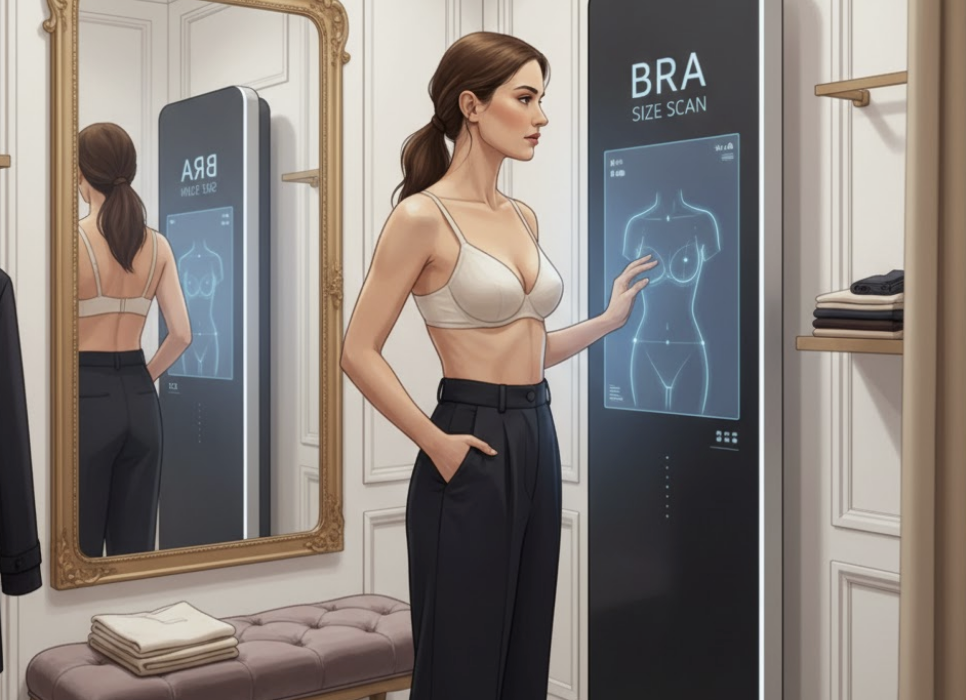
Image: Gemini/AI
There are some things you'd rather put off for as long as possible. Because it's part of life, you can't avoid it, but it's not necessarily enjoyable. For some, that's washing the car, studying, or filing taxes. Others dread the thought of cleaning the gutters or a birthday party on their part.
For me, it's bra shopping. I find it a dreadful, inefficient affair that I prefer to avoid as much as possible. From color and material to size, the distorted mirrors in the fitting room combined with unflattering lighting: I find it all a hassle. I'd love to restock every year, but that's not so simple. There are seven factors that influence which size or style you need: genes, weight, exercise routine, cycle, contraception, and age. So it's easier to go to the store for a fitting. I also call it "the annual humiliation."
That's why I was thrilled when I found my favorite lingerie store. While the tax office can't make things more fun, but it can make things easier, this store could do both. You know what's great? I even started looking forward to it.
As a customer, you're parked in a beautiful dressing room – complete with a drink of your choice. Your personal shopper will measure you, take your wish list, and go on a quest through the collection. The result? Shopping becomes fun and easy. All the hassles are gone, and I often find myself coming home with much more than I thought I'd need.
From fitting room to pumpkin
Until that one day when everything changed. My fitting room turned back into a pumpkin. Equipped with a Bra Size Scan. No human employee who determines your size in 10 seconds and goes hunting. But a camera you have to rotate in front of, under the watchful eye of the personal shopper, who explains how it all works. After 5 minutes, my circumference and size were analyzed, and all I had to do was give permission to share the recording with the fine print. No thanks.
While my personal shopper was on her way to select a selection of stylish styles for me, I got lost in thought. Who was this AI module a solution for? Not for the saleswoman, who literally spent thirty times as long explaining the AI as she did taking measurements. Not for me, because even though I'd come to the store for the personal consultation, I had to use the Bra Size Scan – opting out wasn't an option. It might be a good solution for women (male or female) who prefer to shop without human intervention. Or it might be a hit with home shoppers who can't or don't want to come to the store.
The digital bitterbal
This AI was a prime example of a digital bitterbal: an AI application that pretends to make life better, but doesn't. Such an application exists primarily to improve management, giving them a mountain of data for free, while the experience for both employee and customer is significantly diminished.
And that's exactly what I'm seeing more and more often in the customer contact world: AI applications designed not for the customer or the employee, but for management that wants to collect data.
The saleswoman in my fitting room has a unique selling point. She can see at a glance what fits, hears my voice to tell if something fits well, and knows exactly how to turn an awkward moment into something lighthearted. But those skills are no longer being utilized because, as a customer, I'm forced to rely on a technology (which, incidentally, was wrong about the size).
One-size-fits-none
There are certainly situations where this AI does add value. For people who prefer to shop unassisted, still maintain a distance of one and a half meters, or for home shoppers who want advice from the safety of their own home. But in this case, it seemed as if the technology was implemented without proper consideration of the customer journey or the role of the employee.
And that's exactly what I see in customer contact: smart tools, but stupid choices. Technology that sidelines people instead of empowering them.
AI isn't a one-size-fits-all solution. Sometimes it fits like a glove, sometimes it's a real pain. All sorts of factors determine whether AI is a good fit. And you need to consider all of them to determine where in the customer journey AI adds value. The trick isn't to try and deploy AI everywhere, but to know when and for whom it's appropriate, and when it's better to simply rely on a human.
(Ziptone/Cynthia Mak)


Also interesting
-

For Cynthia Mak, a customer contact interaction is no longer an experience from a consumer perspective.
-
Being more accessible, responding faster, and offering customers even more service: that seems to be the standard for all companies. How self-evident is…
-

Chaos calls for a visible presence. Organizations that do not yet have a scenario for this in 2026 are not surprised – they…