
Image: Alexandros Michailidis/Shutterstock
While we all had to deal with GDPR a few years ago, a whole range of new laws and regulations are now on the horizon. What should you do as a customer service or contact center manager or as a supplier with the NIS2 Directive, the Digital Services Act or the Artificial Intelligence Act?
Ziptone spoke to Micha Groeneveld, tech & privacy law lawyer at BDO. “Chain responsibility becomes essential.” In the first part of this article we discuss the AI Act and the DSA.
Customer contact is becoming increasingly data-driven, real-time and predictive. The importance of digital contact channels is increasing. Add to this the ingredients of platformization, cloud and AI technology and you understand that the new laws and regulations in the field of data, privacy and security will also have an effect on customer service, for example.
Multitude of new laws and regulations
 In the digital domain, organizations are subject to a multitude of laws and regulations. Micha Groeneveld, tech & privacy law lawyer at BDO, sums up: “Consider the ePrivacy Regulation or the AI Act that was recently passed. In addition, we have the AI Liability Directive and the Modernization Product Liability Directive, which extends existing liability rules to digital products (also think of AI) and encourages manufacturers to supply safe ICT products. There will be new rules in the field of information Security and Cybersecurity (the Information Security Regulation and the Cyber Resiliance Act and also the NIS2 and DORA), but also the Medical Device Directive, Data Act and Data Governance Act and the regulation of online service providers via the DSA and DMA and I haven't even mentioned everything.”
The focus is on security and privacy
What are all these new laws and regulations about? As far as Groeneveld is concerned, the focus is always on the protection of and handling of data and privacy and on cybersecurity.
However, that is not the only thing, a lot of attention is also paid to specific rules for the financial sector, to competition and to e-commerce. In the context of customer contact, the Artificial Intelligence Act (AI Act), the NIS2 Directive (NIS2), the Digital Services Act (DSA) and DORA are the most relevant.
Together with Groeneveld we went through the four most important European legal areas in general. This first part focuses on the AI Act and NIS2.
The AI Act
The AI Act is about risks, risk assessment and measures to control them, explainability, transparency and respect for privacy and copyright. The AI Act was recently adopted by the European Parliament. “Agreement has now been reached on the main points,” says Groeneveld. “We have now reached the phase where the result of the so-called trialogue between the European Commission, the European Parliament and the European Council (consisting of the relevant ministers of the EU countries) must be converted into texts that will be included in the AI Act .”
The precise outcome of that process is uncertain, for example it is not yet clear whether all AI-generated text or images should receive a watermark or something similar, says Groeneveld.
AI Act and customer contact
By reaching an agreement, there is finally more clarity about 'General Purpose AI' (GPAI). This includes rules on transparency and documentation, compliance with European copyright law and a risk-based model for managing and monitoring AI solutions, including rules for reporting incidents, ensuring cyber security and report on their energy efficiency.
There is still a lot of work to be done, not only for the users, but also for the suppliers of GPAI. “The AI Act will soon provide transparency regulations for systems that 'interact' with customers (think of chatbots, for example); people need to know that they are dealing with an AI system.”
Groeneveld also emphasizes that OpenAI, for example, is currently not transparent not compliant with the GDPR, while a party that uses such an application as a basis for its own specific application must bear the ultimate responsibility and therefore have to ensure that the basis used is also compliant.
Digital Services Act (DSA)
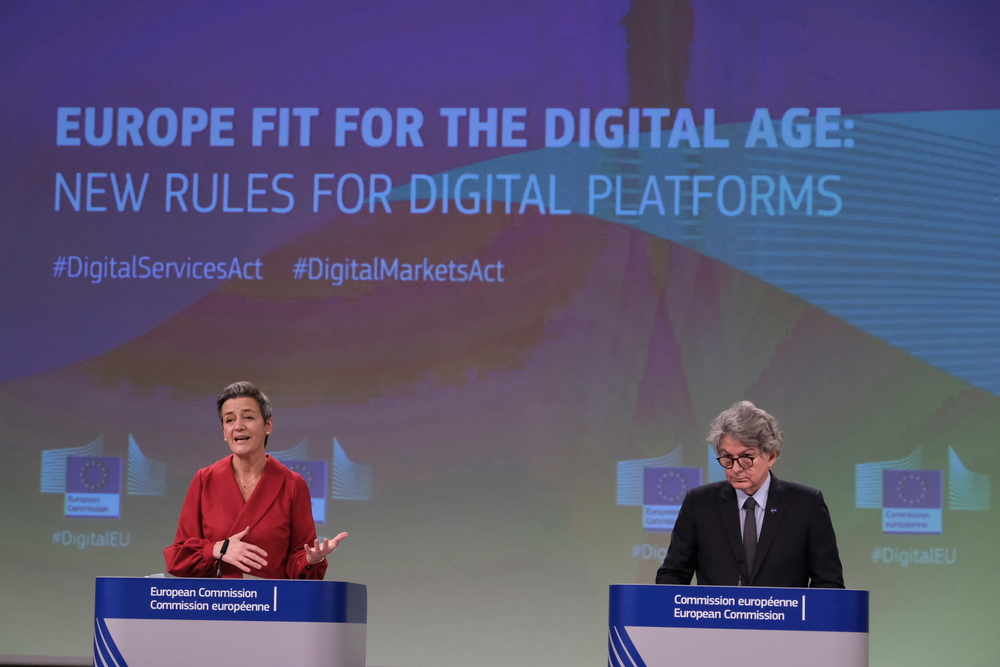
Then the DSA, the Digital Services Act. This law aims to create a safer digital space where users' fundamental rights are protected and ensure a level playing field for companies.
The DSA came into effect on August 25, 2023 and covers 'parties that bring together sellers and consumers or store information from third parties and that make information available to the public at the request of the information provider'. In short, it mainly concerns platforms, but a party that only offers its own products or services on its platform is not included; a party that offers goods from third parties does.
The most far-reaching rules apply to (large) platforms with more than 45 million users every day: think of online marketplaces, app stores, sharing economy platforms, major search engines and social media platforms. But there is also work to be done for smaller platforms.
The DSA imposes all kinds of obligations. Consider an obligation for platforms to ensure user-friendly systems that allow illegal content (from hate speech to counterfeit products) to be reported; the same goes for reporting online harassment and online bullying. Platforms must also clearly indicate who places advertisements and why you see them. In addition, the DSA supports the introduction of a user-friendly, free complaints system about moderation decisions. Very large online platforms must also summarize their terms and conditions briefly and clearly in the local EU language.
Special attention to VLOPs
The so-called VLOPs (Very Large Online Platforms) and VLOSEs (Very Large Online Search Engines) must meet all kinds of obligations in the field of transparency, accountability and compliance from February 17, 2024. For example, they now have to publish information every six months about the average monthly active recipients of their service in the EU. The EC has laid down how this should be done in guidelines.
The VLOPS and VLOSEs are also faced with the mandatory payment of an annual 'supervision fee'. Zalando is one of the companies that has been designated as a VLOP, but has started a lawsuit against this; the company says that almost two-thirds of Zalando's offering is from Zalando itself and the rest from third parties, so it actually remains below the 45 million active user mark when it comes to offering third-party products/information.
The European Commission will adopt guidelines in the coming year to further define the application of the DSA. In other words, the law will be introduced in phases. As mentioned, the obligation to keep track of or report user numbers already applies to everyone. From February 17, 2024, this law also applies to parties other than the VLOPs and VLOSEs.
DSA and customer contact
“An important part of the DSA relates to customer contact,” says Groeneveld. “Article 12 of the DSA states that 'intermediation services' (including online platforms) may not be accessible exclusively via a chatbot or other automated channel. There is talk about facilitating a 'user-friendly way' of communicating. In addition, the platforms must disclose information that recipients of the service need to easily identify and communicate with their central points of contact.”
In this context, it is interesting that DNB has pointed out the risk that companies in the financial sector increasingly use technology provided by Big Tech in their customer contact. That would make it more difficult “for risk-bearing institutions to make good risk assessments and manage risks,” says DNB.
Another element of the DSA has to do with regulating recommendation systems and procedures for canceling a service (such as through a simple cancel button). This is also about making it easier to unsubscribe from online platforms.
This is episode 1 of the two-part series on legislation and regulations that affect digital customer contact.
Part 27 will follow next week (on December 2), focusing on NIS2 and DORA.


Also interesting
-

On December 19, 2025, the German parliament passed a law introducing the cancellation button for online contracts.
-

The investigation focuses, among other things, on the security of user data by Booking.com to prevent misuse by third parties…
-

In practice, switching from one cloud to another is often accompanied by software and data challenges and…