
Customer contact is one of the areas where generative AI does deliver proven results, although not everyone is convinced. In the sixth Koetshuis interview, we explore exactly what AI has brought – for the organization, the customer, and the employee. At the table: no (self-proclaimed) AI experts, but plenty of room for diverse practical experiences and insights.
Discussion leader: Tom Jessen
Image: Sophie Bijsterbosch, SophieB Photography
Text: Erik Bouwer
The participants (from left to right):
Erwin Hasselt, Manager Service Center & ai Manager Green Team Electrification at Feenstra; Arne van Vienna, customer experience strategist at asr income insurance and chairman of the KSF expert group CX; Patricia Schra, implementation and innovation manager at facility contact center Soleo; Sander Hesselink, principal consultant at Coniche; Tom Jessen, conversation leadership; Serge Poppes, CEO of Pegamento; Mark Brewer, client solutions director at TP.
ChatGPT was launched in November 2022. Exactly three years have passed since then. Experts sometimes argue that companies deploying AI are quickly focusing on the "how" question and skipping the "why."
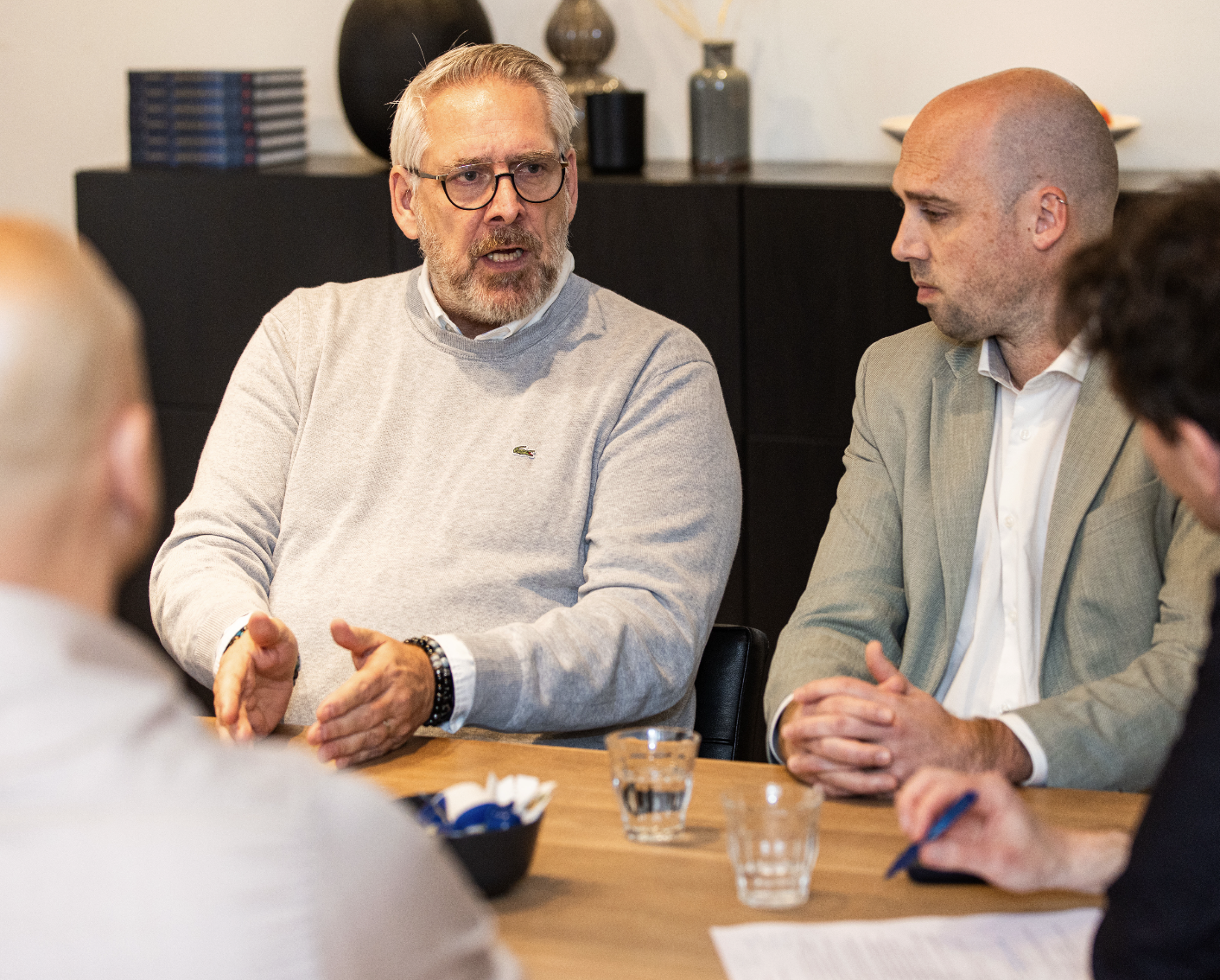
Arne van Weenen, asr/KSF expert group CX
Van Weenen The answer to the question why? To better serve the customer—I wish that were always true. Because the use of AI also involves costs and available resources or capacity. AI offers opportunities to take over employee tasks, such as automatically summarizing conversations. With AI, you can analyze 100 percent of conversations, which is a win for me as a CX professional and the organization. And it results in savings: employees no longer have to summarize the conversation. It doesn't lead to fewer people on board; on the contrary, we simply need more people because our services are expanding: from financial insurance to sickness absence prevention and sustainable employability.
Hasselt The best customer service is when the customer doesn't have to call. Anything you can simplify with AI can help prevent the customer from having to make the effort to contact you. I mainly see opportunities now to make the employee's job easier: to provide support, to help the customer better.
Schra Shortly after its introduction, many people started using applications like ChatGPT. It seems like the most normal thing in the world, even in companies. We've been working with GenAI for about a year now and are currently experimenting primarily with employee support. Our contact center application has been equipped with AI features, which makes it easier to get started: think of real-time support, conversation summarization, a chatbot for the knowledge base, and automated quality monitoring. We're just at the tipping point for definitive implementation. The results of the experiments are very positive – you have to be certain it works well, because employee buy-in is a crucial step. And we're in discussions with our clients about automating customer contact processes.
Van Weenen Ultimately, you want to solve a problem, and AI can help with that, but perhaps you achieve the same goal by simply adjusting a letter. Within ASR, AI is also used to complete claim files. But before you use AI, it should always start with the question: what problem do we want to solve?
What has changed in the last few years?

Serge Poppes, Pegamento
Pop's One of our solutions has been running for over twelve years. It recognizes the intent of an email and suggests a response. Until a few years ago, it was best not to use the word "AI" in conversations with our clients about this solution—it was simply a dirty word. The significant increase in computing power has led to AI's recent breakthrough: it's now highly accurate and present. And of course, it's also useful when it comes to useful applications. Looking back, we can say that Pegamento has suddenly become a trendy company. Now, everyone is eager to hear that "AI" word.
brewer When we wanted to implement a chatbot for Samsung in 2016, people thought we were crazy. That's changed dramatically in ten years. AI is certainly revolutionizing our industry, in a positive way. The job market for customer contact is often challenging: we're always looking for people who can deploy quickly and flexibly. Dutch in a small language area, while the number of interactions between customers and companies is growing. Because Dutch can be translated into any language in real time, it's possible to provide customer service in Dutch from any country in the world.
hesselink AI is indeed not new, but we have come a long way in a short time – just look at the Turing test and the way in which text, images and videos can now be generated that are almost indistinguishable from real things.
Have you already encountered new roles or training courses in your organization due to the arrival of AI?

Marco Brouwer, TP
brewer Before the advent of generative AI, we already had conversational designers on board, or specialists for the realisation of chatbots and voicebots – these types of functions have indeed grown in number.
Hasselt First, employees must embrace AI. I've recently been conducting roadshows across the country to inform people about our plans for the coming year, including launching small-scale AI pilots to see if they work. So far, we've taken a pragmatic approach. Feenstra doesn't yet have something like an AI Academy. Employees vary widely in their reactions to AI plans and in their level of knowledge.
hesselink The difference in knowledge levels is indeed significant, and I notice that when I give presentations. Customer contact will change significantly over the next five years, meaning you'll need different skills and therefore need to recruit and train differently. When it comes to adoption, I wouldn't focus solely on early adopters. I think there are still too few AI-literate people in our industry, even though the National AI Course, for example, is available to everyone. It's also constantly being updated.
Van Weenen Still, I would approach that on a small scale. Even if it's just for an hour. Let people experiment and discover at their own pace; that yields the best results.
hesselink If you don't ensure people understand how AI technology works and don't make it available in a controlled manner, you'll end up with shadow AI, and employees will start using it in other ways themselves. You don't want to risk employees using company data in these kinds of systems. Moreover, AI literacy training is a legal requirement for everyone who works with it.
Van Weenen For experimentation, we have a closed environment, such as Co-Pilot, where company data can also be used.
I hear two lines of thought: small-scale and free experimentation versus controlled rollout on a larger scale. What's the difference?

Patricia Schra, Soleo
Schra You'll especially need to explain to your employees the purpose of all these experiments. Using AI in quality monitoring, for example, isn't meant to allow for scaling down the workload with team coaches, but to empower them to work more effectively. We're also working on AI literacy and are exploring whether the National AI Course is suitable for all employees. It includes important components, such as addressing risks like bias and hallucination, and working with data you provide to the free version of ChatGPT.
Pop's I think we can go a bit further than that. It's about more than just risks. Many people are enthusiastic about ChatGPT. So you can also unleash unsuspected talents in people. Incidentally, I'm not a fan of pilots. A pilot is deferred decision-making. Pilots often assume small-scale deployments and happy flows, which often leads to suboptimal solutions. When you scale up, the dynamics change dramatically. Much of the customer contact is caused precisely because it falls outside the happy flow. Incidentally, our sector is one of the leaders when it comes to the large-scale deployment of GenAI.
brewer Not only employees, but also companies vary widely in their AI literacy. Some companies have a clearly defined problem and know which technology can help, while others simply want to implement AI to reduce costs.
You've now made it clear that using AI can help employees. But what's the most important benefit for the customer?
Van Weenen Consumer dissatisfaction with bots – if you look at the results of the National Voice Monitor – mainly lies in not getting the right answers.
Pop's Chatbot 1.0 is a good example of how companies started small, with a limited knowledge base and the idea that customers have "chatbot questions." The latter is absolutely nonsense; it doesn't exist. The consequence is that it doesn't work. The inventors likely focused primarily on what they envisioned—and that one piece worked perfectly. But customers don't think in terms of the happy flow. In short, if you use a chatbot for customer questions, it has to answer them.
Schra This means customers will need to contact us less and less frequently. Many companies assume they need a voicebot to automate customer contact and a chatbot on their website to handle questions. Soon, consumers will talk to the AI agent on their mobile phone.
Van Weenen We then skip a step, the question of why customers should contact us is also relevant.
Pop's No one calls 112 out of luxury. We don't have a universal answer to that "why" question. We provide a lot of AI to our clients, but interpersonal relationships are what make people happy. Despite all the AI, we'll continue to communicate with each other.
hesselink A lot will change in the near future – chatbots like ChatGPT will increasingly take on your customer's questions.
To what extent will AI become the first line, and human employees the second line?

Erwin Hasselt, Feenstra
Hasselt Disagree. When people have a more complex problem, they want to talk to someone and feel acknowledged. Of course, AI can solve some straightforward issues for you.
hesselink I agree with that statement. You only know what a complex problem is once the technology has already examined it through rapid triage. In fact, agent assist currently refers to AI supporting the agent, but in five years, that will be reversed, and we'll have digital (AI) first, with the agent assisting if the customer can't figure it out themselves. That's also agent assist, but in reverse.
Pop's Examples like 113 and De Luisterlijn demonstrate that this triage isn't universally applicable. We must be careful not to consider tools universally applicable. Some companies want minimal traffic. But an organization like 113 is in a hurry to speak to everyone immediately, for example, because people ask questions on ChatGPT and get answers they shouldn't have.
Schra Ultimately, humans will continue to make the difference, perhaps sometimes this will be slightly better with AI, but this really depends on the problem or the customer's question.
Hasselt People primarily seek contact when they're outside the process. This often has to do with organizational processes, something AI can't solve. It requires communication between people and collaboration between departments.
brewer AI can determine the priority or urgency of a request during intake. This can prevent everyone from having to wait in the same queue during peak times.
Will we need a different profile of employees in the future because customer contact will become more valuable?

Sander Hesselink, Coniche
brewer Yes, and work has become more complex in recent years. Ten years ago, for example, there were far fewer questions about IoT. This growing complexity leads to adjustments in training and the type of employees you hire. By automating simple conversations, employees can be deployed primarily for more complex conversations. This does mean we're investing more in social and emotional skills—think self-regulation, for example.
hesselink Employees will also need to learn to critically interpret the suggestions the AI tools provide, as the results aren't always reliable. Customer service representatives have domain knowledge and will need to utilize it.
Pop's Conversely, complexity also affects existing employees. Some agents will naturally go beyond simply answering the customer's question. They will investigate and want to change the process to avoid contact.
Hasselt It's great that companies are working with AI, but consumers are also becoming increasingly smarter and better at working around processes. As a company, you need to prepare your employees for this as well.
Van Weenen Simple customer queries can also be valuable for the organization. Consider someone who can't log in to their My Account. AI can solve that, but perhaps that customer wants to cancel their contract within My Account. Employers are increasingly able to do more themselves, and more and more automated connections and messages are emerging. The biggest risk is that we'll soon no longer be able to have personal conversations with our customers. Some conversations are truly worthwhile, even if the initial reason is simple; there's always a reason behind it.
brewer Perhaps companies will soon embrace customer contact again, because otherwise they no longer know what is going on with the customer.
Schra Simple customer queries can be handled in a very high-quality manner, so perhaps high-quality is the wrong word.
Besides outsourcing or doing it yourself, the third option is automating customer contact with AI—or a combination of the three. Has that mix changed due to AI?
Schra Costs remain a key issue for many companies; AI is often deployed with cost savings as a starting point. This also applies to offshoring. The chosen solution does not result in a less effective solution. One option is to partially relocate, automate, and offshore customer contact, while retaining some in a local hub. The labor market also plays a role.
Hasselt The question is whether you consider other factors besides just cost in this decision. From a customer perspective, you might come to other considerations. Regarding outsourcing to Suriname, we don't think we can convey the feeling people have when a boiler doesn't work. You can teach everything, but can you convey the feeling?
brewer AI is indeed turning the sourcing mix upside down: real-time translation alone opens up other options.
Pop's And AI enables hyper-personalization, which will play a major role. How do you be there for the customer at the right time and in the right way? Specific customer groups, for example, use specific words in their language or are present in specific online environments. AI alone is incredibly capable of painting a picture of you as a customer – and highlighting differences and insights you didn't know existed.
Thesis: The ROI of AI is difficult to demonstrate. What do you think?
Poppes: Nonsense. When someone says, "We want AI," I say, "How many kilos?" It starts with the right question: what do you want to achieve? I want a compelling case that will contribute to loyal customers for my company.
Hasselt I don't entirely agree. I saw an article about 60 million chatbot interactions at Vodafone. But the question is what's behind all those interactions. What was invested in them, and to what extent do those 60 million questions reflect a shift from, say, a different digital channel?
Schra You can make grand claims about your chatbot: a certain percentage of so many contacts were handled correctly. But if 80% of those previously found the answer in the FAQ and now in the chatbot, what have you achieved or saved? How many people were needed to build that chatbot?
brewer With AI, you see that customers want to achieve positive business in a much shorter time than before.
Pop's Customer service representatives provide correct answers on average 73 to 78 percent of the time. A bot can do much better, but for every percent of errors, the bot is penalized more severely.
 The Coach House Conversations – The KSF trade association and Ziptone magazine organize several roundtable discussions each year on current industry topics. The discussions take place in Doorn and are moderated by Tom Jessen; Ziptone reports. Previous topics: diversity and inclusion in customer contact, affordability of customer contact, the development of the profession en considerations and dilemmas when offshoring to Suriname.


Also interesting
-

AI does not replace customer service representatives. However, AI does take over parts of their duties. What does this mean for their profession?
-

About 20 percent of people have a brain that functions differently from what we label as 'typical'.
-

Erwin Hasselt, Manager of Feenstra Service Center, was elected CCMA Manager of the Year during a festive ceremony in Amersfoort…