
Michel van Roon, Chief Customer Officer at QuandaGo, thinks companies are more likely to invest in chatbot technology than improving HR-related matters. As far as he is concerned, the future of customer contact is mainly about being well prepared for higher volumes and more diversity in interactions.
In customer contact land, we tend to keep saying that everything is changing. Customers or employees, for example, would become increasingly demanding. If you compare HR, customer expectations and technology, where are the biggest changes in customer contact land?
“At the moment, the biggest challenges are at least on the HR side. There is of course a strong interplay between how a company treats people, how people should do their work and the technology that the company makes available. I think there are fewer challenges on the customer side at the moment.”
Michel van Roon has been involved with QuandaGo since 2019. Van Roon has long fulfilled various international roles at hardware and software suppliers (including Genesys). Van Roon gained experience there with customer contact, but also with workflow and process automation. He has a background in business economics.
“It is very difficult for many companies in Northern Europe to find staff. You therefore want to retain employees for as long as possible and employees will of course notice this: they will have different requirements. Contact center work is not at the top of the Maslow pyramid. So in customer contact you will have to please people in a different way.”
“Fortunately, there are new ways to get work done: think of hybrid working, which many people see as the benefits. Each country looks at the technology that is used for customer contact and for working from home differently - think of screen recording. I think we in the Netherlands are quite capable of discussing this in a transparent manner. These are all things that should ultimately contribute to a better customer experience. The employee is a very important part of this; it is relatively quiet on the customer front.”
After years of upward trend, more and more companies are now struggling again with accessibility and service quality. In Van Roon's view, what should be tackled first in order to take customer contact to a higher level: innovation – think of chatbots – or social innovation – think of introducing self-managing teams?
“If I had to choose, we should work on improving chatbots and introducing voicebots respectively. There is progress in (voice) bot technology, but by also improving its applicability, we can also make the work of agents more interesting. And we can also let go of managing on AHT – because agents are then busy with customer contact, which is important for both the customer and the organization.”
How does QuandaGo take into account the way end users do their work when developing the platform?
“We do this in three areas. Our front-end has been developed as a cockpit for agents where real-time information from other systems comes together. In addition, agent-assist tooling is part of it - whether it concerns emotion detection or suggestions for the dialogue. And finally, we enable team leaders to better support their agents: through analytics all interactions are analyzed, avoiding being guided and judged on an extremely small sample of a handful of conversations. After all, agents make hundreds of calls a week. A much more nuanced picture emerges, with strengths and weaknesses across the board. In the Netherlands, this approach is no longer a problem. In France and Belgium, resistance to this is gradually diminishing.”
Then the contact center manager or customer service manager who still needs to move to the cloud – a hot topic for about 1 in 5 Dutch contact centers. The range of cloud solutions for contact centers is extensive. Can the choice of a platform still play a role for your distinctiveness in the field of customer experience?
“The functionalities of the different applications are indeed close to each other when it comes to the routing function. However, this routing function contributes little to the digital transformation of customer contact. The real change lies in the extent to which the agent can make a difference, but also in the smarter organization and integration of systems and processes, such as the back office. QuandaGo focuses on integrating those adjacent processes and data flows. How do you get the latest customer invoice from SAP in the agent desktop? How do you get real-time logistics information to the agent? You often see that employees then have to switch to other external applications, sometimes they even have to go back to AS400 systems. We want to deal with that, but without having to replace those old applications.”
What is the next revolution coming to contact centers?
“That must be in the corner of virtual assistants – think of chatbots and voicebots – the quality of which has increased considerably recently, especially in the latter category. There is still a lot of quality and efficiency gain to be made there. Automation is getting better quality. But it will by no means mean that - when we talk about the future of customer contact - the employee is replaced by a chatbot. Digital is certainly growing, but voice interaction with employees remains the preferred channel for complex and somewhat more sensitive subjects, as is evident time and time again. On balance, managers therefore have to deal with larger volumes and more diversity in interactions. If you do not use automation for this, it will be a difficult job to do.”

QuandaGo has prepared a whitepaper about the Future of Customer Contact. The white paper discusses upcoming changes and trends in customer service, HR and technology respectively. Each section also contains a large number of tips to help you make choices. The white paper can be downloaded here.


Also interesting
-

QuandaGo AiDA launches three autonomous AI Agents, targeting use cases for utilities, financial services, and IT management.
-
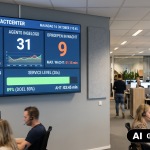
Accessibility is the most measured and at the same time the least understood variable in customer contact. Why is that?
-
What legal requirements apply to the accessibility of your customer service in the Netherlands, and who supervises this?