
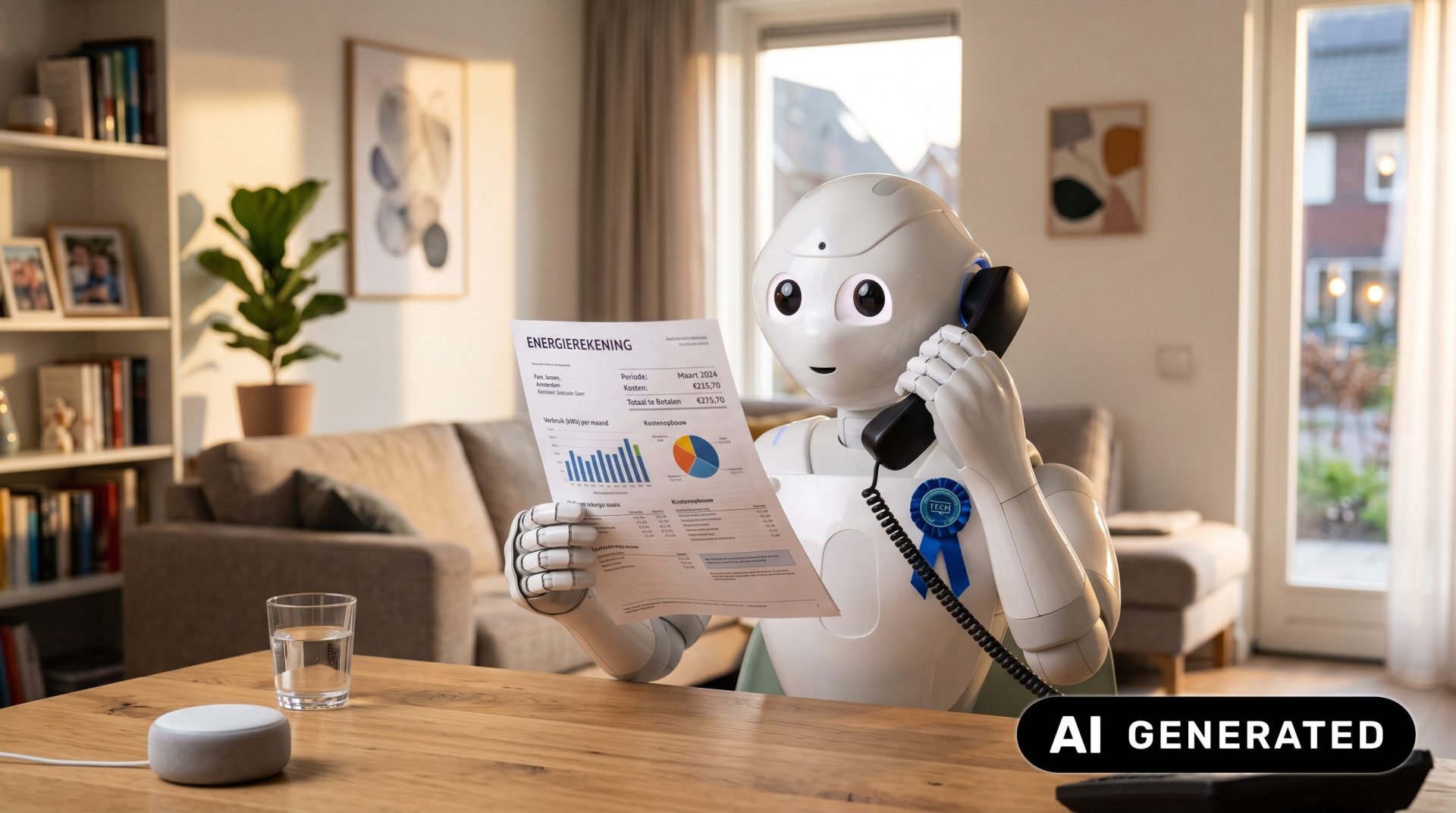
 The privilege of deploying a chatbot is no longer reserved for customer service. The machine customer, or agentic AI for consumers, is waiting in the wings. Five experts on what the contact center should consider when it comes to AI agents reaching out on behalf of the customer.
It is expected that the contact center will increasingly deal with an AI agent operating on behalf of a customer.
One in ten American consumers, according to a limited poll of Gartner Researchis willing to delegate making specific purchases to a personal AI assistant. In the Netherlands, that figure is higher: 31 percent of Dutch consumers are open to completely leaving the purchase to an AI agent; 47 percent do not want to, according to recent research by Deloitte.
What is the impact of this on the contact center? Ziptone gathered the latest insights from various specialists: Job van den Berg (The Automation Group and AI.nl), Francisca Wals (researcher at the Rathenau Institute), Sander Hesselink (principal consultant at Coniche), Sebastiaan ter Wee (Digital Regulations Partner and EMEA Legal AI Leader at Deloitte) and Steve van den Oever (Board member of the Customer Service Federation).
The consumer receives the same resources as customer service.

Stef van den Oever, KSF Board Member
“Companies have invested in self-service and automation for a long time; now consumers are getting similar tools at their disposal,” says Stef van den Oever (KSF). “On top of that, customers can integrate AI applications, which are now readily available, into their lives much faster than companies can implement them into their processes. The KSF does not view this development as something negative. It is becoming more of a level playing field. Organizations do need to start preparing for this.”
If consumers start using personal AI agents to contact organizations or conduct business, then, as far as the KSF is concerned, that is a reaction to another phenomenon, says Van den Oever. “We should not immediately assume that consumers are using AI agents to harass companies. However, it is important to clearly understand why customers are using AI agents rather than seeking contact themselves.”
What power of attorney does the consumer grant to an AI assistant?
Sander Hesselink (Coniche) begins by posing a counter-question. “Does a human being have a fundamental right to allow a digital representative to act on their own behalf? Today, we accept without difficulty that a lawyer, accountant, or authorized representative acts on our behalf. Why shouldn't a personal AI agent be allowed to do the same in the future? At the same time, this raises new questions. How far does such a digital power of attorney extend? Who is liable if the agent makes a mistake? And is an AI agent allowed to negotiate or conclude contracts independently? Ultimately, these are not technical questions, but legal and societal ones.”
Personal AI agents: what is already for sale for consumers – There are still only a few providers that enable consumers to install and deploy ready-made personal AI agents. Google comes closest with Ask for Me. This enables American consumers to To have Google call on their behalf with businesses. Google has built limitations into Ask for Me, for example regarding the number of contacts per day. Google had previously launched Talk to a Live Rep, where Google calls on behalf of the user and stays on hold until an agent answers.
Pine AI is a provider of AI agents for consumers. The agent can make phone calls, send emails, navigate websites, and perform complex processes without the intervention of the consumer. Examples mentioned by the company include: canceling subscriptions, filing complaints, claiming compensation, and disputing bank transactions. During a phone call, the agent identifies itself as a virtual assistant acting on behalf of a customer.
In Europe last month Ollie launched, a product of a number of consumer organizations. Ollie is intended to help consumers get their money back, switch suppliers, and file claims.
Besides, there are AutoCalls.ai, AGI en AI Haggler, a specialized agent that can call service providers to negotiate rates. And finally, there are the generic players such as Manus, Lindy, and OpenClaw, platforms with which you build an AI agent yourself.
What volumes do we need to take into account?
The British Financial Services Ombudsman announced in March 2026 that consumers are increasingly Using AI to file complaintsIn addition, it appeared that the assistance of AI more frequently leads to a successful outcome for the customer.

Job van den Berg, AI.nl and Automation Group
Tech entrepreneur Job van den Berg is convinced that the machine customer will eventually generate more volume for the front office. “A simple example: if something is broken, as a consumer you weigh the pros and cons. Should I have it repaired? Should I look up the warranty certificate? Should I submit a repair request? With an AI agent, you can discuss such a topic with a company more easily. The customer will become more vocal and assertive due to the arrival of AI agents.”
As far as Hesselink is concerned, 'volume' is one of the biggest operational challenges for the customer contact organization regarding the machine customer. “A human customer can only make contact a limited number of times. In theory, an AI agent can do so 24/7 and thousands of times per minute. Without ground rules, legitimate agent traffic can therefore be barely distinguishable from, for example, an automated attack. Organizations will have to start recognizing and handling agent traffic separately, for example via separate API channels, reputation scores, quotas, or economic barriers such as paid APIs. Not to ban AI agents, but to prevent unlimited automated traffic from disrupting the overall service delivery.”
Van den Oever doubts whether companies are already taking into account the possibility that they might face more traffic with the arrival of AI agents. The question is also whether that is necessary, because organizations can process larger volumes themselves with the help of AI, says Van den Oever.
Hesselink does not rule out the possibility of a separate 'machine-customer channel' within contact centers alongside the existing human contact channels, with its own rules, capacity, and security.
Ask every five minutes where my package is
A higher volume is one thing; unrestrained volume is something else. “You cannot prevent consumers from stalking companies using an AI agent,” states Van den Berg. “We are entering a sort of transitional period, where a portion of people are using AI agents. In terms of adoption, I expect a waterfall rather than a very long and gradual process. But in any case, it is going to cause chaos. And that is precisely why customer service representatives will be desperately needed in the coming period and must be trained in the beginning to recognize AI agents. Perhaps software will emerge that recognizes AI agents. You cannot prevent people from doing reckless things with AI agents. In any case, nothing has been regulated for this yet. This phenomenon has also been somewhat swept under the rug in the AI Act.”
It would be strange if companies weren't already anticipating this, because you can see this coming from a mile away.

Francisca Wals, Rathenau Institute
Francisca Wals, economist, philosopher, and researcher at the Rathenau Institute in the field of digitalization and its societal implications, acknowledges that there are few barriers for consumers to start 'stalking' customer service. “It would be strange if companies weren't already anticipating this, because you can see this coming from a mile away. People are also writing scripts to jump the online queue for ticket sales.”
Wals explains that technological convenience naturally raises new barriers. For example, a deposit is increasingly required for restaurant reservations to prevent people from not showing up despite their online reservation.
Which KPIs will a contact center gain?
For the machine customer itself, customer satisfaction is not a KPI. If we start doing business with customers' personal AI assistants, KPIs will certainly be added, Hesselink expects. Think of the percentage of successfully verified agents or the percentage of transactions that are handled fully automatically and correctly. Or the time required to handle a machine request or the number of cases where an employee still has to intervene.
Perhaps a new form of 'machine customer experience' is emerging: how smoothly can a personal AI agent collaborate with an organization?
There are also technical obstacles to the operation. Many companies have trained their own voice AI to ask for name and contact details first before providing, for example, pricing information. Google's agent does not provide personal data. This likely leads to a call that stalls. Companies must consider whether they want to adapt their processes for AI agents.
So much for the operational side. Another issue is how organizations will recognize a reliable AI agent in the future, how they can identify the customer behind it, and what the customer contact industry can or must contribute to standards and codes of conduct for the machine customer.
Who or what is behind the AI agent?
The first fraudulent applications have already appeared in customer contact. For example, a retailer discovered AI bots that thousands of calls made with return requests of 21 dollars, consistently just below the employee's authorization threshold. Companies face the challenge of actually allowing legitimate customer inquiries from trusted AI agents to go through.

Sander Hesselink, Coniche
Hesselink: “Know Your Agent (KYA) can be seen as an umbrella term for new ways to identify and verify digital assistants. The front office needs to know three things: who is this agent, on whose behalf is he acting, and what authorizations has he been granted? Requesting information is fundamentally different from making decisions. For the former, a light form of verification may suffice, but as soon as an agent wants to perform financial or irreversible actions (cancel a subscription, change personal data, or make a payment), additional verification is required.”
Van den Berg: “Companies will not only have to set frameworks but also adapt their general terms and conditions. These are currently aimed at customers, at flesh-and-blood consumers, and not yet at automated systems. Perhaps companies could start creating registers of approved agents that customers are permitted to work with. Furthermore, this is a joint task for the Customer Service Federation and the Consumers' Association. The moment AI agents become commonplace for consumers, there will need to be a form of secure data exchange – comparable to how we started using APIs.”

Sebastiaan ter Wee, Deloitte
Sebastiaan ter Wee (Deloitte): “To start with, companies could begin including in their general terms and conditions the requirements they set for interactions with consumers' AI agents. Furthermore, contact centers, in collaboration with, for example, the Customer Service Federation and the Consumers' Association, could develop something similar to encrypted email traffic to monitor incoming interactions – also to check what 'trustworthy' AI agents are and to monitor volumes. Companies cannot avoid blocking excessive or suspicious traffic.”
Technology is not a legal entity
One of the studies Rathenau is currently working on concerns the culture of convenience: how do we let work be taken out of our hands, and what are the consequences of this? According to researcher Wals, this touches upon the machine customer: “Responsibilities and authority are normally linked to a legal entity, but technology that makes decisions is not. Until recently, it was primarily the consumer who, with some knowledge of the market, assessed information, compared options, made choices, and took decisions. Regardless of all the implications: if we transfer this to a machine customer or a personal AI assistant, the consumer risks losing these kinds of skills.”
“The question regarding the responsibility of the machine customer is not only legal in nature,” emphasizes Wals. “Legal responsibility usually lies with the user, unless there are, for example, software errors in that AI agent. But it also concerns moral responsibility: who has the control and the knowledge? AI agents are black boxes. There is a lack of insight into exactly what ultimately happens. You cannot expect consumers to check all the logs. This is an unresolved problem for society. We assume that surrounding products in the supermarket is a constellation of organizations that ensures our food does not make us sick. The analogy with these types of technologies is obvious: consumers who are going to use them trust that no harmful effects will occur to them.”
As far as she is concerned, regulation will also depend on what governments will allow and how these types of applications of AI agents will be classified within the AI Act“Hardly anything has been arranged for that yet.”
Gap in legislation and regulations
Ter Wee also sees a gap in the legislation and regulations. “I haven’t seen bot-to-bot conversations in business-to-consumer yet, but I am certain that this will change soon. These types of applications are unlikely to fall under the strictest category within the AI Act anytime soon. While this does mean that transparency requirements apply, there are few concrete legal obligations beyond that. That creates a gap. Although standards for AI are being developed, we are trying to capture ethics and human behavior in ones and zeros with them, which is difficult. I am thinking more in terms of a watermark that you could add to the code of an AI agent so that a bot can be recognized on the other end of the line. You could also consider handshake protocols and white listing.”
Companies may assume that consumers who deploy an AI agent on their own behalf understand that they are thereby granting a power of attorney, states Ter Wee. “Much depends on proportionality, or in other words, what the legal consequence of the final outcome of a transaction by an AI agent is and to what extent that result is still reversible. A status query is not immediately an issue; you can revoke an online purchase within 14 days and adjust your installment amount again. Irreversible final results pose a challenge; think of custom work made for you as a consumer. Perhaps for irreversible transactions, you should still consider a form of 2FA or incorporate human approval.”
Who creates the standards and protocols?
Organizations like FIDO Alliance, W3C“The OpenID Foundation and the IETF will likely play an important role in developing open standards for digital identity and authorizations,” Hesselink expects. “These protocols work with digital authorizations in which it is explicitly recorded for what a customer has given consent. That closely resembles a digital power of attorney. For the Netherlands, the challenge lies more in making agreements regarding responsible use.”
In this regard, Hesselink also sees a role for the Customer Service Federation, for example by contributing to guidelines for customer contact between organizations and AI agents.
Ter Wee also sees a role for the ACM: “The discussion regarding the impact and the measures that companies and consumer organizations must take is not really taking place yet. I think the ACM should take the lead in this, possibly together with the KSF.”
Standards – Solutions are now available for recognizing trusted and suspicious traffic from AI agents. However, that does not work for the contact center's most vulnerable channel: voice.
Web Bot Auth is a Cloudflare-led IETF standard that cryptographically verifies AI agents. With a so-called Verified AI Agent, AI traffic can be separated from general bot traffic. Mastercard, among others, uses Web Bot Auth with Mastercard Agent Pay so that merchants can recognize trusted agents. Web Bot Auth is not yet suitable for the telephony channel.
The technology to detect synthetic voices in real time is under development. This is sorely needed, because the fraudsters were there before the consumers. Pindrop, which sells detection software for contact centers and therefore has an interest in rising numbers, analyzed over 1,2 billion calls and saw the number of deepfake fraud attempts in 2024 rise from about one per month to seven per day. The question is whether a customer service representative under pressure will hear the difference.
Waiting is not an option
“The question is whether we are going to be flooded by consumer AI agents,” says Van den Oever on behalf of the KSF. “Within the broader agenda of the KSF, in which AI is a high priority, the specific topic of machine customers is not yet very prominent. This subject is being explored further and will move higher up the agenda when its effects become more visible. The KSF does, however, provide the platform where this knowledge is shared and further developed.”
Are companies allowed to impose requirements on the behavior of AI agents deployed by consumers?
The KSF believes it is still too early to start working on technical standards for recognizing AI agents or establishing their mandate. As far as Van den Oever is concerned, it is also too early for guidelines regarding the moral aspect – should companies be allowed to set requirements for the behavior of AI agents? “It is, however, something that needs to be considered. Within the KSF, a team is working on a vision document regarding the future of the field. The accompanying roadmap naturally includes AI, technology, and related standards, as well as the way in which customers are supported by AI.”
For contact centers, waiting is not an option, according to Hesselink. “They can already start by identifying which channels are vulnerable to automated agent traffic. They can consider authorization models that define different levels of authority and set up logging and traceability. And, importantly, adapt the terms and conditions to contact initiated by AI agents.”
The KSF also advises organizations to closely monitor developments. “If a customer chooses to send an AI agent your way, they apparently no longer see the added value of having direct contact with a brand. That doesn't have to be wrong; in many cases, organizations think this way too when discussing 'waste' in customer contact. But if we completely lose our customer relationship because only AI agents are working on both sides, then we really do have something to think about,” says Van den Oever.
(Ziptone/Erik Bouwer)


Also interesting
-

We need to delve into customer experience for machine customers: MCX.
-

AI in customer service can contribute to working more efficiently. However, the real efficiency gain is determined by the model used.
-

HR should start focusing not only on 'people', but also on 'AI agents', according to Matt Prebble, CEO of Accenture UK &…