
With around 300 attendees and over 35 speakers, Frankwatching can look back on a successful anniversary edition of the Conversational Conference. Ziptone was there. In this second part, we'll give you a glimpse of three other keynotes. Centraal Beheer Achmea is building a generic bot platform for all its brands; Rabobank is focusing on customer-facing AI with chatbot Robin; and VodafoneZiggo is going all out with agent assist.
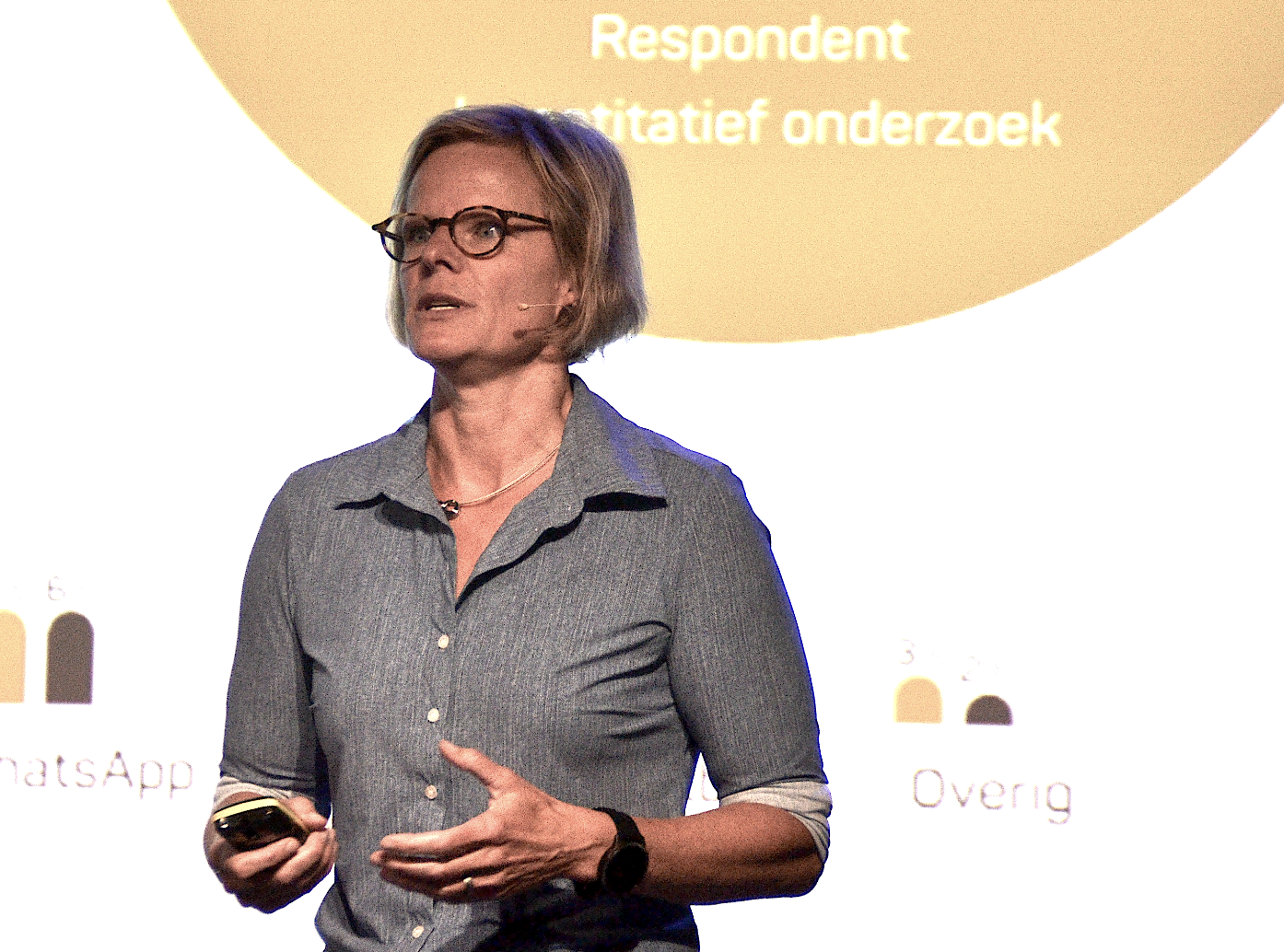 Despite all the hype surrounding AI, telephony remains an important channel for consumers. But touch-tone menus are what we really need to get rid of, according to Achmea, which houses a range of brands. These brands not only offer different products, but each also has its own processes and customer contact strategy. In other words, every brand makes its own choices when it comes to conversational messaging.
This creates “complexity and politics,” according to Annemiek Bakker (Conversational Product Manager) and Robin de Weerdt (Business Change Manager in Achmea's Customer Contact departments). Achmea wants to work towards a single bot framework for all its brands, with Genesys as the customer contact platform to connect to. The goal is for the brands to learn from each other.
How do you get loyal customers when 80% of product requests are made digitally?
Achmea, one of the few keynote speakers, effectively explained its underlying strategy for deploying AI. The company strives for loyal customers. This poses a significant challenge considering, for example, that 80% of car insurance policies are taken out digitally. How do you build brand loyalty across customer contact? Centraal Beheer aims to provide personalized, human service to customers as emotions and complexity increase, but also wants to be able to assist customers without a live representative. Centraal Beheer is making choices regarding contact channels. The company is phasing out its email channel ("we're still struggling with the last remaining vestiges"); social media channels had already been deployed as an interaction option.
Telephony and chat are leading at Centraal Beheer
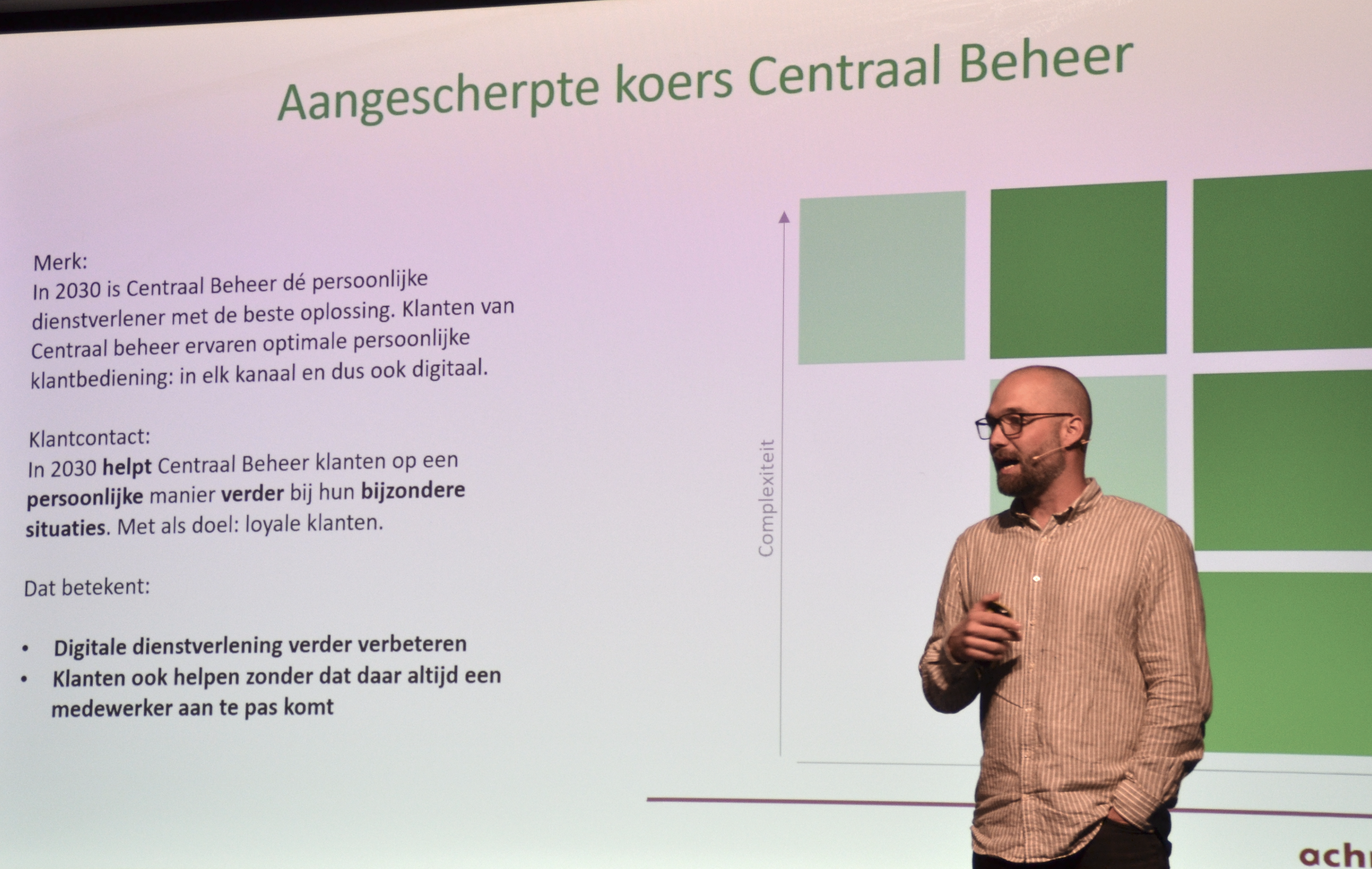
Robin de Weerdt – Click to enlarge
Telephony and chat offer the ideal foundation to build upon: telephony is the domain of employees and voicebots; chat is the domain of live chat and chatbots. As soon as an insurer wants to automate customer contact—and the first step is intent recognition—you must set high standards for quality and security. Regulators and other stakeholders are watching closely. As with Delta, voice routing is the starting point of the innovation process: directing customers to the right counter as quickly as possible without complicated menus, so their questions can be answered as quickly as possible.
Intent recognition currently has three types of outcomes: if an agent is requested, transfer the call without further questions; if the intent is too generic, ask a supplementary question; and if the intent is unclear, offer the traditional menu. Centraal Beheer's message: you can, of course, ask your customer which option they prefer: touch-based or voice-based routing, but they're not really comparable.
Don't go live without reporting capability
Centraal Beheer also has many things on its to-do list after implementing voice routing. These include further personalization; using alternative, synthetic voices; incorporating customer sentiment into routing decisions; and moving towards self-service routing. Centraal Beheer wants to move from voice-driven IVR to a fully-fledged voicebot channel that can also accommodate more complex dialogues. The voicebot can then be the first "person" customers speak to; your brand experience must be perfectly aligned.
Lessons learned: don't go live without good reporting capabilities; ensure proper timeliness so that everything you need is ready and available when taking the next step.
Rabobank: from keypad to voice-controlled

Chris den Arend
Chris den Arend, solution architect for conversational AI at Rabobank, subtitled his presentation "the end of clicking." Den Arend argues that our way of interacting with computers is increasingly shifting from keyboards to speech. He led his audience through a story about the significance of GenAI and is clear about the future: it's about agentic AI.
Rabobank is convinced that customers may soon conduct their financial transactions through platforms other than its own banking app. As far as Den Arend is concerned, this is simply the next step in an evolution: from mainframe to PC to web to mobile – and then to AI agent. This final step puts an end to the need for all sorts of separate mobile apps that barely work together.
Rabobank anticipates the arrival of agentic AI platforms
Robin, Rabobank's chatbot, has been operational for several years on the Rabobank website and within the app. While the latter requires a few clicks, Robin is now AI-powered, making it one of the few customer-facing assistants. According to Den Arend, three-quarters of interactions end with a correct answer.
Advice on cooking rice
Bringing GenAI to the front office is fundamentally different from simply developing software, where you can test based on standard input and output, Den Arend argues. Chatbot Robin, for example, initially also provided information on how to cook rice. With GenAI, you need continuous, real-time moderation and guardrails, if only because the bank is constantly fighting against malicious actors. malicious prompt inserting "Usually, the malicious actors are the first," and the bank must respond to that, says Den Arend. Additional identification steps may also be introduced for users, such as being able to click a specific button in the app upon request.
The audience also commented on the trend of moving from "typing" to "speaking." While Den Arend is convinced that both text and speech will continue to exist as communication modes, the underlying engines can be identical. Text often works well when the customer has a clear idea of what they want; when uncertain or context is needed, speech is often more convenient, according to one audience member. Another visitor added: "From the perspective of accessible service, both are essential."
VodafoneZiggo chooses agent assist 'to the max'
VodafoneZiggo is fully committed to agent assist for its 3.000 customer service employees. The telecom company launched this program a year and a half ago and has made significant progress since then. Agent assist is a safe and effective way to deploy AI: it offers limited risks combined with high (learning) returns. Agents receive support before, during, and after the call. Before the call, a customer summary, tailored to the reason for the call, summarizes the most relevant information for the agent. This is more effective than reviewing ten call summaries while the customer starts talking. This summary also includes information such as customer value, open cases, and the duration of the customer relationship.
Show agents what you've made
Roger Becker
GenAI not only delivers a beautiful product here, it is also a technology that accelerates the improvement of applications, according to Roger Becker (lead operational analytics, VodafoneZiggo) and Hein van Vianen (Product Owner Data & AI within CS). VodafoneZiggo also had a clear strategy and a clear (sub)goal in place: we want to improve employee satisfaction with this.
Customer service representatives deal with a wealth of information, and the trick is to make it as relevant as possible. Creating buy-in was explicitly incorporated into the implementation method: employee feedback was quickly and proactively gathered and processed quickly, which was then shared with the team. "Sit next to the employee and show them what you've created." This contributes to respect and acceptance.
“Sit next to the employee and show them what you made.”
During the conversation, an AI-powered search function helps employees find relevant information faster, next best actions Experienced employees are suggested, and based on the conversation, they are offered a "fast track." This latter is a so-called "elephant path" where the AI concludes that a standard process is involved that can be accelerated and largely automated.
Using AI analytics to find the root cause
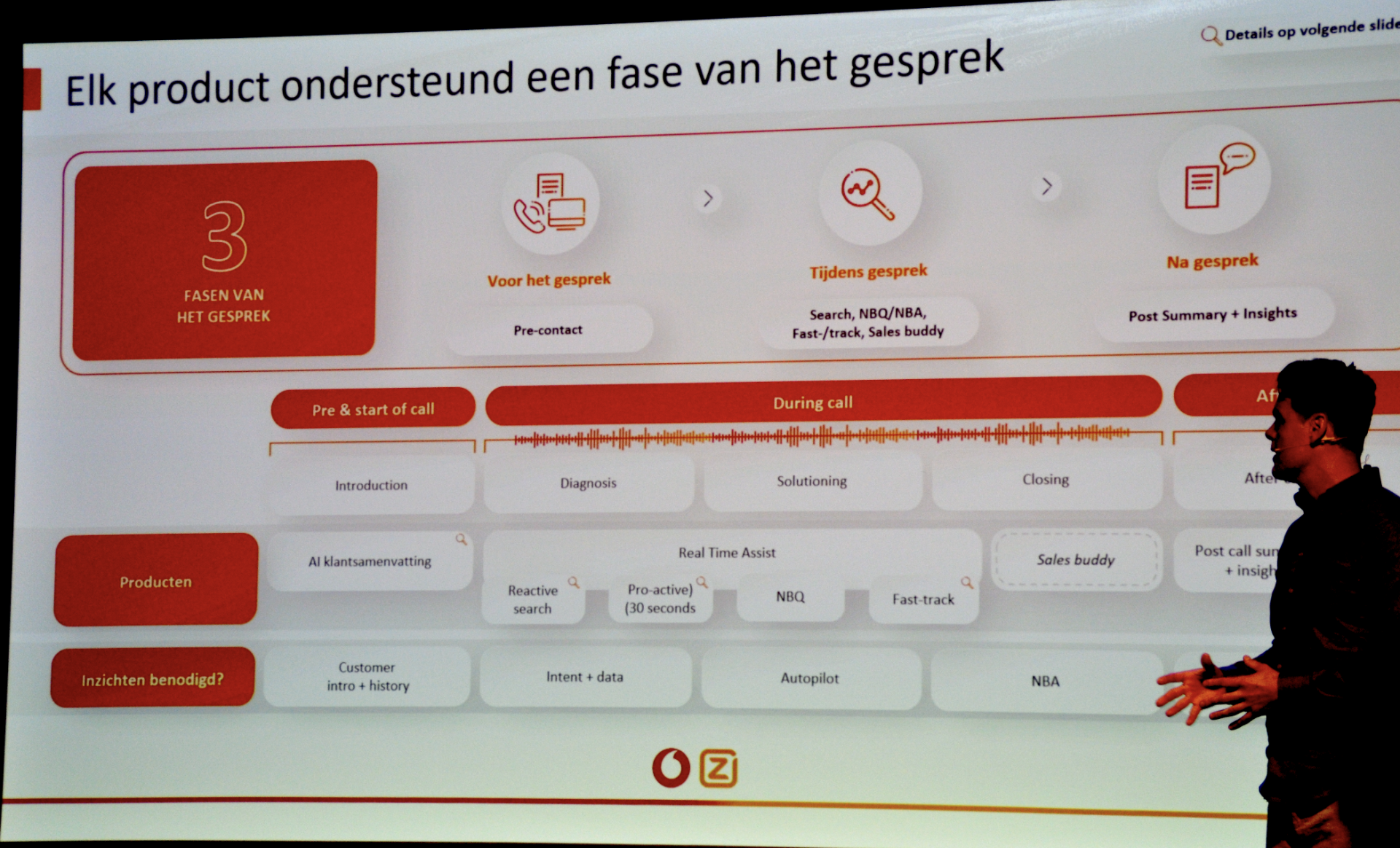
Hein van Vianen – click to enlarge
Automated summarization was implemented at the end of the call. This is low-hanging fruit, even for employees who, according to VodafoneZiggo, generally dislike logging. It's also an out-of-the-box solution with rapid adoption and therefore a fast ROI: 90 percent of employees are happy with it, while about 5% of summaries are still being edited. VodafoneZiggo has also started working with "insights," or AI analytics. Employees are focused on solving the customer's problem, but this often leaves the root cause unaddressed. Post-call analytics helps to properly investigate that root cause.
Legacy of a year and a half old
What was striking about Beckers and Van Vianen's presentation was their candor about the legacy issue. This will soon no longer be the case with Avaya (which will soon be replaced by Content Guru's storm), but rather with the AI applications that were released a year and a half ago. Therefore, starting with GenAI early on, even if only on an experimental basis, also has a downside: the law of diminishing returns. Solutions that are available now (sometimes even out-of-the-box) are often better and more effective, but also fit better into the architecture that has been developed in the meantime, according to Beckers. In the most extreme example, it literally applies: what seemed technically impossible on Friday suddenly turned out to be possible on Monday.
VodafoneZiggo has a clear vision for the future, one where augmentation, automation, and anticipation are central—with a diminishing role for "human in the loop." It's easy to guess: it's only a matter of time before AI moves even further into the front office at this company as well.
Finally
Notable at this edition of the Conversational Conference is that several corporates are still working on implementing voice routing. This may be due to improved intent recognition and the increased opportunities to build on this with GenAI compared to a few years ago. Health insurer VGZ was Already working on the implementation of voicebot Sam in early 2021This would play a role in intelligent routing: to forms of self-service, to an employee, or simply handle the contact itself as a voice bot.
Conversational Conference certainly shows that the pace of change is significant. And regardless of when you start AI initiatives, you run the risk of early-stage legacy.
Also notable: several corporations let their AI roadmaps "end" at the implementation of agentic AI. The Frankwatching team may be able to recruit an organization next year that has achieved demonstrable results in this area.
(Ziptone/Erik Bouwer)


Also interesting
-

Organizations that deploy AI-driven next best actions are 2,6 times more likely to be successful in commercial growth, according to Gartner research.
-

The upcoming edition of Conversational Conference will focus on how organizations can make automated customer contact work well.
-

According to Rick de Hoop, co-owner of NEXT, the company wants to further strengthen its focus with these interventions.