
Last week, NiCE’s AI-First CX World Tour landed in Amsterdam: Theme: The Agentic AI CX Frontline. That is a somewhat cryptic name for AI agents in customer service – and they are on their way. They will start working for you, but they will also become your point of contact on behalf of customers.
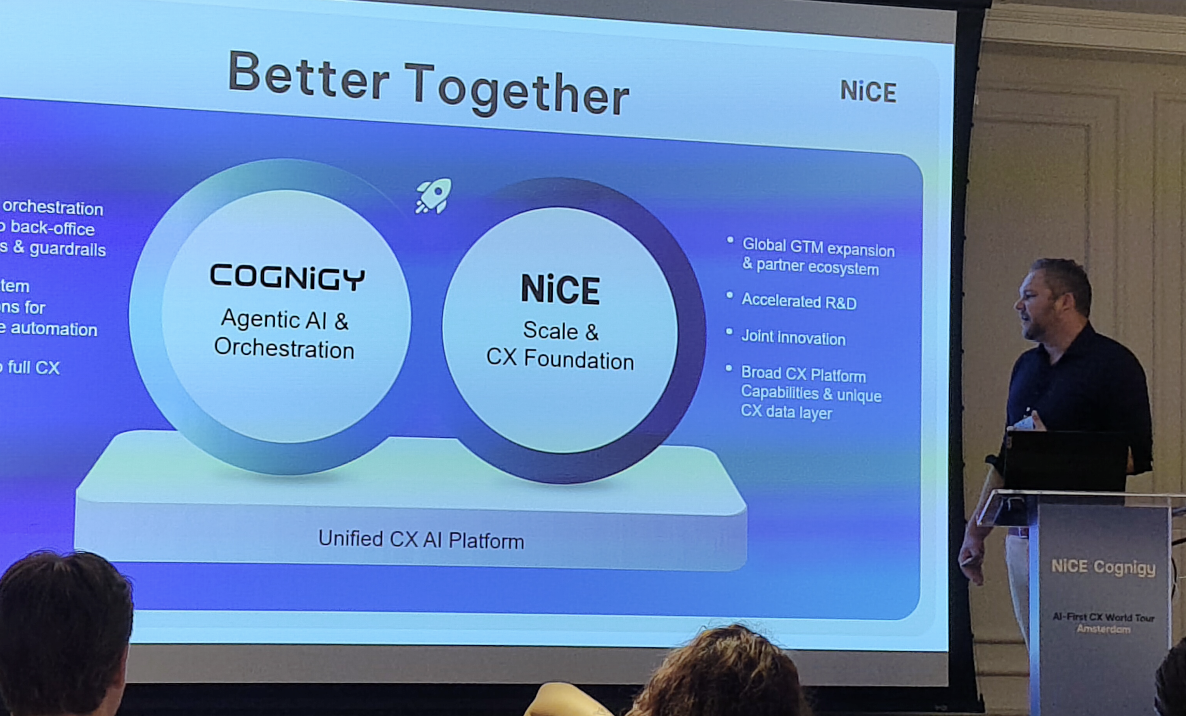 The GPQA benchmark, a good monitor to track how LLM power outputs develop, still shows an upward trend, according to Thys Waanders (VP AI Transformation at NiCE Cognigy), just like the continued investments in AI. As far as Waanders is concerned, the big breakthrough will come when AI agents secure a place on your customer's smartphone.
It is highly likely that this will generate more traffic and, consequently, more interactions between people and AI agents. What does this mean for WFM, your knowledge base, your SOPs, and your after-call work? And how will we monitor the processes to ensure observability is properly guaranteed? These are valid questions that were partially answered during the event. For other questions, organizations are still searching for the answers.
With the recent acquisition of Cognigy, NiCE has certainly positioned itself well for the agentic era. Some of Cognigy’s clients – mostly top European brands such as Lufthansa, Lidl, Bayer, Bosch, and Mercedes Benz – already have concrete experience with agentic AI. This was also evident from the presentations by Cognigy clients at CCW Berlin early this year.
The AI voice agent is going to make a round of calls itself.
Waanders is aware of the skepticism surrounding agentic AI, but emphasized that there are already quite a few use cases demonstrating both impact and ROI. The flagship is perhaps Lufthansa, with bots that handle 30.000 at peak times. concurrent sessions processing for end-to-end rebookings, for example, via a direct link with the aviation platform Amadeus. The airline also uses real-time translation (after office hours, the chats are forwarded to Fiji), and voice translation is on the roadmap. Allianz France also has a great case study, where the AI voice assistant automatically calls local towing companies near the breakdown location to handle roadside assistance.
Low code and no code are a thing of the past.
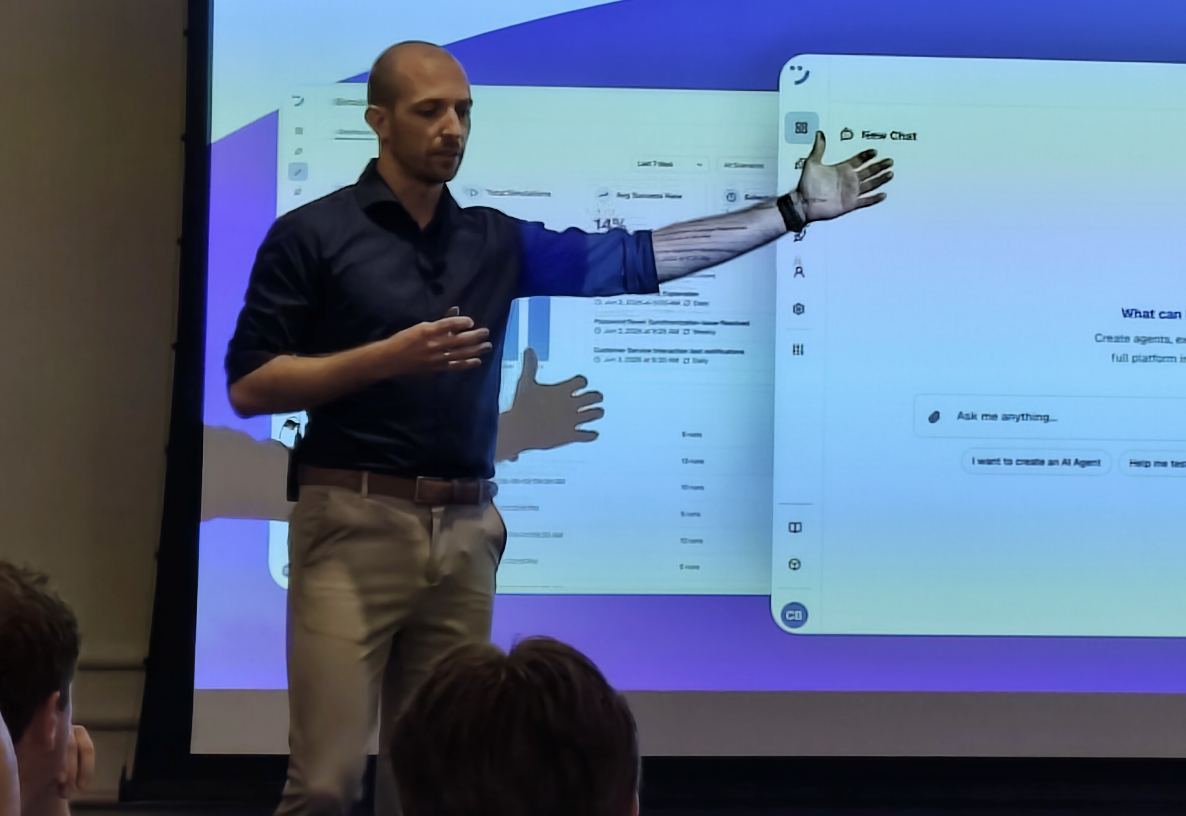 The paint is barely dry, but low code and no code are already passé, according to Janik Emmendörfer, Director of FDE Strategy at NiCE Cognigy. “We tell AI what to do or what to make, and that also applies to the development of AI applications.”
A few years ago, realizing flows using ready-made building blocks and drag & drop was the way to put the business in the wheel when developing new applications. Emmendörfer also stated that for probabilistic applications continuous testing and monitoring Of great importance is: “The same prompt can cause different outcomes.” Therefore, NiCE has developed a simulator in the form of a digital twin of the customer. With this synthetic customer, you can communicate (at scale) with your AI agents, after which you analyze the (dummy) results with AI. In short, AI is increasingly becoming a development, production, and improvement tool.
Observability is the new challenge
But observability It remains a challenge, also for the public, as was heard. How do you organize that, where do you place it? And where will your AI agent ultimately work: on your own website or your own app, or remotely, because a Google or OpenAI platform will soon be the standard?
Emmendörfer also indicated that AI agents thrive best in a multimodal environment. For instance, while you can in principle accept a seat reservation change request via voicebot dialogue, it is not practical to offer seat selection options to a passenger in spoken form: visual information works better in that case. By way of illustration: an AI agent briefly puts the customer on hold during a conversation to fetch a human employee – for example, to grant permission for a discount request. Question from the audience: what if that employee is not immediately available due to busyness? Answer: you will indeed need to define variables such as thresholds and follow-up steps.
Good customer service is becoming widely available again.
During the closing remarks, it came Michel van Roon (VP Europe, NiCE) briefly returns to the acquisition of Cognigy by NiCE. That addition is very important for NiCE: it makes NiCE’s analytics capabilities even stronger, according to Van Roon. Analytics as a basis for automation is also the next step companies can take. NiCE offers an open platform in this regard, which is important to prevent vendor lock-in in an era full of technological changes. It is also a nice thought for customer contact professionals: after years of driving call deflection, you can open the doors of your organization again with virtual agents. Or as Van Roon put it: “Good customer service is becoming widely available again.”
(Ziptone/Erik Bouwer)
Also read:


Also interesting
-
KickstartAI CEO Erick Webbe on how to achieve value creation with AI instead of just efficiency gains.
-

The CCW2026 wrap-up: a lot of attention for AI, agentic AI still needs to mature, and the focus on sovereignty…
-

NiCE is launching NiCE Labs, a dedicated AI innovation lab established for research, benchmarking, and rapid prototyping.