
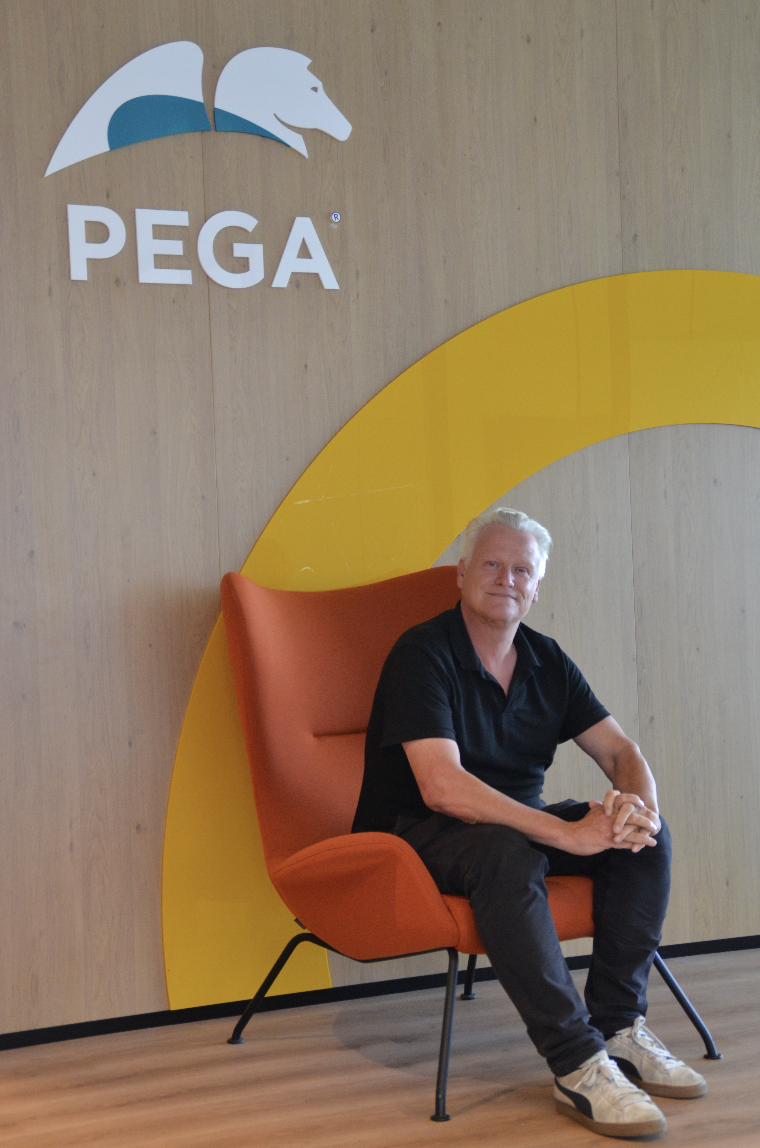
Image: Ziptone
Of course, garbage in = garbage out. But you're never done managing your data. In short, "data housekeeping in order" isn't a prerequisite for starting AI applications, says Peter van der Putten, Director of AI Lab at Pega. "The real value isn't in models, but in what you do with them."
Peter van der Putten is Director AI Lab at CRM vendor Pega, responsible for AI strategy, thought leadership and product innovation. He is also a part-time university lecturer at Leiden University. From the Leiden Institute of Advanced Computer Science (LIACS), he conducts research into the interaction between humans and AI. His personal fascination: 'Artificial X, where X stands for everything that makes us human – in addition to empathy, these are mainly things like emotions, building relationships or even religion – and how AI can interfere with that. He sees AI applications as a mirror of our human capabilities. Is AI capable of creating poetry – for example, by inventing new metaphors?
GenAI is only part of the story
We begin the conversation by exploring the true added value of AI. While GenAI is being widely embraced by the public—especially the latest improvements in generating lifelike videos are generating a lot of buzz—in customer contact, it remains limited to familiar use cases in the agent-assist category. For now, it seems more a case of evolution than revolution.
"When you think of AI, ChatGPT quickly comes to mind. But that's only part of the story," Van der Putten emphasizes. "I call that category 'right-brain AI': creative, generative, associative. But just as important is left-brain AI: the analytical, rational ability of AI to perceive, predict, and make decisions. This form of AI is already fully operational in many organizations, often unnoticed, and it's important that we maintain a broad perspective on AI."
Relatively stupid and passive
Still, if you look at the greatest added value right now, you end up with GenAI applications, Van der Putten also observes. In customer service, this involves things like automatic summaries, dialogue suggestions, and improved routing. Many organizations are already saving on after-work time or increasing employee satisfaction. Another factor that, according to Van der Putten, is the 'commoditization' of models. It's not that anyone can just build a new model, but the models are becoming increasingly similar. "These models are quite dumb—they remain passive, barely incorporate any context, and barely make any plans of their own," says Van der Putten. "The real step forward is the AI agent that gathers context, takes its own actions, and learns from what happens." He cites the example of a bank that makes five billion AI decisions monthly, ranging from risk assessments to routing decisions. "That's on a different scale than a series of prompts in a chatbot."
Create and implement your own action plan
After receiving a query or request, Agentic AI begins gathering relevant context from systems, customer history, or external sources. The agent then interprets the query, reformulates the problem if necessary, and develops an action plan. The AI agent then selects which tools or APIs are available and necessary to arrive at a solution—for example, initiating a return procedure, processing a payment, or requesting additional customer information. If the outcome of that action is unexpected, the plan is adjusted.
An AI agent can then take action independently. Van der Putten cites a life insurance scenario as an example, where the AI determines whether a medical assessment is necessary based on policy rules, initiates it automatically, and then has the case handled by a human or machine. "This creates AI that not only reasons but also operates purposefully within clear parameters."
Pega already works with such an AI agent: Iris, an internal AI intern who "lives on Texel." Pega employees can ask Iris questions about products, sales, support, or strategy. Iris answers based on twenty internal tools, from documentation to reasoning engines. "We deliberately called her an intern; it helps with expectation management," says Van der Putten. What makes Iris different from ChatGPT? "She combines knowledge sources, poses follow-up questions, calls upon tools, and plans actions herself. That makes her a true agentic AI."
Predictable agents
The development of agentic AI is definitely still in its early stages. Van der Putten expects that systems in which multiple agents collaborate—so-called multi-agent systems—will be the next step. "Then you need to not only facilitate coordination between agents, but also be able to explain what they're doing, why, and based on what information."
This touches on the importance of explainable AI and the use of reliable and predictable tools (predictable agents) within business processes. We already create a lot of complexity when a single agent processes data and produces output; let alone what happens when multiple agents collaborate. How is output generated in such a situation?
Is data in order a prerequisite? Nonsense
 A common saying is that AI only works if your data management is in order. Nonsense, says Van der Putten. "Of course, 'garbage in is garbage out.' But companies often say: wait a minute, we have the 'Golden Data 2026' program running. Those kinds of programs always run late, and besides, you're never finished managing data. If you take 'data management in order' as a starting point, there's a good chance you'll never start working on AI."
"Data in order" is more of a mindset problem than a dataset problem, concludes Van der Putten. "The focus should be on business outcomes, such as shorter handling times or higher customer satisfaction. Start small, with a specific problem. Then you'll automatically see which data is important, where the gaps are, and what you need to improve." So don't start from the technology, but from questions like 'what are your biggest challenges' or 'where do you want to go as an organization?' "Look at what's in your annual report. What goals do you want to achieve? Only then do you determine which forms of AI can contribute to those goals. This shifts the perspective: not 'what can we do with AI?' but 'how can AI contribute to what we want to achieve?'
Van der Putten often sees companies reasoning from the bottom up: they have a lot of data and want to "do something with it." This rarely leads to impactful applications. "Top-down thinking means starting with concrete goals or problems and then investigating which technology and data are needed to achieve them."
Autonomous organization
Agentic AI may be the next step, but you can expect the AI Lab to already have a vision of what comes next. Van der Putten refers to this as the 'autonomous enterprise': an organization in which AI not only provides support but also independently pursues goals within predefined frameworks. "We're used to self-driving cars. Why not self-driving companies?" Technologically, this means a closer integration of generative AI (creative planning, interaction) with analytical AI (decision-making, optimization). This requires even greater control over reliability, explainability, and collaboration between ecosystems of AI agents.
You can also explore the possibilities of using AI to enrich the customer experience rather than simply make it more efficient. Van der Putten cites the example of an Australian bank using AI to determine which customers are eligible for government programs or subsidies. "That's not just complaint handling, but truly proactive service. AI makes these kinds of initiatives scalable. Customer service is ripe for transformation. But keep it down-to-earth, practical, and human-focused. Because only then will AI deliver true value."
(Ziptone/Erik Bouwer)


Also interesting
-

Sudden fear that technology like AI will take your job? You might be suffering from Kasparov syndrome. The good news:…
-
This book is about AI agents: software that can perform tasks independently. Will customer contact also have to deal with this? The answer…
-

According to Chinese astrology, 2024 is the year of the Dragon. Or did someone make a math error? Because it is…