
If Salesforce has its way, all companies will become an 'agentic enterprise'. The transition from a rules-based chatbot to an AI-powered chatbot shows that this change in customer service can happen in small steps.
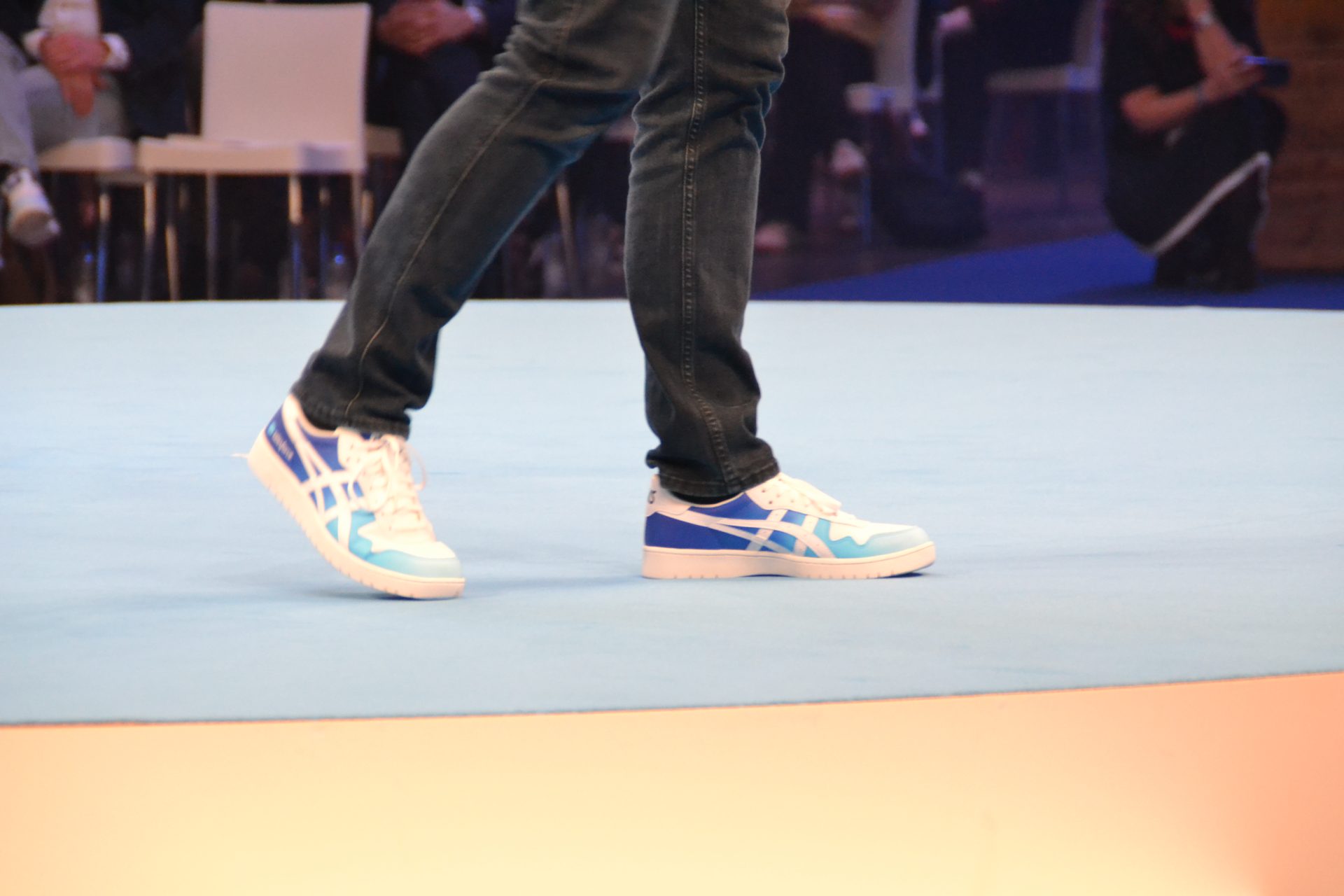 The semi-annual Salesforce circus had landed at the Jaarbeurs in Utrecht this time. Remko Reinders kicked off the event – this time in brand-new ASICS sneakers, more on which in a later article – with an explanation of the foundations underlying Salesforce's solutions. Trust is paramount in this regard.
Whether a conscious choice or not, many Salesforce users have been targeted by hackers recently – think of the phishing attack at Odido. Although the technology is not to blame, Salesforce users themselves are attractive targets for criminals. The average Salesforce user is a large organization sitting on a massive mountain of data.
Attack surface
One of the partners present with whom Ziptone spoke, the Finnish company WithSecure, explained that with the growing use of customer-facing chatbots, the vulnerability of companies increases further. Criminals can place malicious links in chatbot conversations and then push for escalation to an employee. After that, it is a matter of enticing the employee to click on the link. Monitoring what enters your organization via the chatbot channel is therefore not an unnecessary luxury. According to WithSecure, this also applies, for example, to the ability to intercept false customer identities within the chatbot channel.
When can you speak of an agentic enterprise?
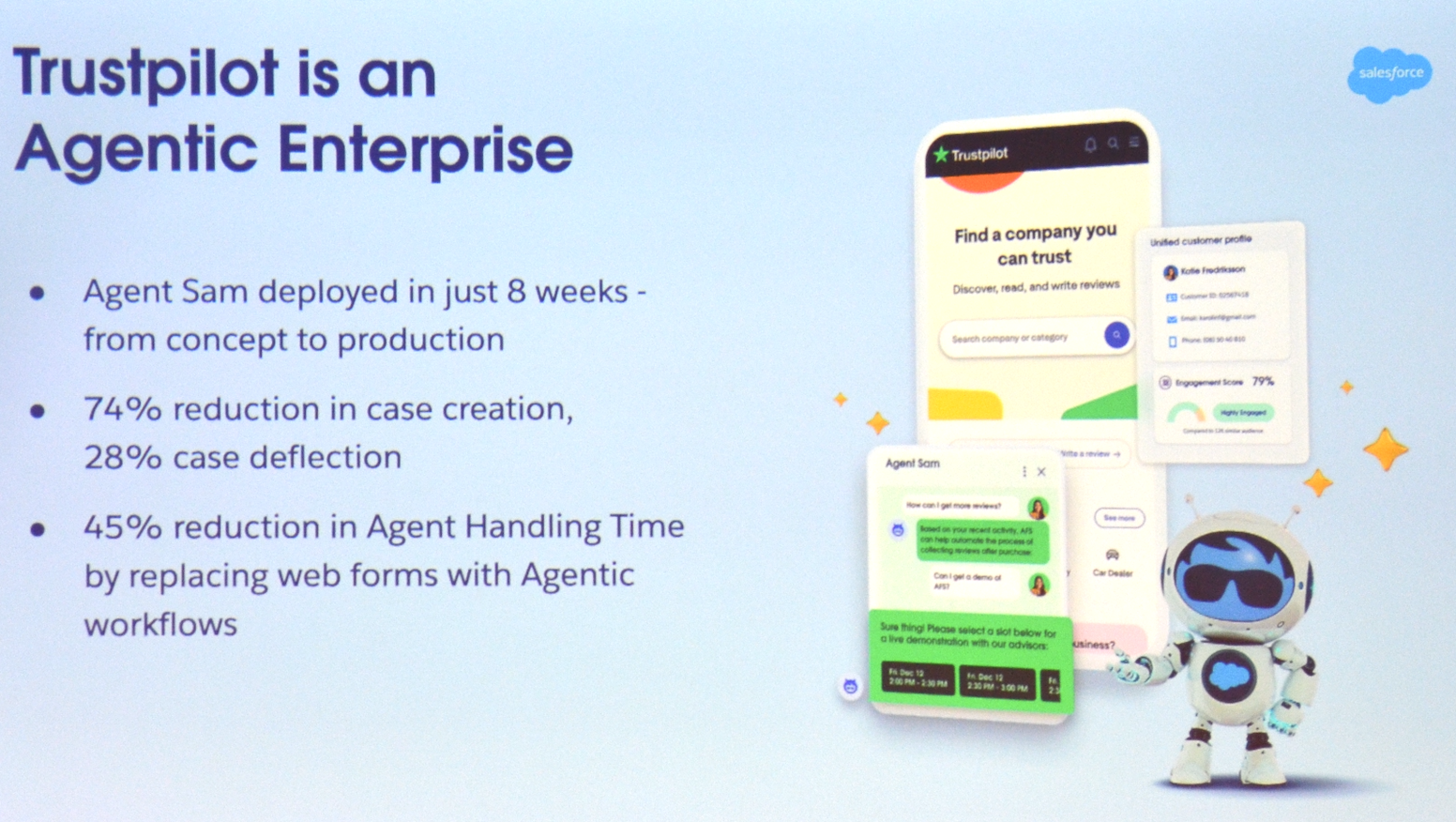 Now back to the agentic enterprise, Salesforce's pet project. Judging by the client organizations that took the stage, it is customer-facing chatbots that are heralding the rise of the agentic enterprise. Pandora, ASICS, and Trustpilot spoke about implementations of AI agents – sometimes as a pilot, sometimes fully in production.
Whether one can then already speak of an agentic enterprise is the question. That concept refers to an organization where people and AI agents work side-by-side, but where large groups of specialized AI agents also collaborate with each other.
What is clear, however, is that organizations want to automate a larger portion of their contact volumes. At Pandora and ASICS, the AI agent was the successor to a rules-based chatbot, and in both cases, the resolution rate increased.
AI chatbot brings much more context
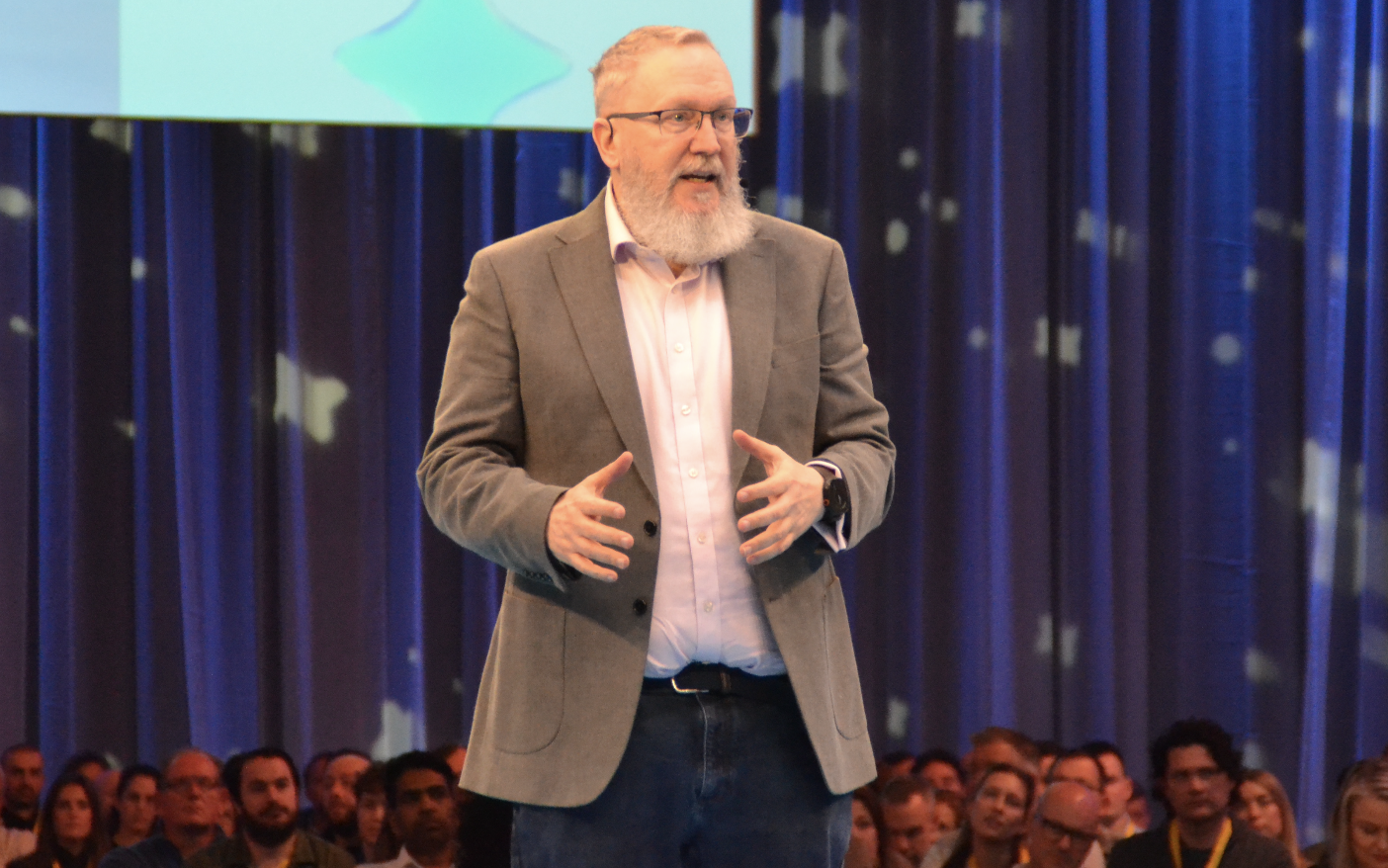
Trustpilot CTO Dave Williams. Image: Ziptone
Trustpilot CTO Dave Williams spoke about chatbot Sam, who is ready to assist both business customers and consumers. “We have many customers who want to talk to us,” said Williams, one of the few who did not appear on stage wearing ASICS sneakers. Trustpilot’s objectives: reducing the number of cases (the company consistently had a backlog of thousands of cases) and eliminating phone queues. Additional added value of chatbot Sam: escalations contain much more context than before, and the backlog was reduced to nearly zero. In Trustpilot’s case, the chatbot was an alternative to scaling up with FTEs; apparently, the latter was not a desirable option for the company.
That scenario also applied to ASICS, which is growing rapidly, partly as a result of a direct-to-consumer (DTC) strategy. That growth was quite rapid, and at ASICS, too, the intention was that customer service would not grow proportionally. The result: longer waiting times on the phone and getting the second version of the European chatbot Akira into production within four months. Managing the earlier (rules-based) version of Akira required 4 FTEs, including for the various languages and updates. The switch to the AI version made scaling up – both in terms of inquiries and international rollout – much easier, according to ASICS.
'Voice to form'
Customers such as VodafoneZiggo and food giant PepsiCo also indicated: we have started developing and deploying agentic AI. At PepsiCo, too, it became clear that the path to an agentic enterprise involves small steps in the form of specific use cases. For example, PepsiCo has implemented 'voice to form,' where a customer's spoken input (think of a service request from an SME selling PepsiCo products) automatically leads to the filling in of the correct fields on a form, so that the output can enter the organization in a standardized manner.
The sovereignty debate
In conversations with a number of the dozens of partners and sponsors, the impression arose that the discussion regarding sovereignty is not yet a major issue among Salesforce users themselves, but it is all the more so among technology partners. In the technology world, vendors sense that something needs to happen, and American providers in particular are at their wits' end because they cannot escape the CLOUD Act. Setting up a 'European sovereign cloud,' combined with data encryption, offers a form of data sovereignty, but that extra protection offers no guarantees. And that is a cruel irony for a sector that offers services based on SLAs.
Customer contact is mission critical for sectors such as healthcare, utilities, finance, and government, according to a CCaaS provider Ziptone spoke with. No CCaaS means no contact with your customer; that is of a different order than when your CRM is down for an hour or a day. It is up to the tech players to be transparent about the (new) risks of their CRM or CCaaS solution, and up to the client organizations to make new risk assessments based on realistic estimates.
Changing DNA for customer service?
Finally, one more remarkable observation. During Agentforce's plenary keynotes, a real-time text-to-speech conversion ran on the large screens above the audience. The speech recognition software accidentally turned 'agentic transformation' into 'genetic transformation,' and that cannot be a coincidence. Salesforce users are convinced that their organizations are going to change drastically in the near future.
(Ziptone/Erik Bouwer)


Also interesting
-
Because the solution offered by AI seems perfect, I miss options that I would otherwise have found through search results…
-

With chatbot Lumo, the company wants to add a solution to its existing portfolio of privacy-friendly applications.
-

My espresso machine refuses to make a cup of coffee. It doesn't help that Coolblue's customer service department is also broken.