
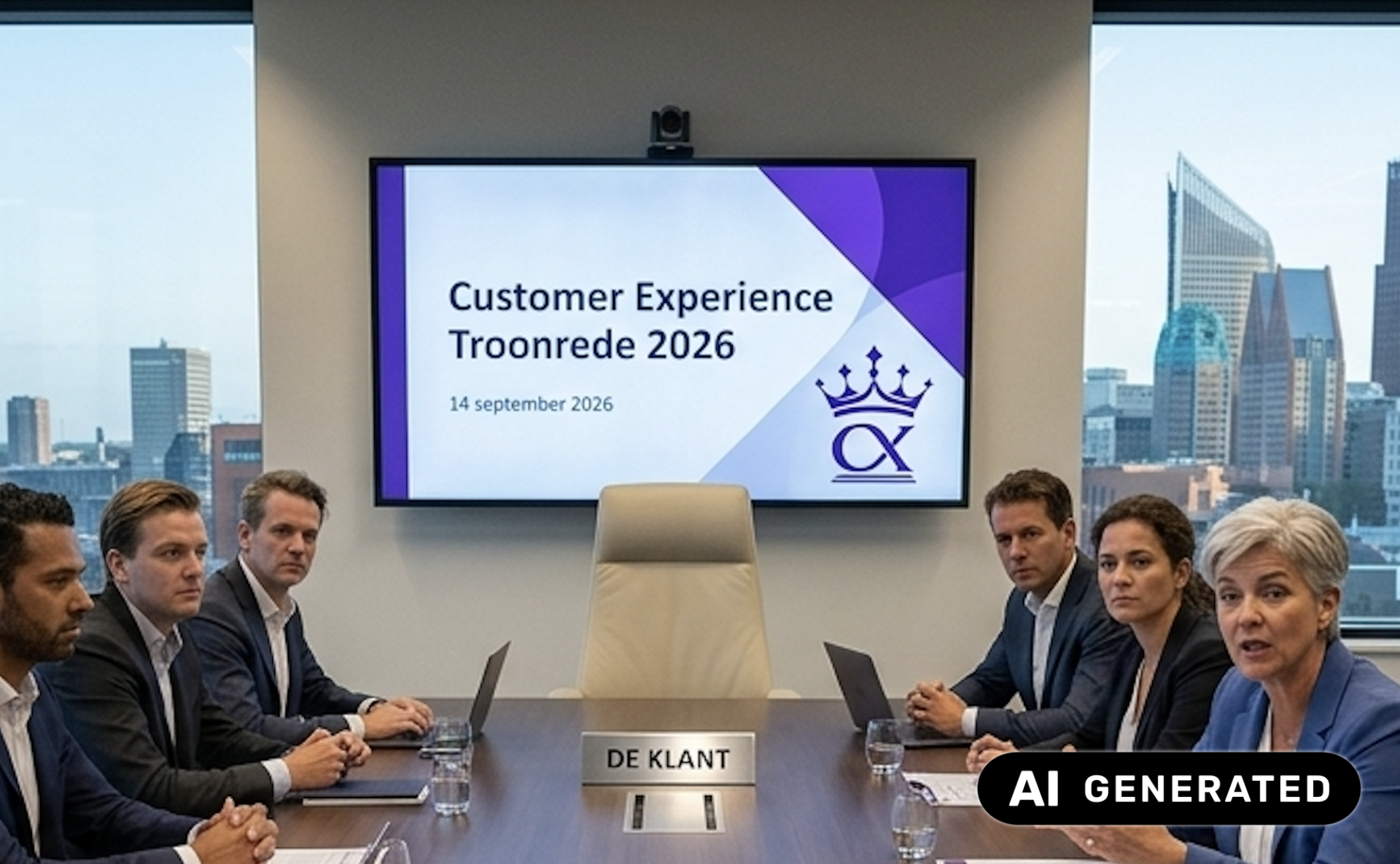
Image: Ziptone
A CX State of the Union address has been delivered again this year. The question is not whether we consider the customer important. The question is: does the customer truly have an influence on the choices we make? That is central to the CX Speech from the Throne of 2026, drafted by 17 CX professionals from the Netherlands. The CX Speech from the Throne is reproduced in full below.
Dear CX colleagues, board members, managers, employees, consultants, and members of the press,
Imagine a meeting. A packed agenda. The coffee is ready. Sitting at the table are Finance, IT, Operations, Marketing, and the Executive Board. Decisions are being made regarding a new customer portal. Regarding the deployment of AI. Regarding cost savings and new processes.
And somewhere at the end of the table stands an empty chair. That one is for the customer.
But she wasn't invited. Forgotten.
Not because she is unimportant. She is in the strategy, in the mission, and probably on the PowerPoint as well. But while the decisions are made that determine her experience, her perspective is far from always represented.
And that is exactly where the problem lies.
Because AI is accelerating. The pressure to work more efficiently is increasing. Customers expect more, and trust is becoming less and less of a given. Especially now, the question is not whether we consider the customer important. The question is: does she truly have influence on the choices we make?
In this sixth CX Throne Speech, seventeen authors examine that question from five perspectives: towards technology that must serve humanity; towards customer insights that must lead to real change; towards trust that is earned anew every single day; towards leadership that delivers customer focus; and towards CX that must demonstrably add value.
The meeting is about to begin. This time, we will send her an invitation. And we will make sure her chair is where the real decisions are made.
1. Humans at the center of the AI era
Companies, organizations, and governments primarily deploy AI and technology for internal efficiency. Think of chatbots and automated complaint processing. The idea? Automation creates space for genuine human contact. But customers are now in control themselves, too. They deploy their own AI agents to search, negotiate, and save time on their behalf. This creates a race between systems, potentially leading to endless digital conversations without human intervention.
We must stop pitting technology against the customer. We must ensure that they reinforce each other. With AI, too, we must resolutely look at, understand, and design from the perspective of the customer and their world. It is precisely in this way that we create space for human contact, attention, and hospitality.
If done correctly, technology can unburden, eliminate administrative tasks, and save time. In healthcare, for example, AI can reduce the administrative burden, leaving more time and attention for the patient. The starting point is always human need. Only then do we determine which technology helps.
Technology is advancing rapidly, while policy and decision-making often take years. We must close that gap. If we want to innovate responsibly, we must experiment and adjust together more quickly.
Customer Experience is the starting point here. Therefore, always place the customer at the head of the table and invite AI. Not the other way around.
The call for 2026 is therefore: help build. Do not start with what technology can do, but with what people need. This way, we can transform AI from an efficiency tool into a human connector.
2. From customer insight to real change
Had Henry Ford asked what people wanted, they probably would have answered a faster horse, not a car. This reasoning is often cited as proof that listening to customers yields little. We see it differently. The customer wanted her problem solved: traveling took too long. Ford then devised the solution. That is how it still works today. The customer does not ask for a design, but does provide important signals about what can be improved.
The CX profession has grown by gathering those signals through surveys, interviews, and data analysis. Listening remains essential. It prevents corporate blindness and reveals where internal logic clashes with the customer experience.
Thanks to AI, we gain access to a multitude of insights that we did not have before. Every conversation, every chat, and every signal becomes analyzable. But precisely because of this, one question becomes more urgent: what do we do with it? Customer insight is not an end result. Neither is a printed customer journey on the wall.
The goal is a better customer experience. Yet, that is where things still stall too often. Organizations do listen, but actual improvements lose out to systems, budgets, and other priorities.
That demands something of us as CX professionals. We must connect customer insights to the organization's goals and priorities and make clear why improvement is not only desirable but also relevant.
We invite management not only to ask for customer insights. Above all, ask the question: what will change as a result of these insights? Customer insights form the starting point; the real value arises from the improvements that follow. Only then is the customer truly at the table.
3. Trust is earned in every choice
Trust arrives on foot and departs on horseback. This is not wisdom from the last century, but the reality of every organization working for customers and citizens today.
Trust is not earned through campaigns or letters of intent. It arises or disappears through daily choices: in handling a complaint, in making information accessible, in deploying AI, and in the space given to someone to explain the situation. Small operational choices can have major consequences for trust.
Take the 'know your customer' principle. The laws and regulations surrounding money laundering and terrorist financing are based on this. These regulations protect the financial system. But for a customer, this can feel like distrust.
As soon as organizations implement rules without involving the customer, trust and compliance become polar opposites. But that doesn't have to be the case.
In public service, even more is at stake. Groningen demonstrates what happens when citizens' interests are systematically ignored in decision-making. Other interests took precedence, while the safety and well-being of residents were insufficiently taken into account. The consequences of this are still felt today.
It is precisely when the system clashes with the human scale that the choice an organization makes becomes visible. Restoring trust requires more than solving a problem. It requires people to feel seen and heard, that there is room for their personal situation, and that mistakes are acknowledged.
Trust is ultimately the cumulative effect of thousands of small and large choices. The challenge is not only to measure whether trust is present, but to actively steer the choices that build trust or help restore it. It is not just about inviting the customer to the table. It is about ensuring they stay at the table.
4. Leadership makes customer focus a reality
Almost every organization claims to put the customer first. Yet, too little changes in the way decisions are made. The customer's chair is somewhere in the boardroom, but often not yet at the table.
The intention is there. Almost everyone wants to be customer-oriented. What is often missing is a shared definition of what customer-oriented behavior means in daily work. Without that definition, good intentions break down into as many interpretations as there are people.
What a leader focuses on grows. What is neglected disappears. Within the central government, nearly 70% of employees indicate that the demands of the day rule. Sometimes, employees feel more responsible to their minister than to the citizen. A striking example: a ministry sent a six-page annual letter containing two lines on service delivery and six on internal performance standards. When that standard was met, the executive celebrated on the intranet. Not a word about the customer.
Customer focus only becomes true when leaders themselves demonstrate the behavior they expect from their people. Exemplary behavior is not a soft factor alongside direction and results. It *is* the direction.
That calls for choices that sometimes cause friction. Entrusting ownership of the customer to a single responsible party, not to everyone and therefore to no one. And daring to say that an efficiency drive will not proceed if it demonstrably harms the customer experience.
Anyone who truly wants the customer at the table doesn't start with a new plan. They start with their own behavior. CX professionals can feed that process with signals. But the chair only shifts when leaders pull it up.
5. From CX to demonstrable value
In uncertain times, we see organizations playing musical chairs. As soon as things slow down, the music stops and there is one seat too few. Unfortunately, we increasingly see the marketing or CX team left without a seat and disappearing. It is therefore more time than ever for the next step in the maturity of our profession: the shift from CX management to CX impact.
Organizations generally do not lack data. But how does that data become relevant? How do we use it to solve customer problems? What behavior changes as a result? And what does that yield for the customer and the organization? These are questions that must be addressed in the business case for CX.
We make an impact both before and after. Beforehand by providing input for strategic decisions, multi-year plans, and vision development. Afterwards by making it crystal clear what value CX has delivered for the customer and the organization.
To do this, we must first understand the organization's strategic and tactical objectives and how CX aligns with them. Consider revenue, trust, costs, risks, efficiency, churn, and reputation.
Next, determine in advance which goals we want to influence and which improvement themes can be used from a customer perspective. And also calculate the other side: what is the risk of doing nothing?
In addition, consider where we have influence: in the language used, the reports presented when decisions are made, the meetings where choices are made, and the stakeholders who make a difference.
And then demonstrate what the work has yielded. Celebrate the successes and let the data speak for themselves.
By consistently demonstrating CX impact, the customer earns a seat of their own within the organization. A firmly pulled-in spot. This way, the CX discipline need not worry about its place in the game of musical chairs.
And finally
The meeting is almost over. The agenda has been covered. But the real question has not yet been answered: was the customer involved in the decision-making process?
You don't answer that question in a single CX Speech from the Throne. But you do in the choices you make tomorrow. In the conversation you have with your board. In the data you don't leave sitting in a dashboard, but bring in where it counts. In the courage to say: we are not making this decision without involving the customer.
The seventeen authors of this Speech from the Throne show, from five different perspectives, what is needed for this. Technology that starts with people. Customer insights that lead to change. Choices that earn trust. Leaders who deliver customer focus. And CX that demonstrably adds value.
The meeting goes ahead. Make sure the chair is pulled up and occupied. Keep listening to the client. Take what she says seriously. And above all, ensure that her perspective is taken into account when the real decisions are made.
CX Netherlands
In this Speech from the Throne, we refer to the customer as 'she'.
The CX Speech from the Throne 2026 was written by:
Anneke Rijk – IND
Marije Gast – Guest Perspective
Sjo Delvaux – Eggink & Delvaux
Marieke Smeets – Altuïtion
Leon Bosma – Kyden
Loretta Ranzijn – Complaint Experience
Gerda Swinkels-Legierse – InteraCXion Works
Tessa de Vries – IMG
Tamara Mom – ASN Bank
Babs Asselbergs – BlommaBerg
Martijn Lentz – National Organization ODI
Leonie Melchers – Tax and Customs Administration
Bart van Engelen – Kyden
Tim Thijsse – Land Registry
Karolien van der Ouderaa – National Organization ODI
Robert Vels – National Organization ODI
Nienke Bloem – CX Leadership
Editors – Joost Mangnus – ICTU


Also interesting
-
Trust does not disappear because of bad news, but because of empty promises - column by Mark Elschot

Customer contact sits precisely at the point where policy and reality meet. If all goes well, trust is created there…
-
Yesterday, the board of the Dutch chapter of the Customer Experience Professionals Association (CXPA) met for the last time.
-

77% of consumers say they are more likely to achieve good results when they speak exclusively with a representative.