
 Over the past fifteen years, Big Tech has fully embraced strategic themes like big data and the cloud. Now, AI is the name of the game, including in customer contact. However, sovereignty—as a genuine party-killer—also demands attention.
Billions are being invested, particularly in American AI players, and of course, these investments need to be recouped. At the same time, there's immense pressure on companies and governments to further digitize. They not only have to eliminate their legacy software but also migrate to the cloud and innovate along the way. All in all, everyone is busy: we all want to move quickly and innovate, with Big Tech leading the way.
But that rush and bustle are becoming less and less self-evident, let alone positive. The country where Big Tech originated no longer seems trustworthy. European heavy users of American technology are increasingly concerned about their sovereignty. The fact that this involves much more than just data and privacy is still often overlooked, but for a growing number of decision-makers in Europe, the genie out of the bottle.
For Big Tech, it's impossible to miss: doubts about Big Tech are growing. The European market isn't talking about postponing investments, but about a fundamental reorientation. If we have to replace and innovate anyway, wouldn't it be wiser to buy European products? Solvinity plays a leading role with DigiD and Kyndryl, but even here, there's much more at stake.
Who's in control?
Big Tech is responding to these European doubts in various ways. The most obvious is the establishment of European sovereign clouds, a blatant example of cloudwashing. According to the NIST definition of cloud As a user, you are primarily autonomous when it comes to provisioning.
There are also lobbyists and advocates who are fully committed to legal certainty. Should the US initiate undesirable actions, we still have our lawyers! The fact that these lawyers don't have any control over IT—think availability, functionality, access, and costs—is conveniently omitted.
A nightmare is unfolding for both sides of the market. The supply side's sales and marketing are starting to lose their obvious shine, while the demand side of the market is forced to consider alternatives that were never obvious. It's taking some getting used to for both sides, but there's a difference: the demand side faces a completely different problem than the supply side.
Replacing a single application with a European alternative is one thing – although there are companies that have been working with SAP for years. Or governments that have been struggling with rusty server farms full of COBOL code in damp basements for twenty years. But replacing an entire IT landscape? As is often the case, we want to quickly solve a problem we've spent years building up.
Bright spot
There's a silver lining for both the demand and supply sides in Europe. We can get started with European software. It's been developed for a long time, and customers can simply buy it. This also applies to contact center software. IT service providers that have until now specialized in American products can supplement or perhaps even enrich their product range with it. This way, even as a contact center manager, you'll have real choice. And for a change, the development team and helpdesk might even be just around the corner instead of on another continent.
If the equipment isn't good enough (you still hear that sometimes), then you might need to put some extra effort into it. We've done the same with cars (they don't rust anymore), household electronics (they rarely break down), airplanes (they've become cheaper, more efficient, and safer), and utilities (they're quite reliable these days). We even have European navigation satellites and payment platforms.
In other words: if you put in some effort, it quickly becomes better than a product or solution that works well but you don't have full control over. And you only discover the true value of the latter when you lose that control.
(Ziptone/Erik Bouwer)


Also interesting
-
Consumers are increasingly having to engage in conversation with chatbots first and overcome other hurdles. Is something growing wrong...
-
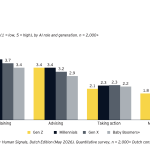
The acceptance of agentic AI in customer contact plummets as soon as AI acts independently. And empathy is desired less often than expected.
-

High turnover? Shaky knowledge management? No chain responsibility? Whatever it is, for now, AI is trailing 1-0.