
In the market for facility customer contact and CX services, there is room for mid-size players focusing on more complex customer contact. This is evident from ContactCare's notable move: the company started operations in Antwerp last week. Ahead of the official opening, Ziptone spoke with CEO Jasper Meerding.
 The conversation with Meerding takes place on the Meir in Antwerp, in a monumental Beaux-Arts office building dating from 1923. The building was designed by the Antwerp architect Alfred Portielje, commissioned by the British maritime insurer Eagle, Star & British Dominions Insurance Company Ltd. A bronze eagle, the insurer's emblem, still stands at the top of the facade. In the real estate market, the building is therefore known as the Eagle Star Building or the Dominions House. The property is a prime example of the economic boom of the 1920s, also a period of transformation.
Fast forward to a hundred years later. Last week, the Customer Service Federation stated clearly for the first time: offshoring and automation ensure a decrease in the number of customer contact jobs in the Netherlands and increasing complexity in the remaining work. Part of that, as is becoming increasingly clear, will remain in the Netherlands.
The conversation with Meerding in Antwerp reveals that not only complexity determines sourcing decisions, but also the type of client behind it.
Longer conversations
Meerding on the trend: “The work disappearing due to automation is low-complexity in nature. It involves customer contact that can often be resolved via self-service. That is also the work that mostly ends up at offshore locations. The work we do here for CCV boils down to maintaining the lifeline of SMEs. It often involves longer conversations – usually fifteen minutes or more – with business clients, concerning more complicated technical and administrative matters. Currently, those conversations are too complex for offshoring.”
Offshore locations such as Suriname, Morocco, and Turkey are truly different from the onshore market in the Netherlands and Belgium, says Meerding. “The frames of reference are too different. With a clear script, you can bridge that gap to a certain extent, but if more depth is needed, it becomes very difficult. I think that at the moment, you can go up to medium-complexity for offshore locations.”
To make the step to high complexity, you have to add so much that it is no longer profitable, Meerding explains. And another factor is that clients of highly complex customer contact work do not ask for offshore solutions.
Sourcing by workflow
ContactCare's move to the Belgian market therefore means that the company is focusing on more complex customer contacts there. “For relatively simple work, such as in e-commerce, price is the driving factor, and this work is outsourced offshore. Due to our B Corp certification, these are projects that we cannot handle financially. Conversely, there are also projects that end up with us precisely because they do not work out well with the top three (TP, Yource, Concentrix, ed.). An example is Werkspot, where the front-office work is based in the Netherlands; we handle the back-office work from Suriname.”
This reveals another trend: clients are no longer making sourcing decisions based on projects, but on workflows. “A 24/7 breakdown service, for example, where reports are recorded, can indeed be located in Suriname, after which it is picked up by a specialist.”
The choice for the heart of Antwerp
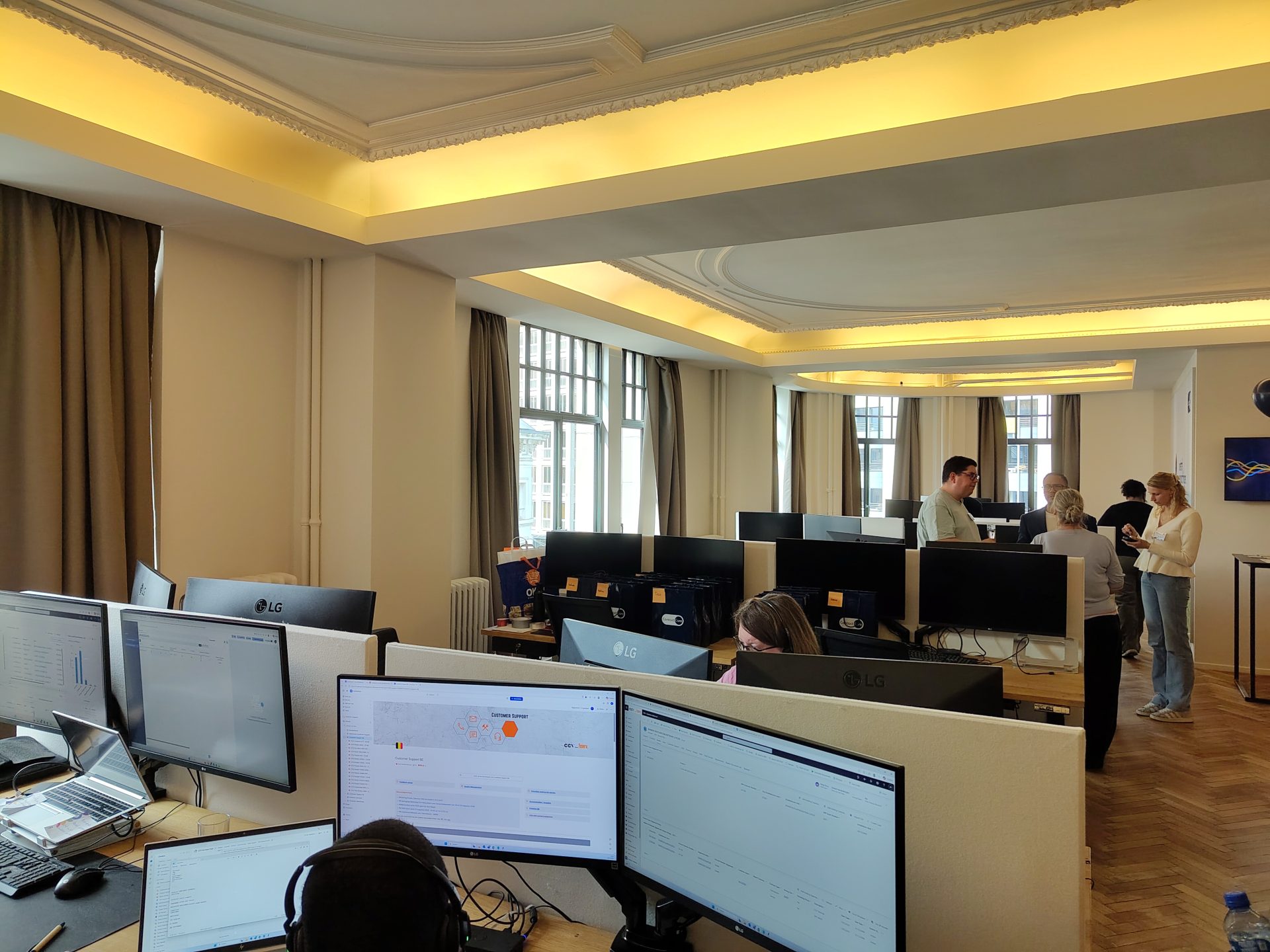 A clear vision underlies the choice of the city center in Antwerp. Employees still want to work in a hybrid manner; the office location, in particular, must contribute to the connection between colleagues and with the employer. According to Meerding, this is an important building block for low absenteeism and turnover, which has a dampening effect on total personnel costs. And anyone walking out of the building can immediately visit dozens of eateries that accept the meal vouchers commonly used in Belgium.
The team at the new location is by definition bilingual. “Customer contact in Belgium is by default Bilingual. For a client like Hans Anders, we handle bilingual customer contact from the Netherlands. For clients from Belgium and France, clients prefer native speakers.
Turbulence in the Belgian customer contact market
The Belgian market for outsourced contact centers has faced considerable turbulence in recent years. The Belgian WEngage (the merger product of IPG and Call-IT) suffered a blow to confidence due to what Meerding calls the “Belgian Chapter 11The Dutch branch of WEngage went bankrupt last year and was subsequently taken over by ContactCare. Also active in Belgium: Yource, which acquired Mifratel years ago and sustained damage at the end of the corona pandemic. TP has been since 2022 active again in Antwerp (TP previously operated from Brussels from 1997 to 2014; that period ended with a closure) and, according to Meerding, successfully. He does not rule out further consolidation of the Belgian BPO market for customer contact, but ContactCare is opting for autonomous growth.
“We focus on a different type of client than what TP serves. We focus on clients who value sitting down with the entrepreneur themselves, or who are not large multinationals themselves. The Belgian market is also undergoing significant changes, partly due to offshoring. Morocco is a popular destination, and AI assists with settlements there as well. The remaining work is more complex. I believe in offshoring, but not for everything.”
Flex has become more expensive
Local labor legislation also plays a major role in sourcing. For years, the Netherlands was a nearshore location for Belgian companies, primarily due to the significantly higher Belgian hourly rates and the flexible Dutch labor market, says Meerding. That flexibility has been drastically reduced in recent years, and furthermore, as an employer, you continue paying for two years during illness, whereas in Belgium it is only thirty days. “That is a huge cost for companies with absenteeism rates sometimes reaching as high as fifteen percent,” says Meerding, adding that absenteeism at ContactCare stands at around four percent.
In the Netherlands, flexibility now comes with a hefty price tag – such as the transition payment. However, precisely for day-to-day operations, costs in Belgium are significantly higher than in the Netherlands. That is why Belgian companies like to outsource frequently to countries such as Morocco, and why the Netherlands is no longer a serious option.
Affordability of Dutch customer contact
 Returning to the KSF vision. Investing in automation and offshoring is not equally feasible for every company. Will high-quality customer contact remain affordable for Dutch companies? “Customer contact is a relatively small part of the economy, but in terms of remuneration, just like hospitality and logistics, it is just above the minimum wage. The level of this wage determines which work remains in the Netherlands. Arrangements in the collective labor agreement, such as the night shift allowance, can cause customer contact work to move abroad. The trade association needs to realize this. At the same time, you want to employ good people, and an allowance can help with that.”
In the longer term, therefore, only the more demanding customer contact work remains in the Netherlands. “Training a class of twenty people and putting them on the line tomorrow simply doesn't exist anymore,” concludes Meerding. “Furthermore, as outsourced contact centers, we must continue to educate our clients: customers don't call for the fun of it. So good processes and automation are essential. But customers also want to be able to reach a company by phone when it is truly necessary. That is part of the customer relationship.”
Morocco and Germany beckon
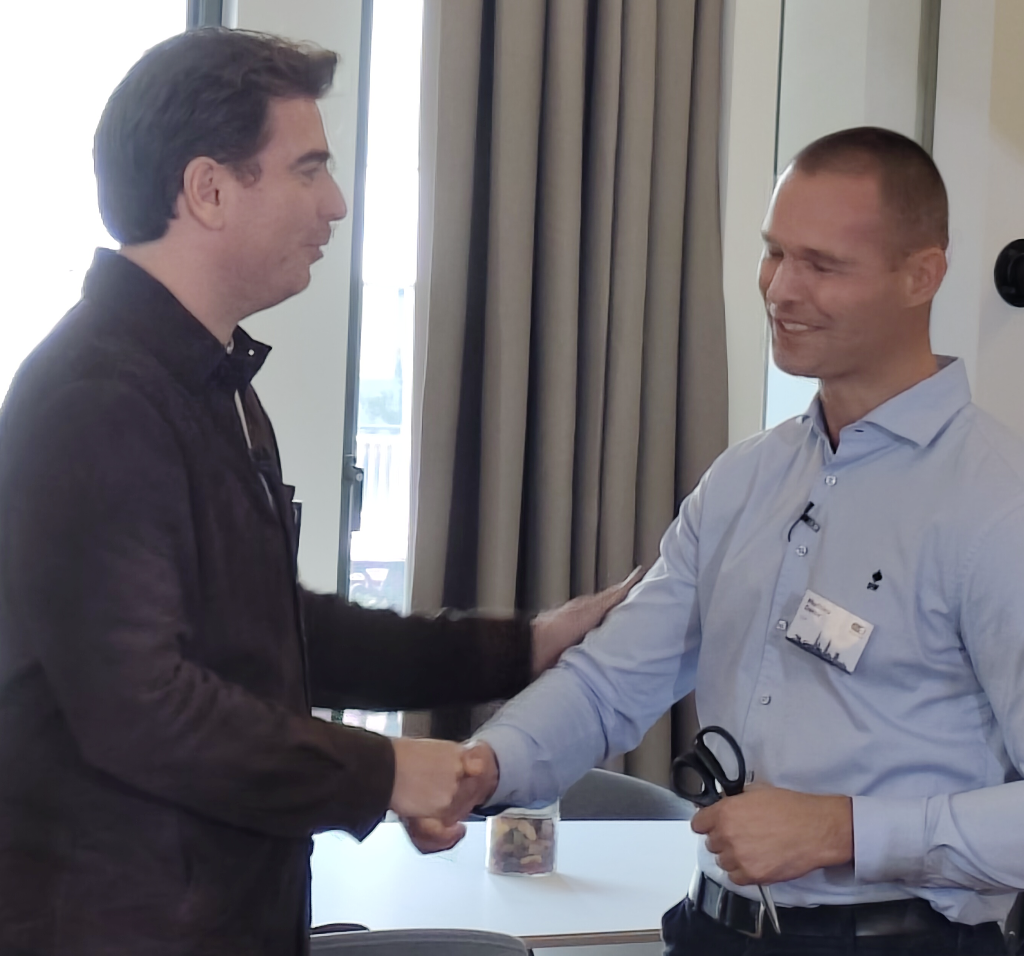
Jasper Meerding (ContactCare, left) and Mathieu Derez (CCV) at the opening of ContactCare Belgium
Finally, ContactCare's strategy. At the opening of the new, smaller office in Amersfoort, Meerding already stated that his company eats itself very gradually. In other words: ContactCare is also transforming into a different type of service provider. Expanding with new capacity in a new country after all: how should we view that? “You have to keep growing; in this business, it’s eat or be eaten,” says Meerding.
He explains: customer contact work can be increasingly automated, meaning your outsourced contact center can theoretically be halved. With downsizing, overhead becomes a heavier burden. “Just think of the investments in ICT. Growth in size is a prerequisite for our transformation. In this regard, we are focusing, among others, on clients among the top three outsourced players who have reduced their number of seats due to automation. These clients are reorienting themselves and are looking for short lines of communication and customer intimacy. Flanders is a large market. We are in discussions with various prospects.”
Morocco and Germany are beckoning for the near future, says Meerding. These destinations are obvious choices because a large proportion of ContactCare's Dutch clients are active in multiple European countries. Consolidating customer contact with a single service provider is therefore more efficient. While the Netherlands and Suriname go hand in hand, Belgium is a good stepping stone for Morocco – particularly Tangier and Casablanca, according to Meerding.
Our clients are also crossing the border themselves.
The Moroccan contact center sector is under pressure: the French have strict telemarketing rules introduced. Outbound parties that want to survive must switch to inbound. This shift may also offer opportunities in the acquisition market. Is Meerding in a hurry? “The move to Morocco won't happen this year,” he says. “We are going to further expand our activities in Belgium first.” But the move to Morocco and Germany won't take years anymore, according to Meerding, “because there is demand for it. Our clients are crossing the border themselves as well.”
(Ziptone/Erik Bouwer)


Also interesting
-
Yesterday, ContactCare's new office in Eindhoven opened. This is the result of the successful acquisition of WEngage…
-

Automation and the shift of work to countries with lower labor costs are cited as reasons for the reorganization.
-

This summer, facilities contact center ContactCare is expanding with a new branch in Antwerp.