
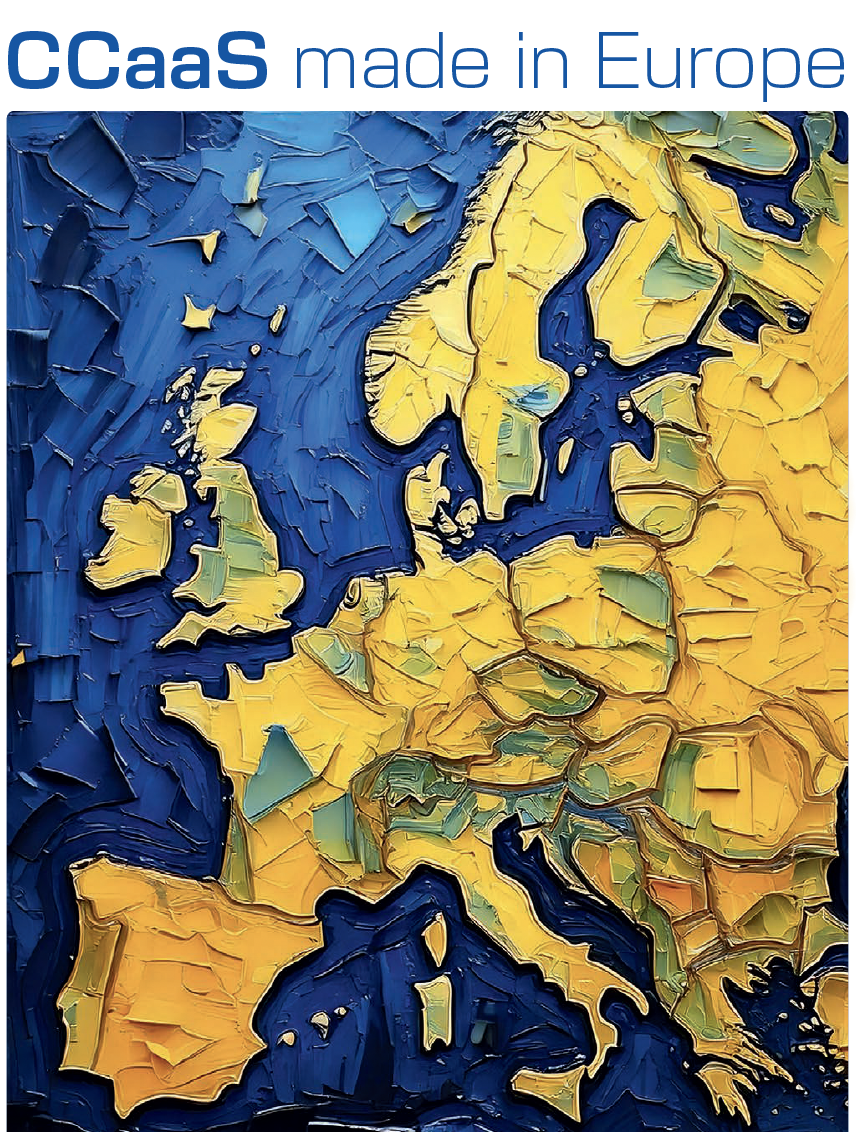
 In recent months, large companies and national governments have come to realize that there are risks associated with using state-of-the-art cloud and software applications from the US. Thinking about a more balanced application landscape would do no harm. Ziptone mapped the European market for contact center software. In this article a preview.
Shaky data protection guarantees, risks surrounding access to hyperscaler services due to US sanctions and vendor lock-in: there are plenty of reasons why companies and governments may reconsider the obvious choice for US technology.
73 providers
The above developments have prompted Ziptone to map out the European market for CCaaS solutions. The comprehensive market overview will be published later this month and includes profiles of 73 European CCaaS providers. Detailed overviews are available for 50 providers with information on functionality, cloud options, governance, certifications and other characteristics of both the company and the solution. It is emphatically not a ranking and the market research is not intended as a buying guide, but as an aid in exploring the market. The report also helps to initiate discussions on the CCaaS issue, both internally and with suppliers. That is why the report also contains a series of additional articles.
The report (148 pages with 51 extended and 22 mini profiles and a series of articles) was released on June 24, 2025 and is freely accessible (download, pdf)The market overview was compiled by the editors of Ziptone in collaboration with Cynthia Mak and Eveline Meijer.
Hardcopy copies (Euro 99,00 each, excl. shipping costs and VAT) can be ordered from Ziptone: info@ziptone.nl.
How is the market structured?
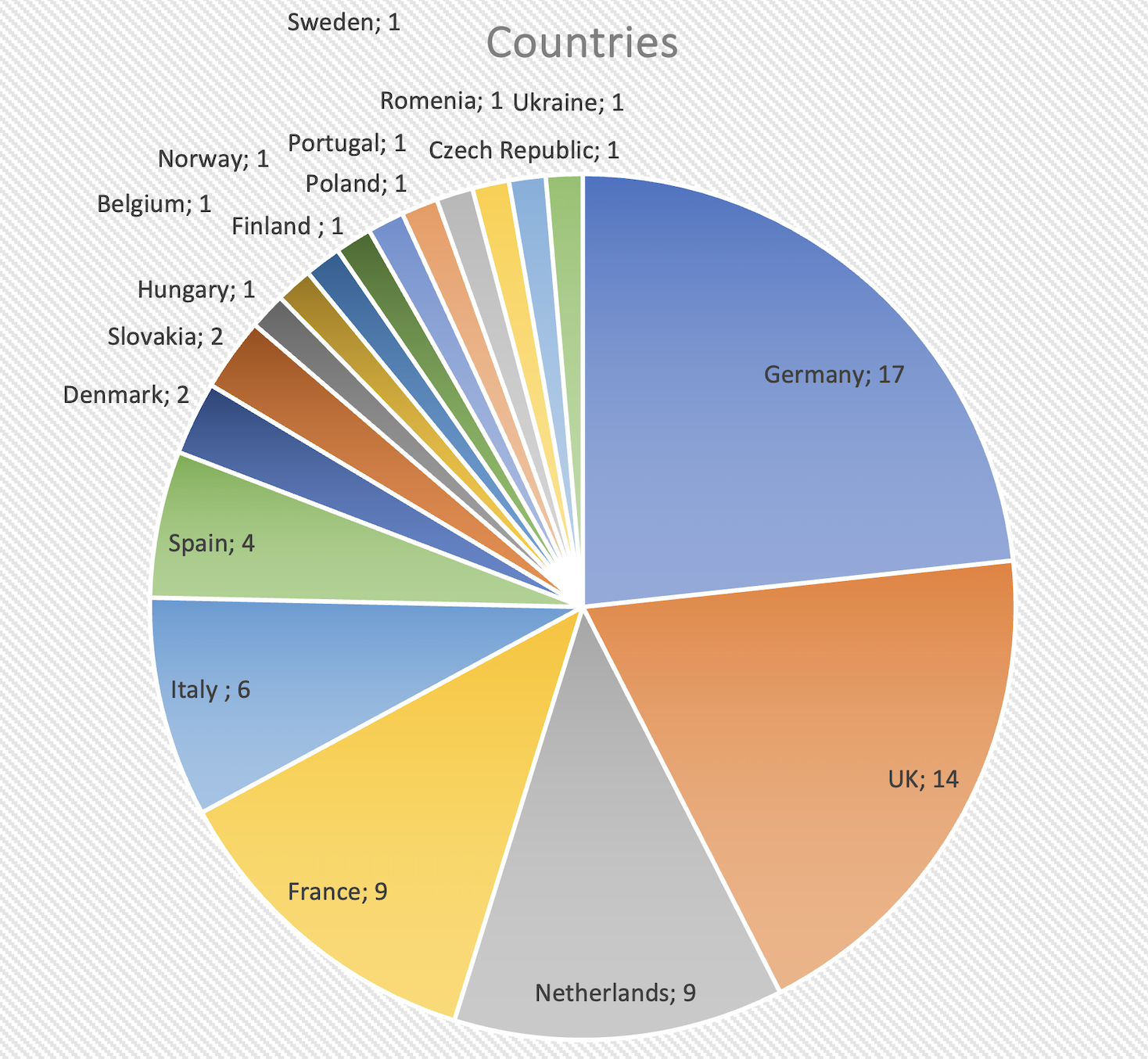
Distribution of CCaaS providers across EU – click to enlarge
The market research also provides insight into how the European CCaaS market operates. For the market research, Ziptone examined more than 80 CCaaS players. A small number were eliminated as 'European' or 'CCaaS provider', for example because providers turned out to be system integrators in reality, or because companies were managed by entities outside the EU or the European Economic Area.
Due to the close cooperation and strong footprint, British CCaaS providers have also been included. As a result, four countries dominate when it comes to the number of different platforms offered: Germany (17 providers), the UK (13 providers), France (9 providers) and the Netherlands (9 providers). Most players offer both public cloud options from hyperscalers (especially AWS and Azure) and private cloud options. In Germany and the Nordics in particular, an on-premise installation is still possible.
AI is almost a must
For the demand side of the market, it is difficult to compare. The supply of CCaaS suppliers is rarely completely transparent. There are only a few suppliers who provide an almost exhaustive overview of the functionalities offered. Some platforms are offered as 'integrated', where the price per user per month is determined by the number of seats. In other cases, suppliers opt for packages where the costs are determined by the functionalities. Some CCaaS solutions are basic, others are very extensive.
On the technology side, we see that almost all vendors provide AI functions for transcription and summarization; if this type of functionality is not yet available, it is often part of the vendor roadmap. It is notable that video calling is far from always a standard contact channel of onmichannel solutions (in 18 of the 50 CCaaS platforms that were examined for functionality).
Difficult to compare
But other important details are also missing from publicly accessible information, which prevents obtaining a complete picture of a provider and/or a solution. For example, information about billing models or rates is often missing, as well as about the data centers used and cloud variants used. More than two-thirds of the parties offer both public and private cloud options, but these are not always specified. Two out of five players allow you to specifically choose European data centers. As far as has been communicated by providers, scaling up is rarely a problem, but less information is provided about scaling down.
Definition issues also play a role. For example, not all providers use the same lingua franca of technology. For example, Secure Real-time Transport Protocol (SRTP) is not comparable to TLS (Transport Layer Security) or HTTPS, but all three are mentioned when you ask providers about end-to-end encryption of calls.
What is the origin of what's under the hood?
It is also wise to ask further questions when it comes to the structure of the solution's technology stack. The precise origin of all those ingredients is rarely clear or traceable. For example, the core engine (the routing engine with an IVR, queues and notifications) can be completely European and run in a European cloud, but additional functionalities can be based on American technology. The latter is particularly obvious for core technologies such as speech recognition and generative AI. The same applies to additional functionalities such as recording, quality monitoring, dialers, scripting, reporting or knowledge management: developed in-house, purchased in Europe, or based on tooling and/or technology from American technology companies.
“We can never catch up with American players”
In the broad discussions about European software, it has sometimes been stated that we are spoiled by the rich and crystallized offering of established players from the US. In contrast, it is then stated that European solutions are often less complete. This picture only applies to a limited extent to CCaaS. Various providers are still busy expanding the functionality (see the roadmap, further on). But there is also a range of providers that can match the 'rich and crystallized' functionalities of American market leaders. Across the board, it is striking that only one in five offers gamification tooling. Incidentally, the following applies to every contact center: which functionality do you really need and are you going to use?
The road map
The inventory also asked players what their roadmap looks like. The most mentioned: agent assist and automated summarization, followed by automated quality monitoring and AI-based reporting and analytics applications. AI-based knowledge management applications are also high on the agenda to be added. Younger and larger platforms are also working on the underlying technology, including improving the interface and composability. Although there is still a lot to be gained in the field of (ISO) certifications, this is hardly mentioned: about a quarter is not ISO 27001 certified. Voice biometrics/fraud prevention is also still in its infancy and is not mentioned on the roadmap by any of the players.
Expected: Turbulence in the CCaaS market
The CCaaS market is busy and full. In addition to the group of European players from this market overview, there is also a group of international players active, probably somewhat larger in size – with an emphasis on the US. With an estimated 150 to 200 CCaaS players worldwide, all moving in roughly the same direction – cloud and AI – consolidation is inevitable and a shake-out is obvious. This market development will most likely also occur in Europe. That is also a reason to always have a plan B ready. What are you going to do if your supplier makes a move that has negative consequences for your organization?
And finally
As mentioned before, this overview is not intended as a 'buyer's guide'. The profiles in this report, together with the articles, form a guide for those who want to start thinking about their own IT landscape and about dependencies and risks. It can be the starting point for drawing up scenarios and explorations. Or, for those who are a bit further along, for getting to know providers who literally or figuratively appear to be around the corner (in Europe). For those looking for real European software, it is essential to search well, ask a lot of questions and request documents, about all facets of both the company and the software.
Thinking about European software is not just about dependencies and risks. There are also great opportunities to stimulate the European economy – also in the field of contact center software.
(Ziptone/editors)


Also interesting
-
Voys Ascend is developed and delivered by the American Intermedia; Voys is the first white label partner in the EMEA region.
-

The European Commission is launching a market survey in connection with the upcoming tender for the Europe Direct Contact Centre (EDCC).
-

Avaya doesn't look back too much, wants to focus on the largest customers and doesn't want to make too much noise...