
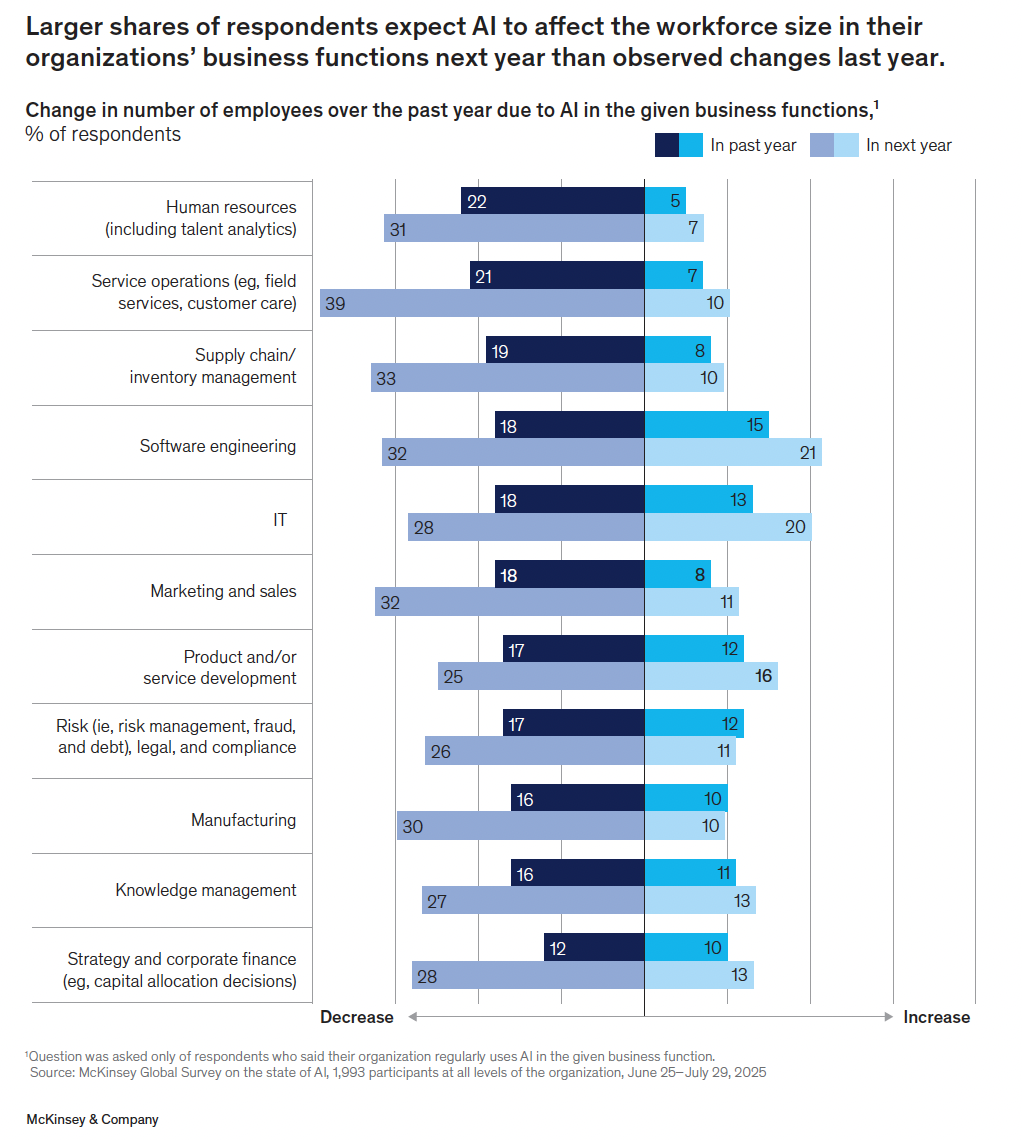
Nearly one in three companies expects to cut jobs next year due to AI, according to McKinsey research. AI's impact on customer service jobs will also increase in the coming year.
Source: McKinsey – click to enlarge
Companies expect AI to have a significantly greater impact on the number of jobs in service operations next year than last year. While 21% of companies expected a decrease and 7% an increase in the number of jobs last year, 39% anticipate a decrease next year. 10% expect an increase in the number of jobs next year.
That is one of the striking conclusions of research agency McKinsey in the report published yesterday 'The State of AI in 2025: Agents, innovation, and transformationThe report clearly shows that AI has been widely adopted in companies. Nearly nine in ten organizations indicate that they already use AI regularly in at least one business function. However, a majority are still in the experimental phase: only a third of the companies surveyed are able to deploy AI on a large scale and in an integrated manner. So-called "AI high performers" in particular stand out because they have redesigned their work processes, use AI not only for cost savings but also for innovation, and have leadership that actively steers value creation with AI.
Customer operations is a notable outlier in the research
Source: McKinsey – click to enlarge
McKinsey examined various business functions, including customer operations, and this business process is an outlier when it comes to estimated job losses for the coming year. Across all business functions, nearly 30 percent of companies expect to cut jobs due to the use of AI. At the same time, McKinsey also found that a larger group of 43 percent of companies expect little or no impact on their workforce as a result of AI implementation next year.
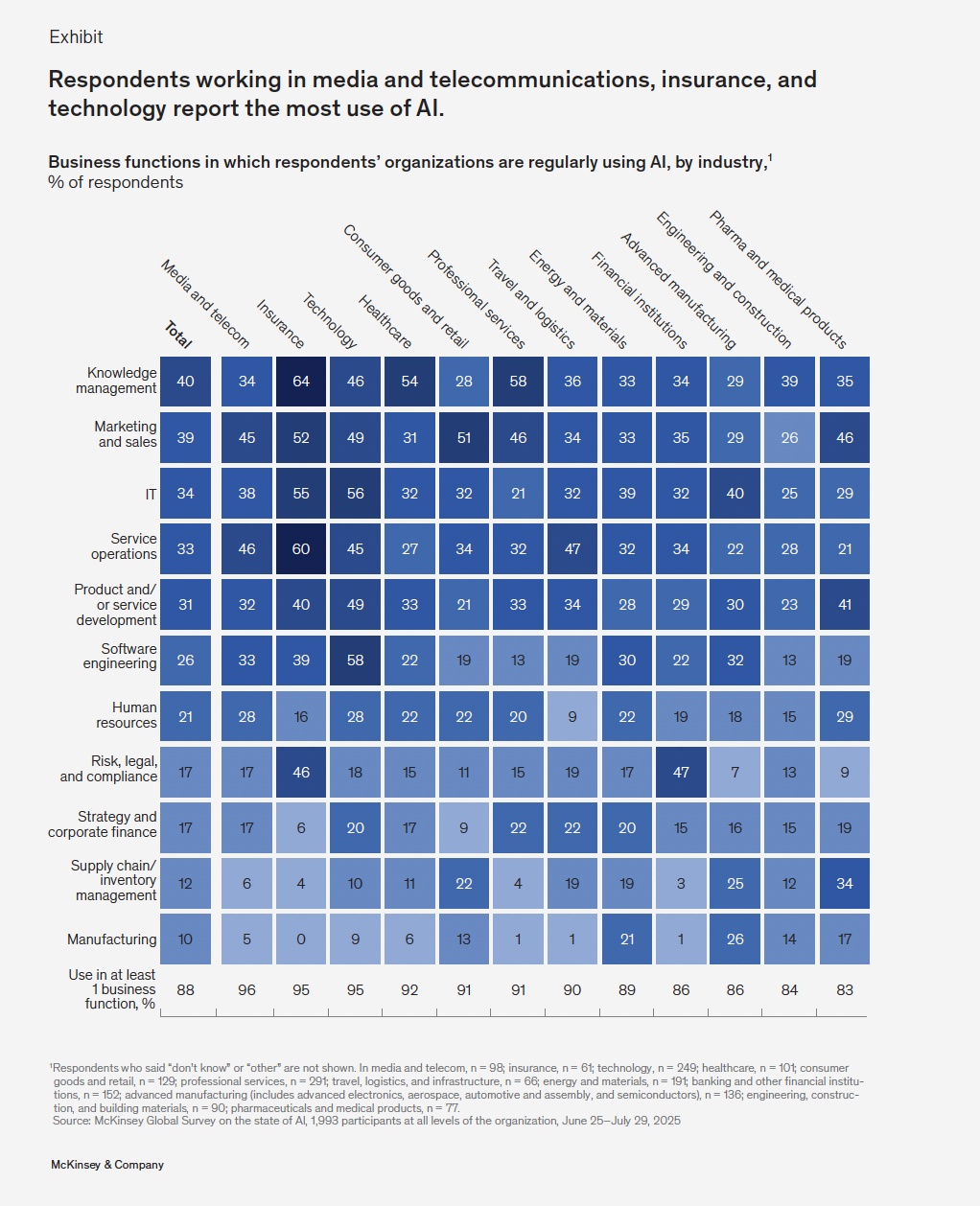
The latest findings show that knowledge management is one of the business functions where AI is used most frequently. Respondents most often indicate that they use AI to capture, process, and deliver information, for example, through a conversational interface; in content support for marketing strategies, including drafting, generating ideas, and presenting knowledge for creating marketing strategies; and in contact center or customer service automation.
Similar to studies published earlier this year, the vast majority of companies have not progressed much beyond the experimental phase or pilot projects when it comes to AI. Three in ten companies are deploying AI on a larger scale. Only 7 percent have fully integrated AI throughout their entire organization, according to McKinsey.
AI agents: popular, but still in the experimental phase
McKinsey also notes a rapid rise in "AI agents." Approximately 62 percent of organizations are experimenting with them, while 39 percent already report a measurable EBIT impact, usually modest. Concerns also exist: half of users say they have experienced at least one negative effect of AI, with inaccuracy and poor explainability being the biggest problems.
About the research – A total of 1.993 respondents from 105 countries participated, representing a wide range of sectors, functions, and organizational levels. Respondents came from both small and large companies: 38% worked at organizations with annual revenues exceeding $1 billion. Responses were weighted by each country's share of global GDP to prevent bias from over- or underrepresentation of certain regions. The questionnaire focused on eleven business functions (such as service operations, marketing & sales, IT, HR, supply chain, and knowledge management) and examined the extent to which organizations are applying, scaling, or experimenting with AI agents. They also asked about the impact of AI on costs, revenue, innovation, customer satisfaction, and employee development, including expectations for the coming year.
(Ziptone/McKinsey)


Also interesting
-

With the rise of AI, not only the simple question but also the simple conversation is disappearing from the work of…
-

More than 50 percent of American jobs will change drastically due to AI. Customer contact work will partially disappear.
-

The recruitment campaign is part of a plan to bring back jobs that were previously located abroad…