
 Accessibility is the most measured and, at the same time, the least understood variable in customer contact. Organizations score well on 'service level' but score low on customer satisfaction. In this article, we explain why this is the case.
This article is part of the accessibility dossier – Last updated: 14 September 2026.
What is accessibility?
KPIs that show green on the manager's dashboard while service delivery is perceived as substandard? Then we are talking about watermelon KPIs: green on the outside, red on the inside.
Availability is not the same as picking up within twenty seconds. Availability is, however, the sum of three things: can the customer find your contact details, is it possible to speak to someone within a short time, and is the problem adequately resolved within a reasonable timeframe.
The watermelon KPI demonstrates that unilaterally measuring an objective rarely makes sense. The service level (an internal measure) only relates to the calls that reach the contact center. A mystery call also measures what happens when the phone number can only be found after four clicks, or what the customer experiences when the IVR's selection menu is inadequate or, conversely, too complicated.
How do you measure accessibility
To adequately measure accessibility, you need four metrics.
1. Service level
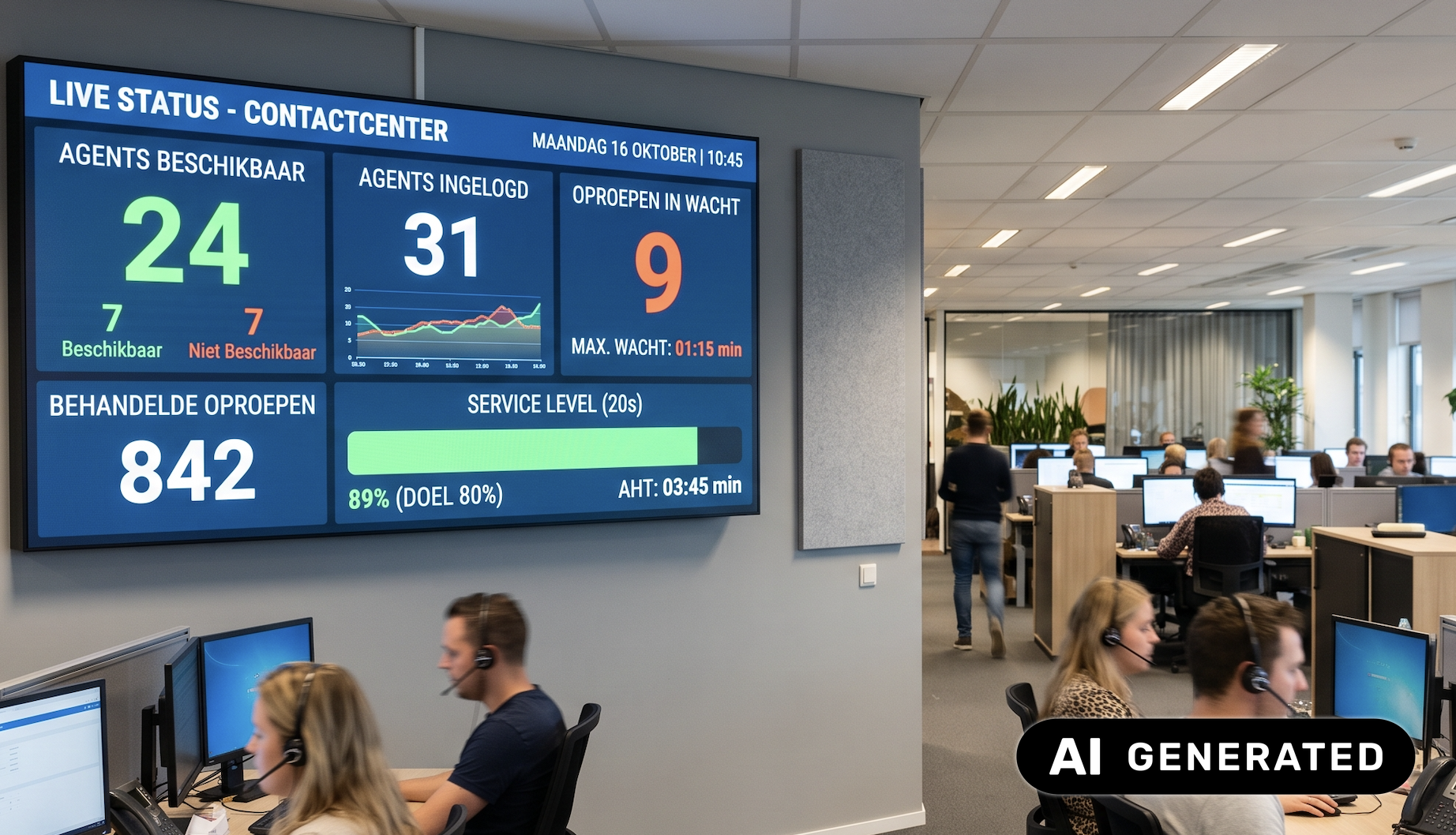
The percentage of calls answered within an agreed time. A commonly used standard is that eighty percent must be answered within twenty seconds. The extent to which you achieve this depends, among other things, on your staffing and the call duration. The service level is therefore primarily useful for the WFM team, but says little about the substantive quality of service. It does, however, say something about the waiting time for the customer. Read more about the service level
2. Abandonment rate
The percentage of callers who hang up before an agent answers. As far as Ziptone is concerned, it is a good indication of possible repeat trafficThis is the fairest measure of accessibility you have in-house, because it cannot be flattered by keeping calls on hold for longer.
3. First call resolution (FCR)
First call resolution is the ultimate measure of your customer service effectiveness. It is a pretty good indicator of customer satisfaction: is my problem solved correctly the first time? Underlying this are various other factors, such as well-trained employees, good call routing, employee expertise, fast systems that provide good support such as good knowledge management, et cetera. When you fall short on several of these aspects, the number of dissatisfied customers and the number of repeat calls increase (see point 4).
A high rate of first call resolution is also cost-effective: the customer is helped faster and better (and will therefore be less likely to leave), and you need fewer employees to help all your customers. Paradoxically, improving FCR is often easier than accurately measuring FCR. Read more about the benefits of first call resolution.
4. Repeat traffic
The customer who calls for the third time about the same problem appears in your statistics as three neatly answered calls. But here too, there is something else behind it. Measuring repeat traffic is the way to work on first call resolution, but measuring it is more complicated than measuring technical reachability, simply because repeat traffic can spread across different channels. A range of approaches and strategies is available to reduce repeat traffic. Read: Ten tips for tackling repeat traffic
Why your service level can be good while your accessibility is poor
The service level is a metric that looks from the moment the caller reaches the queue. Everything that preceded that does not count. Think of searching for answers in FAQs, communicating with a chatbot, looking for a phone number, and even communicating with a voicebot. Such a voicebot can already 'send away' the call – before it enters a queue – by referring to the website or sending a link to the customer. None of this counts towards your service level. Customers who hang up very quickly are also often omitted from the figures. Conversely, average daily figures can effectively mask the fact that things go wrong at certain times. An average waiting time of three minutes can mean that a third of your customers waited twenty minutes. Therefore, it is preferable to review the service level on an interval basis: where was it not met and what was going on at that time? In many contact centers, the service level drops at the start of the day and during the lunch break.
Why maximum accessibility is extra expensive
Accessibility is at its core a queuing problem, and the Erlang C-formula still forms the basis for calculating the required staffing. As you further optimize that staffing, costs rise without a proportionally large improvement in accessibility to offset them. In other words: shortening the waiting time from 20 seconds (equivalent to ringing three times) to five seconds costs extra people, but the question is what you gain from that.
Conversely, cutting back on staffing can lead to waiting times that are no longer acceptable to customers, causing them to leave.
In practice, organizations frequently choose not to increase staffing levels in response to accessibility problems, but rather to temporarily lower the standard or discourage making phone calls – also known as call deflection.
Accessibility is also a legal obligation
While accessibility was a strategic choice in recent decades, it has been regulated by law on an increasing number of points in recent years. Energy suppliers in the Netherlands must be reachable by email and telephone, and this information must be easy to find.
In Belgium, since January 1, 2026, suppliers must be reachable by telephone and email on weekdays between 9 a.m. and 5 p.m., including a callback button for digital contracts. Additionally, the Digital Services Act stipulates that intermediary services may not be accessible exclusively via a chatbot. The European Accessibility Act sets requirements for accessible contact channels.
Moreover, companies whose accessibility leads to complaints over extended periods nowadays appear on the radar of the ACM and the Consumers' Association. Ensuring good accessibility is therefore also a matter of enlightened self-interest.
Accessibility is almost always part of research into service quality.
Ensuring good accessibility is not a given for all organizations. From time to time, it becomes a problem. For consumers, waiting time has been number one for years. irritation listsThe Customer Service Federation counters that the majority of customers are attended to within a reasonable time, and calls for clarity and transparency about your availability.
What AI can mean for accessibility
A voicebot can handle a portion of your customer contact (24/7 and without a queue) and route calls to an agent or another solution. When an AI-based portal intercepts 40% of all calls, the remaining 60% generally become more complex. Consequently, the average call duration increases. With potentially fewer agents and a longer AHT, the flexibility of the contact center decreases and susceptibility to peaks increases. When bots start handling a portion of contacts, you need to re-evaluate how you measure repeat traffic.
The resolving power of bots is often overestimated and is different from containment.
Get started on better accessibility tomorrow?
Anyone wishing to improve accessibility must start by measuring. Also, have an external expert conduct measurements and compare internal and external key performance indicators. Only then can you proceed in a targeted manner with analyses, improvement plans, and repeat measurements. Monitoring accessibility is an ongoing process.
Want to know more about accessibility? Consult the comprehensive file on this topic.
(Ziptone/editors)


Also interesting
-
What legal requirements apply to the accessibility of your customer service in the Netherlands, and who supervises this?
-

An analysis by Parloa shows that 43,3 percent of the surveyed companies do not offer a clearly visible phone number or chat function.
-
Many webshops do not take legal obligations regarding digital accessibility seriously, according to research commissioned by…