
 In 2033 it is self-evident that we will be able to communicate with most animals. What does that mean for customer contact volumes, your customer contact strategy, and the design of CRM systems within contact centers?
There are many more animals than people on this planet. In the Netherlands alone we have approximately 12 million pigs, approximately 1,7 million cows, more than one and a half million dogs and approximately four million cats. The latter two groups are expected to be able to communicate with humans and vice versa within a few decades; each in their own language. Obviously, AI has an important role to play here.
Whale sounds
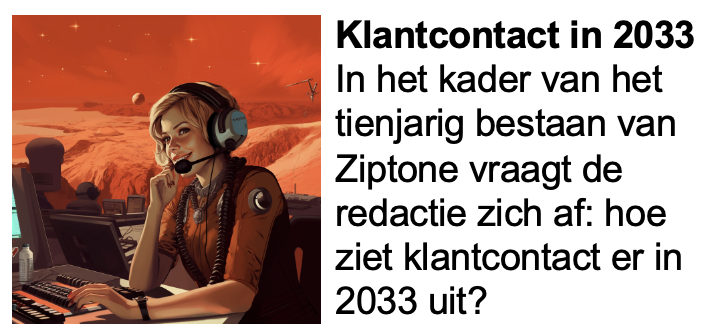 Scientists have been working for some time to create a database of animal sounds. Although pigs are relatively smart animals, they are specialists Earth Species Project (ESP) started collecting whale sounds. The non-profit organization wants to make two-way communication between people and animals possible - and this also significantly increases the communication options between animals. The first results are expected in 30 years, but we all know by now that AI can sometimes make a huge sprint. That's why it's already important for customer contact professionals to think about what happens when pets can contact the customer via AI customer service.
For the time being, ESP researchers assume that animals do not use complex language (with sentences, words, expressions, etc.), but mainly communicate through their behavior and body language. Everything that is visible and audible will have to be linked to behavior in order to unravel patterns and provide them with meaning. But once we are able to decipher the language of animals with the help of AI, this would mean a revolution – also in the world of customer service and customer contact.
FAQs: why does my animal do this?
Being able to communicate directly with pets means that their questions and problems become clearer faster. It may burden pet owners with more responsibilities and tasks, but it also makes visits to the pet store and vet a lot easier.
While dog and cat owners still scour the web asking 'why does my dog/cat do this' or 'what can you do if your cat/dog...' (fill in something clumsy, unpleasant or mysterious), they can now simply consult a specialist together with their pet and start the conversation together. When pets are given the opportunity to explicitly define their needs and preferences, it provides opportunities for animal-focused loyalty and feedback programs.
It is certain that as soon as animals and people can communicate with each other, the animals will quickly understand how companies respond to their preferences and wishes. And marketing can get started with new customer groups, both in the CRM system and in the campaigns. Business to Animal (B2A) is becoming the new B2C.
Animals in the call flow
If customer contact employees can talk directly to animals, the contact center manager can prepare for the arrival of additional teams in the department. Consideration will have to be given to animal recognition at the start of the call flow, to routing based on barking and meowing and to recorded messages and notification texts. As researchers manage to decipher more animal languages, the call flow becomes more and more complex. What about sheep, goats and horses, a group of almost two million animals? And does a Saudi racehorse neigh differently than a Frisian?
The new option also raises questions: what are the rights and obligations of animals, can animals also order things via online web shops or telephone lines, will animals soon have their own mobile phone, and who actually owns the data that animals make available? to companies: their own or their owners? And, not unimportantly, do almost extinct animals get priority in the queue? (Ziptone/editors)


Also interesting
-
Bol still sees opportunities to grow in the Benelux and is opting to broaden its platform services.
-

Following an extensive investigation by the ACM into the functioning of the e-commerce platform, bol will implement improvements. These also affect…
-

De Bijenkorf reports a potential data breach resulting from a security incident at a logistics partner of De Bijenkorf.