
If you are creating a customer journey map without involving customers, you are doing nothing more than drawing a process map. That is something fundamentally different from being concerned with the customer experience, says Arne van Weenen. And not entirely off-topic: an office dog can help.
 “Personally, I continue to find it remarkable that companies are willing to spend millions on managing customer contact, but do not want to take the trouble to prevent unwanted customer interactions.” That says Arne van Vienna, in daily life working as a customer experience strategist at asr and chairman of the KSF expert group CX. All the more reason for an interview; Van Weenen speaks in a personal capacity.
Van Weenen responded with his statement to an article on Frankwatching about the meaning of AI for customer contactThe first question that comes to mind is what the difference is between 'managing away customer contact' and 'preventing unwanted interactions'.
What is 'managing away' customer contact? “I understand 'managing away' customer contact to mean that you make it more difficult for customers to get in touch and at the same time you do not address the root causes of that need to get in touch. As far as I am concerned, companies should first look for the reason why customers seek contact. No one calls their insurer as a pastime. The cause often lies in things that an organization does that the customer does not expect; or in things that an organization does not do while the customer did expect something.”
Channel control can cause irritation
But even when companies are doing a good job of eliminating contact reasons, companies often send you to the web, the FAQs and the self-service environment first. Increasingly, the next stop is the chatbot to ask for the phone number. Once in the IVR or queue, you are told that you can also look at the website.
“That last one is really annoying,” says Van Weenen. “Most companies use channel management and not all customers are happy with that. I don’t want to be managed, but I do want to be helped. It’s fine to show what the response times are for different channels. Then the customer can choose for themselves. Management goes much further: companies usually don’t report anything and simply turn off a channel. I have something to say about that, although as a company you can make different choices for different groups of customers. But in any case: with drastic management you are still managing away customer contact to a certain extent.”
How many customers does the CX manager speak to?
Van Weenen knows that there are companies (and CX managers) that hardly ever talk to customers or hardly do any customer research. He has no clear explanation. Maybe CX managers find it exciting to approach customers, maybe it is laziness. “How do you do your job then? I have the impression that it is also sometimes held back by the business. Because doing customer research – for example prior to implementing a change – easily costs an extra six weeks. Discussing a change thoroughly in advance is often the most common within the organization. A final point is that CX managers may find their domain very important, but there is a lack of commitment from management.”
Process plate
“If you are creating a customer journey map without involving customers, you are doing nothing more than drawing a process diagram. I fear that is often the case. You are then looking at the steps that you take as an organisation. And it will often be real missionary work: as a CX'er, shouting in the wilderness until someone hears you. If you are in a cubicle with team managers as a CX'er, they find it super important; as soon as they are out of the cubicle, they are swallowed up by the madness of the day. Four weeks later they offer their apologies for the fact that they did not get around to what they were supposed to find out for you.”
Part of the solution is to ask customers more often about how they experienced the process behind their customer question, says Van Weenen. “Agents sometimes say 'I get a low score from the customer; not because of the conversation, but because of the entire process'. Separate conversation and process. For a customer, a process is often relatively simple: think of submitting an invoice and then receiving money. They don't care that this process is spread over multiple teams.”
Terminator on the line? Agent lowers voice
As a customer, you may experience that not all processes are equally popular with CX managers. Think of processing a cancellation or complaining about poor service. That cancellation is certainly part of CX, says Van Weenen. “In almost no sector is a cancellation an 'end game'. A pleasant cancellation process increases the chance that your customer will come back later, that is what research I have done shows. The cancellation is very important.” In practice, Van Weenen sees, for example, that employees who receive a canceling employee on the phone lower their voice and lose their empathy, enthusiasm and energy. “Anyone who experiences that as a customer will never come back.”
Does the CX professional really care about the real pain points in the customer journey or should the cheapest solution – think of the chatbot – ultimately be chosen? Where, for example, is the CX resistance movement that takes action against bad chatbots? Van Weenen: “There isn’t one. I do see resistance here and there. But sometimes colleagues don’t have enough power to stand their ground: no chatbot here. By the way, I am personally not against chatbots, on the contrary, the new generation of chatbots will do much better. But you do have to test them, and preferably first on your own employees – for example via an application such as agent assist. And if you make the switch to 'customer facing' at a later stage, you really have to redevelop your bot. Because the language of the customer is different from that of an employee: it is full of jargon.”
Pick your battles
Van Weenen fears that the influence of CX managers is generally too limited. “Companies want to do something with CX and CX managers then throw themselves into measurements, analyses and tools. But I think there is too little attention for difficult choices. On the one hand, that is a bad thing: how can you dump a chatbot on customers that does not work? Look at the results from the National Voice Monitor and you know enough – with the exceptions, but there are not many. On the other hand, CX managers sometimes also face the challenge of 'choose your battle'. It is your job to signal and name things. If you have done that, you have already been successful in a certain way. If management decides otherwise? On to the next project! I had to learn that too, because I had the tendency to keep nagging. However, there is enough to do and to realize.”
Gurus on the mat
Van Weenen would like to say something about the CX gurus: the people who talk a lot about CX, but no longer work in it on a daily basis, as Van Weenen describes them. He does not want to criticize them too much – he lists them – because of course they offer vision, inspiration and Van Weenen himself is also inspired by them. But: “They may have acquired their operational knowledge ten or fifteen years ago and now proclaim 'the truth'. For example, that you should definitely start from a strategy and roadmaps or get started with tooling. There is a chance that if you listen to this too much, you will set up all sorts of things and then nothing will happen. I prefer to say: start somewhere, start small, just experiment, be civilly disobedient, start with an Excel sheet. Purchasing CX tooling or fully developing a strategy is not necessary to make an impact. Start asking 'stupid' questions, listen, and continue talking.”
Starting Small and the Benefits of an Office Dog
 Starting small sounds appealing. But isn’t it a requirement for CX managers to have a vision of what good customer contact is? “Knowing how a contact center works in detail can be very helpful. At the same time: if you don’t have that insight, you can still ask ‘dumb’ questions about processes. Why do we do it this way? I also consider myself the boss of asking stupid questions. Does this make sense? Should we continue doing it this way? Healthy curiosity is important.”
Then a completely different question. We as customer contact experts have the data, the tools and the process maps, so the customer really can't fool us anymore. What can an office dog add to the human dimension in customer contact?
“An office dog softens people. When you are busy petting or cuddling an office dog – that is not the intention with an assistance dog – you can suddenly have different conversations with people. Topics that seemed unmentionable come within reach. An office dog can really help companies.” (Ziptone/Erik Bouwer)


Also interesting
-

The KSF is getting to work on a national chatbot improvement plan. Ziptone is launching the research into chatbot performance one last time…
-
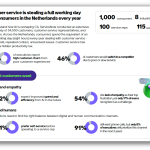
Dutch consumers spend an average of eight hours annually on customer service: waiting, calling back, problems that are not resolved.
-
If no one answers, customers get – even if unintentionally – the impression that the company or brand…