
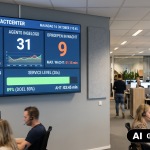
 It's 11 a.m., Wednesday morning. It is still quiet in the control room of the Animal Ambulance Amsterdam at the end of the Middenweg in Watergraafsmeer. The volunteers have taken 33 calls since midnight, the 3cx wallboard shows. Every year, the control room makes about 50.000 telephone calls about animals in distress. Part 11 in the series of unusual contact centers.
Text and image: Laurie Treffers
De Animal Ambulance Amsterdam is led by director and director Margje de Jong. De Jong has been working for the organization since 2016, which consists of 14 paid employees and 164 volunteers. Both the control room and the ambulances are manned by volunteers. The organization has three main goals: to promote animal welfare in Amsterdam and the surrounding area, to support owners and bystanders when animals get into trouble, and to guarantee a healthy city for animals and people alike. De Jong: “We are the eyes and ears of the health services when it comes to animals. For example, the Animal Ambulance is the first point of contact for reports of diseases that pose a threat to public health, such as bird flu and rabies.”
Marge de Jong has been working as a director/manager at Dierenambulance Amsterdam since 2016, where she is responsible for the financial and substantive improvement of the organization. Before that, she worked for five years as a manager for Blij Groep, an organization that works for victims of domestic violence. For Blij Groep, she was responsible for all services related to serious domestic violence in Amsterdam. Before De Jong plunged into the NGO sector, she worked in the commercial world.
An animal ambulance departs every forty minutes
In her office above the control room, De Jong says that a third of the budget of the Animal Ambulance Amsterdam consists of municipal subsidies. A third comes from donors. The last part of the budget is obtained through activities that the Animal Ambulance carries out on request. For fixed rates, someone who has difficulty walking can call the Animal Ambulance, for example, if a pet needs to be taken to the vet urgently. The organization has six ambulances at its disposal. Three ambulances drive daily in the summer and two in the winter. On average, an ambulance leaves every forty minutes. In 2022, the Animal Ambulance Amsterdam turned out 13.194 times for animals in need.
But, De Jong emphasizes, the Animal Ambulance also carries out activities that people are usually unaware of. As part of the Amsterdam-Amstelland Security Region, the Animal Ambulance helps in case of calamities, such as disasters and fire. The organization also helped transfer and monitor pets taken by Ukrainian refugees when Russia invaded the country in the spring of 2022. “Ukraine is a high risk country for rabies. We coordinate in such a situation that all pets are checked by a vet.”
Staffed 24/7 by volunteers
Bedding hangs to dry over the railing of the stairs from the management office to the control room. “Every night a volunteer sleeps in the bedroom next to the control room, so we have a lot of laundry, as you can see.” The control room is available 24 hours a day, seven days a week, attainable on 020 – 626 21 21. The control room is called an average of 139 times a day. In 2022, the volunteers made a total of 48.965 telephone calls. About thirty volunteer dispatchers take turns. During the day two volunteers are ready to help callers, at night one volunteer is present. “That's quite complicated: just find volunteers who want to work at night. Knock on the door, but so far we are succeeding.”
 “Everything comes together in the control room”
The volunteers in the control room have all kinds of backgrounds and ages. Some have been working there for 25 years, others for a few months. They have one thing in common: a great affinity for animals. All volunteers are trained internally, says de Jong. “As a dispatcher in the control room, you have to be at home in many markets. It's quite a complicated function. Everything comes together in the control room: you must be able to speak to people who are in complete panic. You will be called in all kinds of languages. You must be able to provide people with advice, including first aid advice. You must be able to set priorities and direct ambulances. And you have to be able to talk on the phone with all kinds of chain partners, such as veterinarians, Rijkswaterstaat, the police, but also, for example, bailiffs if animals have to be evacuated from a home. As a volunteer at the animal ambulance, you have to be firmly in your shoes.”
The control room employees are not only trained to watch for signs of animal abuse. For example, there is a strong correlation between animal abuse and domestic violence. “By establishing that an animal may be being abused, you can sometimes also force help in a family where violence is taking place. We have a so-called care form that our volunteers fill out if they have a 'gut feeling', as we call it. About fifty times a year we report this to the authorities that deal with this.”
Expectation management
Emotions can run high on the phone. “We explicitly train our volunteers on how to conduct bad news conversations. Sometimes you have to call someone that their pet has been killed by a car. And sometimes you get people on the phone whose animals have just been confiscated by the police. In situations like that, we transport the animals and people call our control room to get a story.”
Customer contact is sometimes difficult because callers do not realize that they are being helped by volunteers. “Citizens expect a level of service that you are used to from the regular ambulance or fire brigade. But you sometimes have to deal with the limitations of volunteers: sometimes the stress of our volunteers also increases. The control room also often receives angry calls from people wondering where the animal ambulance is, but if there is a traffic jam, we are stuck in traffic. As an animal ambulance, we are not a priority vehicle: we have to comply with the traffic rules just like everyone else.”
But, says De Jong: “We get few complaints. Of the 50.000 telephone calls last year, we had 24 complaints. If you explain to people that they are dealing with a volunteer organization, you often see that the sting is gone. Our volunteers want to help, perhaps even more than in a paid job. That does not alter the fact that we always try to improve the training and take complaints on board.”
Animal Ambulance Administration System
The control room works with the DAS system: the Animal Ambulance Administration System. “Until 2021 we worked with our own system. But we've had that since 2011 and it hasn't been updated since. DAS was written by a former volunteer who is an ICT specialist and has worked at various animal ambulances. He was annoyed by the fact that the majority of organizations did their administration in Excel. He said: 'Yes, that is not quite up to date anymore.' So he has developed a nice system that is made available for a very reasonable amount.”
Introducing DAS in 2021 was quite a challenge in the organization, says De Jong. “Because we have many volunteers who often only work a few hours a week, it was difficult to practice with the new system. We had to train all those people internally to work with the new system. It takes time."
The entire organization now works with DAS. “The control room registers the report on the computer and then the ambulance employee sees on his tablet where he or she has to drive to. On location, the ambulance employee creates an animal form in the same system. The bookkeeper also has immediate access to link payments.” DAS is used by more than 20 other animal ambulances in the Netherlands. The system can be linked to other systems, such as the system that many animal shelters work with. In this way, information about an animal can be exchanged quickly.
Challenges for the future
 Like many other volunteer organizations, De Jong sees attracting and retaining volunteers as the biggest challenge for the future. “The throughput is quite high, because people are more likely to give up their voluntary work than their paid job. We are always recruiting and training.”
Another challenge is accessibility via other channels. Currently, the emergency room of the Animal Ambulance Amsterdam can only be reached by telephone. “I think that real telephone calls will become less and less and that people will contact us through other channels, such as chatting or texting. We will have to prepare our volunteers for that. That's a challenge when people are used to sitting next to the phone. We are still holding back on that. Also because we notice that, just like with 112, it is easier to ask questions on the phone.”
De Jong also foresees that animal ambulances will collaborate more regionally in the future. “We are a very professional animal ambulance, but in the rest of North Holland you see that animal ambulances only have a control room for a limited number of hours. People answer the phone in the car outside office hours. That is of course sub-optimal. We are investigating whether we can organize a regional control room in the future. That is quite a challenge: you have to understand how each region works and all work with the same system.” (Ziptone/Laurie Treffers)


Also interesting
-

The accessibility of the 'non-emergency, but police' number 0900-8844 has deteriorated in recent years.
-

The series of unusual contact centers is about customer contact professionals who provide (fast) assistance.
-
Accessibility is the most measured and at the same time the least understood variable in customer contact. Why is that?