
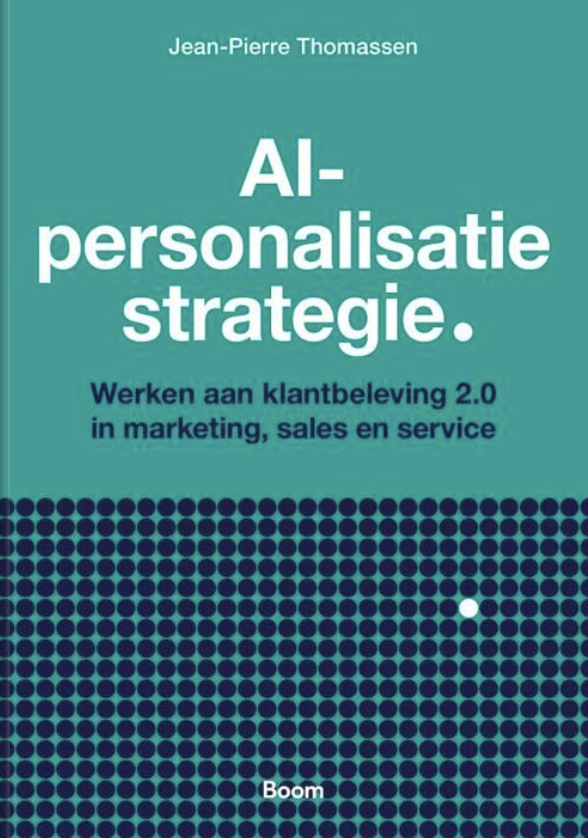
 AI should offer excellent opportunities to further personalize customer service, among other things. Jean-Pierre Thomassen wrote a book about it. The question remains whether AI personalization is successful and leads to more customers or more satisfied customers. Perhaps we need to be a little more patient for the answer.
With an original educational background in hospitality (Hotel School The Hague, an institute), it is a big step for Jean-Pierre Thomassen to enter the world of AI—where the paint is barely dry, so to speak. Especially when you consider the promise of this book: (AI) personalization in marketing, sales, and service. A glance through the table of contents immediately reveals practical examples—that's promising. In fact, a separate section of the book is specifically dedicated to service applications.
Thomassen is a versatile professional: active as a consultant, author of a considerable number of books, lecturer at various institutions including the University of Groningen and Beeckestijn Business School, and founder of the Service Excellence Institute.
AI personalization
Despite the risks of "cold relationships due to increasing digitalization," Thomassen sees excellent opportunities to use AI to build warm relationships with customers. Three-quarters of companies use AI to personalize the customer experience, according to research from Genesys he cites. Such a finding raises the question of whether personalization has been successful everywhere—and for whom, if so, has it benefited. You can expect the answers to these kinds of questions in this book, "AI Personalization Strategy."
In his book, Thomassen explicitly focuses on AI personalization (with an emphasis on AI), which he defines as the structured collection of data from individual customers to develop customer profiles based on this data. These profiles, in turn, form the basis for service delivery in which recognition, appreciation, customization, and flexibility are central. Digitization hasn't led to personalized customer service over the past 20 to 30 years, let alone improved performance or profitability, he says. "Face-to-face contact at counters and the use of call centers have been massively replaced by chatbots and other forms of self-help."
How great is the need for a personal touch?
Those call centers (sorry, that old term) have definitely shrunk in relative terms. But is it a given that customers want a personal touch? At the beginning of the book, Thomassen overlooks the fact that the need for personal contact is almost always context-dependent. Millions of users are happy with Spotify, but do they also expect personal contact? Perhaps only when something goes terribly wrong with their credit card charge or when they suffer the consequences of a data breach at the streaming service.
Only after page 27 does the author promise to address the AI aspect of personalization. Incidentally, Spotify returns in the chapter "Personalization in E-commerce," with AI-based personalized customer recommendations as its success driver.
Thomassen believes AI's potential for personalization lies in five areas: analytics and predictions, content analysis and creation, natural language processing, bots as virtual contacts, and agents that coordinate and execute tasks. Remarkably, "In many cases, the use of AI doesn't lead to entirely new personalization possibilities," says Thomassen, who then adds that hyper-personalization based on N=1 is indeed possible. This is confusing, because with the latter, the potential actually seems quite substantial.
More time for real contact
Thomassen also points out that, because AI takes over all sorts of routine tasks, employees would have more time for truly special and emotional customer contacts (for customers). This is a common misconception, because that possibility already existed before, without AI. The risk is that this opportunity for truly personal contact will be further limited by cost pressure, a persistent phenomenon in contact centers. Or, as Thomassen explains further, citing research: management is eager to significantly increase the use of AI, but cost reduction is the most important argument.
AI personalization in customer service
The Ziptone editors were naturally more than interested in how this book presented the applications of AI personalization in service. The takeaways: bots are increasingly taking over frontline tasks, AI can drastically simplify the work of agents (and make it more efficient and enjoyable); and both customers and employees determine whether the deployment of AI is successful—errors are not tolerated. In this chapter, Thomassen also cites Jan van Ginkel, who advocates for AI-free zones, where "humanity is needed." Unfortunately, how to determine in advance whether the use of AI is desirable or undesirable isn't discussed, but it is a key point of discussion in the field—and a strategic issue par excellence. What kind of brand do you want to be?
Interesting case: VodafoneZiggo
The book extensively discusses, among other things, the case of VodafoneZiggo, where 3.000 customer service representatives lacked a complete customer profile, resulting in high AHT for half a million calls per month. In 2024, the telecom company implemented a system where employees were presented with an AI-generated summary of the customer context at the beginning of the call, tailored to the identified customer's intent. This is a great example of personalization. It makes conversations more efficient and enjoyable for both customer and employee.
In addition, the company has deployed agent assist (in this case, offering relevant content for the dialogue), and conversation summaries are generated by AI. The idea is also to shorten the onboarding time in the near future, according to Thomassen, who mentions in passing that VodafoneZiggo briefly had an AI-based chatbot live. However, it was shut down due to quality issues, raising questions about the precise negative impact on the customer experience and how the bot was intended to provide greater personalization.
Cost savings are also a benefit
Ultimately, AI will do more work, and VodafoneZiggo's customer service will be smaller, according to the book. Is that the strategy? AI apparently didn't prevent VodafoneZiggo from losing large numbers of customers and seeing its profits plummet in 2024 and 2025. On the other hand, even in that unfortunate scenario, cost savings through AI are, of course, a bonus.
In subsequent chapters, Thomassen presents various forms of customer contact: in addition to reactive and inbound, he also addresses proactive outbound (with United Airlines as the most significant and telling example) and the use of agentic systems. Agentic AI is supposed to be the icing on the cake of personalized service, but it's still too early for that, even for this book: it's highlighted as promising for personalized service.
The book then briefly addresses implementation issues that are somewhat unrelated to AI. Incidentally, quite a few analytics applications are still categorized under marketing, and it's questionable whether they even belong there, since customer service is precisely where knowledge of processes and customer context resides.
Who sets the lines?
What should we make of this book? Marketing, sales, and service are approached separately, which is beneficial for readers with a clear blood type. What it contains is partly a snapshot – the technology is developing rapidly – and partly valuable in terms of the proven applications presented. At least, proven for the board or possibly for the employees; whether companies have seen their revenue or profit increase with their AI initiatives is rarely addressed. The strategic embedding is particularly lacking in the section on customer service. Is AI an essential tool for cost leadership or customer intimacy? Or is AI part of your IT strategy? Who sets the tone and who leads the way?
Whether marketers will find this book new to read is difficult to judge for the Ziptone editors, but they will certainly find plenty of food for thought. Any customer contact professional who attends two or three events and keeps up-to-date with professional literature on GenAI and agentic AI can skip this book. Unless you think your sales or marketing department is lagging behind, or if you feel you still don't know enough about personalization in marketing, sales, and service.
(Ziptone/Erik Bouwer)
AI personalization strategyWorking on customer experience 2.0 in marketing, sales, and service. Published by Boom, 2025.


Also interesting
-

Ranzijn promises: after reading this book, you'll be eager to help dissatisfied customers. For the service…
-
"AI Will Replace You" reads largely like an AI cookbook or an AI textbook. The most important part is about scaling.
-

Oliver Talens wrote a book about collaborating with AI. Or as he puts it: “About making choices. About daring to say: here…”