
A new table is circulating online listing professions vulnerable to AI. The table originates from a scientific paper by Microsoft researchers. The research shows that customer service roles are particularly well-suited for AI support.
Even Geen Stijl covered it, but failed to explain which party conducted the research. The new figures come from researchers affiliated with Microsoft Research and based on 200.000 anonymized conversations with Bing Copilot across a range of professions and roles.
The results show that tasks such as gathering information, writing, and communicating are currently being supported or taken over by AI. Roles that focus on advising, providing explanations, and answering customer questions are found to be above average sensitive to AI assistance. However, AI can also perform some tasks independently.
To what extent can AI be successfully applied in which professions?
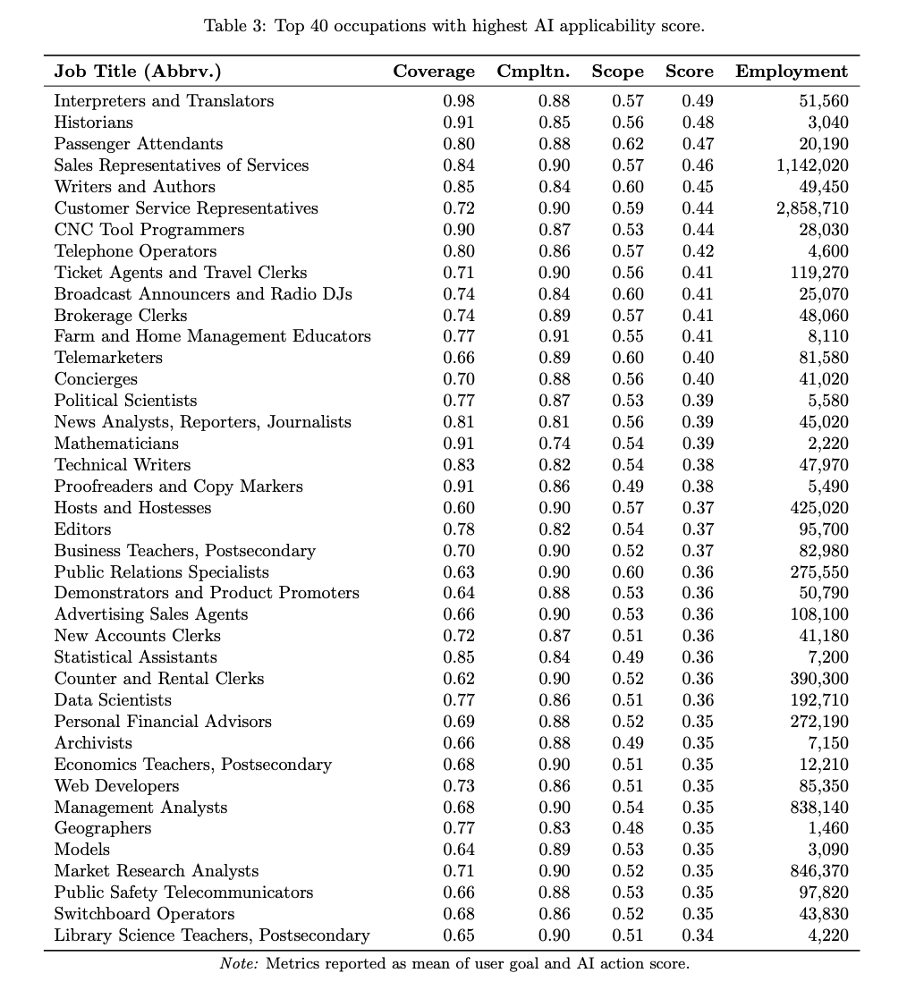
Each conversation was classified based on the work activity the user sought assistance with ('user goal') and the task the AI performed ('AI action'). These activities were linked to job profiles from the O*NET database, an American standard model for labor market data. The researchers then calculated an 'AI applicability score' for each occupation. This score is based on how often AI is used for work activities within that occupation; how successfully AI supports or performs those activities; and to what extent the AI covers a broad range of the activity. (text continues after image below)
Source: Microsoft Research
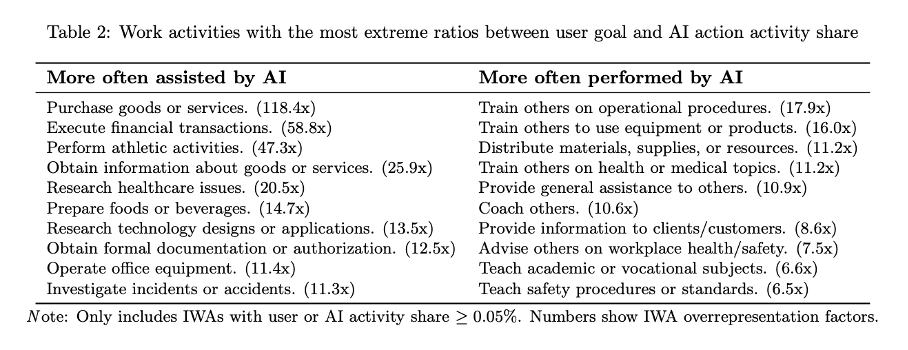
The researchers found that there is overlap between the activities performed by employees and the AI. The study revealed that in 40% of conversations, the user's activity differs from that of the AI. For example, while the user is busy gathering information, the AI primarily provides explanations or advice. In only 4% of cases do the AI action and user request fully overlap. Generally, the AI provides more advice and instructions, while the employee focuses more on gathering information, reading, and researching. AI is also well-suited to perform activities related to training, coaching, teaching, and advising.
The top 40 is relevant for customer contact professionals
The professions with the highest AI applicability scores are primarily found in knowledge-based professions. Many customer-contact-related professions also score surprisingly high. The top 40 include:
- Customer service representatives
- Sales representatives
- Telemarketers
- Ticket agents and travel clerks
- Concierges
- telephone operators
Source: Microsoft Research
These professions focus on conveying information, customer-focused communication, and answering questions, and these are precisely the areas where generative AI is now performing well. Activities with physical or interpersonal characteristics, such as physically assisting customers or preparing products, are difficult for AI to handle and score poorly.
These results show that GenAI is currently primarily an assistant that complements the work of the customer contact employee rather than fully automating it, but also that AI is eminently suitable for performing a number of tasks independently.
The researchers emphasize that the results are a snapshot. However, they state that the analysis based on Bing Copilot indicates that professions that focus on providing information to customers are most affected by AI.


Also interesting
-

Amelia was originally a solution from IPsoft. That company was a pioneer (and ahead of its time) in 1998 with…
-

Sudden fear that technology like AI will take your job? You might be suffering from Kasparov syndrome. The good news:…
-

With the acquisition of Echo AI, Calabrio strengthens its CX intelligence and agent performance coaching offerings.