
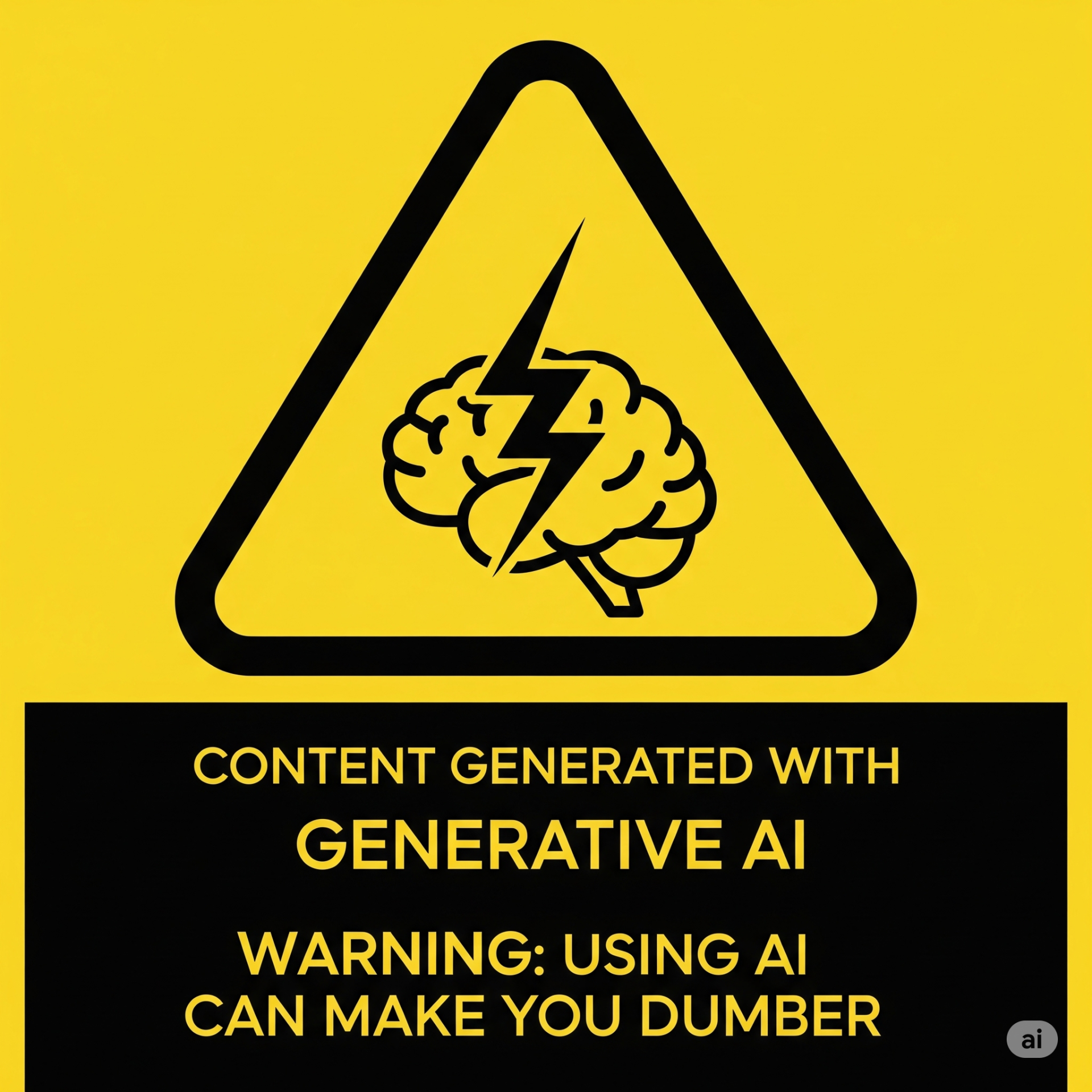
Image: Gemini – AI
Let me just get straight to the point: AI makes us dumber. At least, when we use AI first and only then engage our own brains. This is the conclusion of an MIT study.
Text: Charlotte Meindersma
Our cognitive skills, such as remembering and summarizing, decline when we let AI do most of the work and only afterward do we assess what AI has actually done for us. Conversely, the effect is much smaller, according to the researchSo if we think for ourselves first and do the most substantive work ourselves and then use AI, our cognitive skills will decline much less.
Using AI to brainstorm, to better formulate or structure texts, to speed up or optimize your work is fine, as long as you don't let it do all the thinking.
You need to label AI content
By the way, did you know that content created (primarily) with AI must also be labeled as such? Just as you have to tell people when they're interacting with an AI chatbot, you also have to tell them when they're looking at an AI-generated image or listening to hold music created with AI. If it's art, work created for enjoyment, then the AI mention shouldn't hinder the enjoyment too much. Of course, you might wonder how enjoyable hold music is, so mentioning it can't hurt there. With online images and videos, it can usually just be placed in small letters underneath.
There's an exception for text if it's been edited or reviewed by humans. And therein lies a small risk.
Human customer service, with AI
Because if you want to maintain human contact and have therefore chosen customer service by phone or email, for example, the temptation is very strong to have AI generate answers and then have humans communicate them. After all, let's face it; it likely results in more personalized responses, advice, and solutions than the standard text models that customer service often has to use now.
That's certainly a positive development, so we should definitely take advantage of it. But are customer service representatives sufficiently equipped to assess whether the AI response is actually appropriate? Aren't they promising something that might be technically feasible, but doesn't fall within the company's policy?
Of course, you need to ensure everything is technically sound. Use databases with the correct information, ensure that information is clean, and configure the system properly. But that takes time, there will likely be some initial kinks, and it will never be completely flawless.
Training employees differently
So employees still need proper training. Especially if it's different. The systems are becoming easier. And perhaps AI will be better at analyzing customer questions or problems initially, and thus formulating a more accurate answer than an employee could have simply found the right block of text. Therefore, employees need to have more substantive knowledge, or at least a good understanding of the boundaries of internal policies, so they can properly assess the AI answers.
After all, everything a customer service representative says or promises, the company is bound by it. Many AI answers can sound logical or reasonable and still be incorrect. Such an incorrect answer can have serious consequences, cost a lot of money, and damage your reputation. You don't want that.
AI literacy: mandatory
Therefore, carefully assess the opportunities and risks, how the systems can be configured effectively, and what employees need to know to work best with the AI answers. Sound familiar? That might well be. Because, in reality, you're not just protecting the company's interests here; you're also empowering customer service employees. AI-literate for their position. That's another legal point you can check off.
(Ziptone/Charlotte Meindersma)


Also interesting
-
Of course, if AI takes over our computers, phones, and lives, something unexpectedly goes wrong. Who is…
-

Communications specialist Renata Verloop is appalled by the reactions to poor chatbots at municipalities. For example, the VNG calls the chatbots 'not yet…
-

The upcoming edition of Conversational Conference will focus on how organizations can make automated customer contact work well.