
 The debate about "AI is eating our jobs" has gained new momentum. Last week, Professor Henk Volberda (University of Amsterdam) made headlines by confidently stating that 8% of jobs will be lost due to AI. He made this statement in response to the round of layoffs at ABN AMRO.
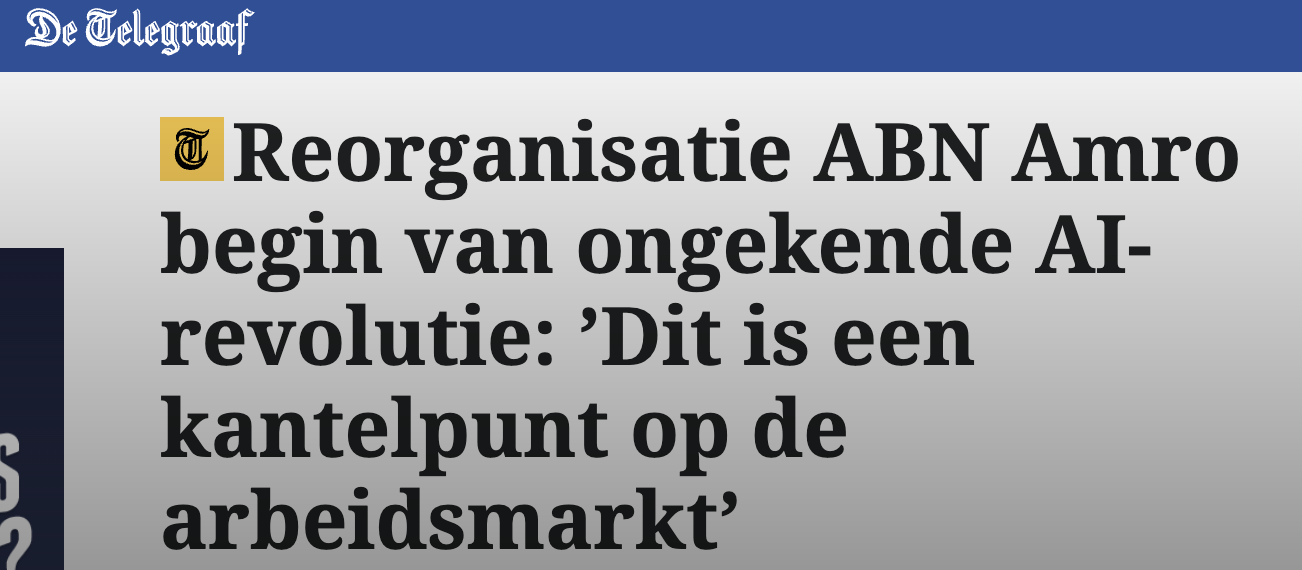
Volberda mentioned the customer service representative's work as something that could be "replaced" by a chatbot. "And translators and copywriters are no longer needed. AI can do that too," according to the AD newspaper, which did its utmost to imitate the Telegraaf newspaper. That newspaper said the reorganization at ABN AMRO the beginning of “unprecedented AI revolution: 'This is a tipping point in the labor market'”.
It fits well into the current social discourse to go completely overboard. The reality is that AI is still being used increasingly, particularly in customer contact.
There are several reasons for this. Companies view customer contact as a cost center, and the most important design principle of contact centers is efficiency. For years, contact center managers have been using all sorts of technologies to cut costs: through call deflection (allowing customers to resolve issues themselves, for example, via self-service), by focusing on efficient conversations, and through automation.
Good math
To some extent, all these interventions are successful, and generative AI also holds great promise. Many companies can calculate the potential savings by implementing agent assist, automated summarization, and automated quality monitoring.
Critics argue that the usefulness of these automated summaries is questionable (what agent would read the entire story on a subsequent call?) and that the savings are sometimes fictitious because nothing was summarized at all to begin with. Moreover, the use of real-time transcription, which is the basis for real-time agent assistance, is relatively expensive.
That may all be true, but contact centers are good with numbers, and there are more and more news reports about layoffs. A tight labor market? That's not only old news, it's also no longer an argument. Contact centers are mainly concerned with price of labor.
Who will do the unhappy flow?
Meanwhile, the rise of generative AI in customer contact continues Just by And we haven't even considered the potential of agentic AI. At the same time, we also know that even if AI does take over some of customer contact, it primarily affects the happy flow. This only increases the significance of the unhappy flow, both for the company and for the customer. There's even a risk that the contact center will be thrown back in time: that's the department you end up in as a customer when you're super frustrated and angry. Just like in the old days, when we hadn't yet invented CX and were still making things complicated for the customer. If we're not careful, contact centers will be transported back to the 'dark ages,' and that fits perfectly with the times.
Future skills and future employment conditions
Until now, contact center managers have been beating around the bush. If you truly want to help customers escape the unhappy flow, you have to invest in customer service representatives. This upgrade is currently being sought in "future skills," a mishmash of "learning to work with AI" and "making a difference." But when it comes to "future employment conditions," the conclusion is increasingly: more offshoring, more automation, and fewer people.
(Ziptone/Erik Bouwer)


Also interesting
-

Sudden fear that technology like AI will take your job? You might be suffering from Kasparov syndrome. The good news:…
-
This book is about AI agents: software that can perform tasks independently. Will customer contact also have to deal with this? The answer…
-

Premature deployment of GenAI chatbots and virtual agents for customer contact will lead to increased consumer skepticism, according to Forrester.