
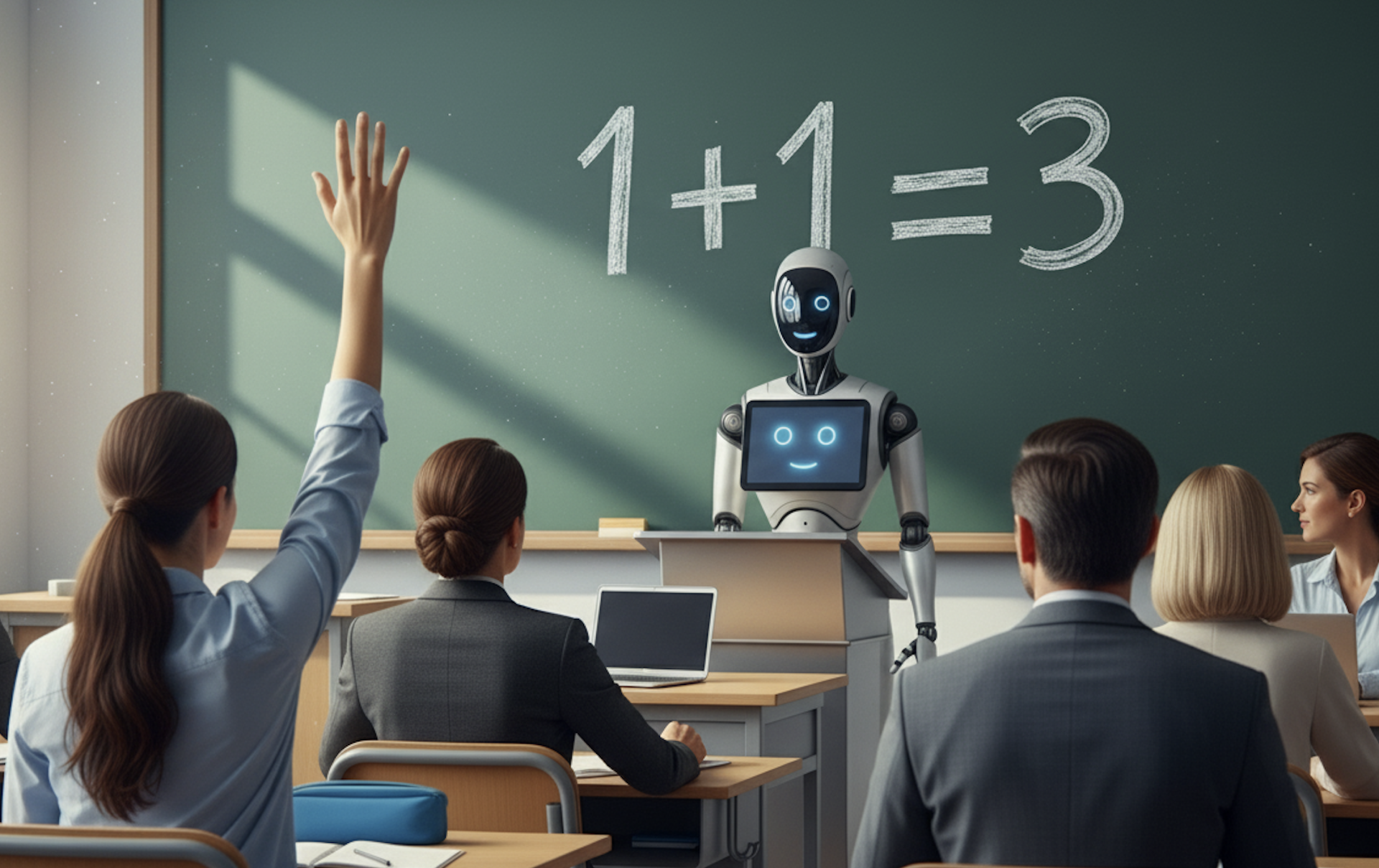
Image: ChatGPT/AI
What skills do you need as a customer service representative to work effectively with AI applications? Experts believe it's more than just a dose of empathy.
In brief:
- Customer contact work is changing due to the use of AI tools
- AI tools seem easy to use, but experts also see risks and points of concern
- AI use requires, among other things, critical assessment skills
More and more contact centers deploy AI applicationsFor example, to automatically summarize conversations, provide agents with suggestions during customer conversations, or even compose an email. Employee coaching is also increasingly being automated. Chatbots and other tools are also being used to automatically handle simple customer queries. Employees may soon also encounter AI agents that can perform tasks independently, with or without a human customer service representative "in the loop."
How will the rise of these kinds of AI applications change the work of customer service representatives? And what does this mean for the current or future skillset of customer service representatives and for training programs?
1. How does work change through the use of AI?
Researchers at TNO warn that the use of GenAI can negatively impact the quality of work. For example, the use of AI can reduce informal learning within teams, giving new employees fewer opportunities to develop. Moreover, there's a risk that employees will adopt the knowledge provided by AI without truly understanding it. Because AI takes over the active acquisition of knowledge or the conscious execution of administrative tasks, skills like in-depth procedural knowledge and reporting fade more into the background. The loss of simple customer contact—necessary for learning the trade—is another problem, which also affects other sectors are noted.
At the same time, there is increasing emphasis on communication and analytical skills and solving complex customer questions, according to TNO, which also warns about the disappearance of rest periods for employees. when automation is taken too far.
Side effects of AI in customer contact
The idea, of course, is that after implementing AI tools, customer contact processes will be faster, better, and more efficient. But that's not the obvious or only outcome.
Sander Hesselink, principal consultant at Coniche, argues that using AI can make people lazy in some ways. From real-time conversation suggestions and next-best-actions to automated summaries: depending on the software, you can simply "ignore" or "accept" AI suggestions. Helping customers and training AI tools are often the same thing in many applications. This means an agent-assist solution can make a mistake that the agent accepts; or an agent can incorrectly modify the agent-assist solution's contribution. In both cases, the AI solution is further trained with incorrect information.
"To what extent is it traceable how the agent's response was generated? Which part of the answer originated from which source?" Assessing the quality of customer contact is becoming more complex anyway, Hesselink emphasizes. And, in his view, the use of AI tools is especially important for agents working from home, who may use their own AI agent in their work. An automated summary can also include follow-up actions, which can increase the impact of inaccuracies.
In addition to a lack of accuracy, completeness, timeliness and relevance of dialogue suggestions, agent assist tools can also lead to other problems, researchers found based on a small sample. Real-time transcription, the basis for dialogue support, among other things, can freeze or stutter when there are changes in languages, accents, and dialects. Many applications struggle to interpret phone numbers and addresses. This means agents need to implement workarounds, according to the researchers. This is also the case if the AI-generated output doesn't comply with internal policies or regulations. Under high workloads, agents can find inappropriate next-best-action suggestions irritating and distract them from listening.
Responsibility for the end result
According to Hesselink, customer service representatives shouldn't be able to hide behind AI output. "Future skills," he believes, are about the intrinsic motivation to do well for the customer – and anyone who wants to properly support employees in this area should also be given the appropriate authority.
Although not directly mentioned by the experts Ziptone spoke with, AI may also bring new security risks to the "call floor." Social engineering is considered the biggest human-related risk in cybersecurity by 80% of organizations, according to the SANS Institute Security Awareness Report. The rise of artificial intelligence amplifies this threat, which increases the risk of human error. And there are growing concerns about who responsible is for negative or even disastrous consequences of various AI applications – a discussion that is still not held enough in customer contact land.
The work of agents is changing fundamentally
“AI is fundamentally changing customer contact,” says Caroline de Oliveira Marreiros From trainer Ocaro. "Simple questions disappear, but what remains becomes more difficult. It's not just about the content, but also about the emotional burden: customers have a 'short fuse,' for example, when a chatbot fails."
Also Lisney Platteeuw (educationalist at Lirin) believes that if employees are presented with relatively more complex conversations, their work will become more demanding. "The workday will look different. Besides practicing these complex conversations, partly with a focus on resilience, you'll have to make this clear upfront."
It is a given that employees are faced with relatively more complex questions because simple customer contacts can be automated, Tinne Van den Broeck, customer success director at Orion. But just as importantly, the customer contacting us has often already used AI to find a solution. "Previously, that customer had to go through their My Account, browse the FAQs, and try out the chatbot—all tedious steps for customers. That's no longer necessary. They ask Google a question and get an answer in the form of Google AI Overviews."
Van den Broeck says there's a good chance that the AI summary will also incorporate tips and experiences from customer forums: for example, "this is a bad organization" or "they offer poor service here"—whether justified or not. It's not inconceivable that Google will include information in the AI summary that will ultimately complicate the conversation between agent and customer. "Customers are becoming really smart and critical now."
Even simple conversations keep happening
At water company Dunea, employees are still asked simple questions in addition to complex ones, according to Robert Duijvestin, Customer Service Manager. For example, because customers struggle with language, with online transactions, because they need confirmation, or because they find it easy and convenient to call. Improving service and preventing unnecessary contact is now higher on Dunea's agenda than the large-scale introduction of AI or customer contact automation. Customers will definitely use AI themselves, according to Duijvestijn. This can lead to both good and bad results – the chance that customers will come to you with incorrect information or already "well" prepared with possible answers or solutions will certainly increase. Therefore, Duijvestijn expects that analytical skills will become even more important for customer service employees.
Quality problem in the knowledge base
Van den Broeck also points out another problem that can result in unusable output, which can, in turn, confuse the employee. Knowledge bases are designed with the employee as the end user. They can easily manage with general work instructions formulated literally, such as "the customer can arrange this themselves in the My Environment." Such a generic phrase could appear in all sorts of places in the knowledge base. "For an AI application, that generic phrase is actually a problem; the phrase is no longer linked to a specific question or problem. All these kinds of formulations need to be rewritten: for example, "the customer can easily arrange an increase in an invoice amount themselves."
2. Future skills: what do employees need to make AI work well?
AI influences the information available to employees and customers. It's up to customer service representatives to be extra vigilant. That's why, according to Hesselink, sound judgment—think of recognizing inaccurate or processing contradictory information—is one of the future skills. This judgment, in addition to making your own interpretation of the customer conversation, also forms the basis for being able (and allowed) to adjust AI tools. To what extent should all employees be involved in this adjustment?
Is information worded correctly and appropriately?
Judgment is also an essential skill for Duijvestijn. "An automated email can appear very empathetic and beautifully worded, but what's the question behind it? For the non-standard questions, does everything in it really make sense in relation to the customer information and history, and does it come across well?"
With more AI-based customer contact, the role and added value of the employee becomes more important, especially when a customer gets stuck in the AI-based customer journey. "It's not wise to have the employee repeat what a chatbot has said before, for example. The employee must also be able to accurately interpret the past. And precisely because human assistance must be more comprehensive than what an automated system can do, it requires appropriate responsibilities and authorization." Duijvestijn also points to the relationship between customer and company: there too, a human can add more value than a bot—but in that case, the employee shouldn't act like a bot. Duijvestijn believes AI certainly offers opportunities, but when digitizing customer contact, attention to 'humanization' is just as important.
Blindly accepting something is a risk
"It's a fallacy to think you can blindly adopt everything AI comes up with," says Platteeuw. She also believes that skills such as critical thinking, analysis, and problem-solving will become more important for employees in all sectors.
De Oliveira is adamant: for customer service representatives, the introduction of AI means increased pressure because—especially initially—they also have to assess the AI's output. "If you're not sharp enough, things won't go a little wrong, they can go terribly wrong." This is where complacency lurks: if agents quickly click "agree," not only do their own sharpness and judgment deteriorate, but systems are also less effectively trained. In De Oliveira's view, critical thinking and accuracy are just as important as customer curiosity and empathy. The question is where maintaining that sharpness should fall—on the employee or on the leadership?
Think more instead of less
Van den Broeck also expects that customer service representatives will have to think more, rather than less. "The representative will have to work even more intensively on steps like analysis, assessment, and problem-solving. "The agent actually needs to delve deeper, but also to understand the AI tool well. Because it produces output that isn't always 100% accurate." According to Van den Broeck, this also means that employees need to be more stress-resistant and flexible – because the end customer comes with all sorts of self-discovered information that may need to be corrected.
Working with AI tools in combination with a relatively higher proportion of complex conversations, one could conclude, forces contact centers to take a closer look at the employee experience.
3. What does this mean for training programs?
Experts believe that introducing AI into customer contact won't lead to shorter training times. "A few months ago, we might have thought training could be shortened because AI would suggest answers that the agent could simply read out," says Van den Broeck. "I think we definitely need to move away from that idea. As an agent, you'll still need to have a basic understanding of many things, so that, combined with common sense, you can recognize the wrong suggestions."
Platteeuw also believes it's unlikely that the rise of AI will lead to shorter training programs. "They'll likely have to be expanded."
Embedding AI in your training
At Coniche, knowledge of AI is already incorporated into all courses, says Hesselink. This primarily focuses on understanding how AI works, rather than on specific skills. For example, the AI module for WFM doesn't yet include exercises like "analyze and optimize your forecast with a good prompt." But that seems only a matter of time.
Platteeuw, who, as a colleague of Hesselink's from Lirin, is working on embedding AI literacy in various training courses and programs, points to the regulations: "Since February of this year, companies working with AI have been required to train their employees in AI." According to Platteeuw, this also includes raising awareness of the sustainability issue of AI. Are departments aware of the amount of energy and water AI requires? "That could contribute to the choices contact centers make—or perhaps even individual employees: when do you put AI to work? What are the costs of arriving at a quick answer?"
In the search for the question of what qualities employees need to use AI effectively, research by the EdTech company Multiverse 13 core skills forward, divided into three domains. The most important:
- Cognitive skills: analytical reasoning to analyze AI output, creativity to push the boundaries of AI, and systems thinking to recognize patterns in performance;
- Responsible AI skills: ethical understanding, attention to bias and cultural sensitivity;
- Self-management: self-regulated learning, adaptability, curiosity, and detail-orientedness.
According to Gary Eimerman, chief learning officer at Multiverse, leaders view AI as a technological challenge, while it's primarily a human challenge. "Without analytical reasoning, creativity, and the right culture, AI investments will remain underutilized."
Common sense
Van den Broeck agrees that there are plenty of reasons to adapt basic training for customer service representatives. "But even more important is that common sense and analytical skills—including critically assessing AI output—are up to par. Employees will have to learn how to review results instead of simply copying and pasting. This also applies to understanding how AI works, how knowledge bases are structured, and the intricacies of, for example, outdated knowledge."
Van den Broeck estimates that with the increasing pressure on customer service representatives, it's becoming even more important for managers to coach on the invisible aspects of employee behavior. "One contributing factor is that many companies are actually finding it easier to meet their SLAs and KPIs by using AI. So they won't be turning AI off anymore. I do think contact centers need to pay attention to the breathing room. The majority of stressors for agents are the invisible part of the iceberg."
“Don't be blinded by tools”
Platteeuw: "Tools are constantly evolving, and they're constantly evolving. I think adaptability is a key future skill: employees will need regular training in the coming years. Part of this is also engaging in dialogue, for example, between employees who feel threatened by AI and—as I call them—naive adopters who adopt things without much thought. This topic, also part of AI literacy, shouldn't be limited to e-learning alone, but should be integrated into a blended format, allowing for meaningful dialogue."
(Ziptone/Erik Bouwer)


Also interesting
-

Sudden fear that technology like AI will take your job? You might be suffering from Kasparov syndrome. The good news:…
-

Will the human touch disappear as we further automate customer contact, or will technology actually make it possible to provide real customer service?
-
This book is about AI agents: software that can perform tasks independently. Will customer contact also have to deal with this? The answer…