
 With the introduction of ‘Operator’ by OpenAI (and similar AI agents that can act autonomously), companies may be on the cusp of a major change in customer interactions. What does it mean when customer service starts dealing with AI agents that act on behalf of real-life customers?
Imagine: you wake up in the morning and see a confirmation email in your mailbox: your AI agent has booked ten days on Bonaire on your behalf via Booking.com during the night. That seemed like a good idea, but now that you are awake, you realize that you also have to go to a conference during the chosen period. Your AI agent could have known that, because it knows exactly what you want, but also has access to your agenda. What do you do: do you put your AI agent to work to rebook or cancel the holiday and if so, do you do that with voice or text? Or do you contact Booking yourself? And do you continue to use the AI agent or is it put aside?
AI agents calling your contact center, a pipe dream or not? Google is testing out a new tool that lets AI call businesses to ask questions for you. The feature, Ask for Me called, collects information about a service’s pricing and availability, but it’s only available for nail salons and auto shops for now. Once you enable the experiment in Google Search Labs, you’ll see an “Ask Me” prompt when you search for local nail salons or auto shops in Search. Select this option and Google will ask you a series of questions, like whether you need an oil change or tile rotation, what kind of car you have, and when you’d like to schedule an appointment. You’ll also need to enter your email address or phone number, where you’ll receive updates about your request.
Traditionally, customers were people who interacted directly with companies through human contact channels or automated systems. An autonomous agent such as Operator, which performs transactions independently, opens up new possibilities. Think of an AI agent that books a flight on behalf of a customer, places an order at a webshop or communicates with the company via a chatbot. Autonomous agents that operate on behalf of customers: the new generation of AI assistants is good for a huge range of questions and challenges around customer contact, interactions and transactions. Siri, Alexa and Google pale in comparison.
Video: ChatGPT vs legacy assistants Siri and Alexa
Flesh and blood customer and AI customer
There are several differences between human customers and AI agents that report to companies on your behalf. Humans are largely driven by emotions; from 'AI customers' or autonomous agents that act on behalf of customers (see also this previous article on Ziptone about the 'machine customer') can be expected to act on the basis of hard – and often limited – information. AI agents will have a high processing speed; humans determine how much time they take depending on the circumstances. Human clients usually communicate about themselves; autonomous agents do this about and on behalf of their client. They can also communicate digitally with (other) systems in the absence of that client (so without direct supervision).
And of course, there is no reason why AI agents should not also be able to communicate with customer service agents. For example, via live chat, email or a chatbot or via the telephone based on artificial speech. The main difference: the human customer tries to act wisely based on a lifelong education; an AI agent tries to stick to the given assignment as best as possible. The size of the assignment and the learning experience of the AI agent determine the performance. The AI agent can be seen as someone who, without life experience, can handle large amounts of information very well.
What changes do AI agents bring?
On both the consumer side and the enterprise side, things will change once AI agents are put to work by those consumers.
Consumers will have to learn how to control autonomous agents, similar to writing good prompts or speaking a navigation command. The impact of autonomous agents goes a step further: they don’t produce output on your screen, but instead execute transactions. In other words, AI goes from assistant to stand-in. Consumers will therefore have to learn how to set boundaries with their AI agent. A matter of practice, making mistakes and building trust?
Data, software
On the organizational side, management will first have to consider whether they will accept interactions and transactions with autonomous agents. If they do, it will have huge implications for their processes, people, systems and procedures.
Companies will need to prepare their front office to handle customer AI agents – potentially from multiple, different vendors. Before opening the door, companies need to ensure that AI agents authorized are to act on behalf of customers. The key question here: how do you recognize communications or transactions coming from AI agents? How do you prevent unsafe or untrustworthy AI-agent interactions (think phishing via autonomous agents or manipulation by AI logic)?
New interfaces?
Furthermore, it is necessary to develop and implement interfaces that enable structured communication with AI agents. They will also have to adapt their CRM systems to recognize and correctly record transactions initiated by AI agents. Will the AI agent become a new customer type category? How do you record the steps in a transaction, also for the owner of the AI agent? Are the existing systems (and infrastructure) suitable for working with real-time processing and real-time data, even under higher loads? It cannot be ruled out that autonomous agents will behave like web visitors, but perform multiple actions simultaneously. For example, to quickly compare different scenarios (or prices) in a short time.
Governance
It is clear that with the advent of autonomous agents, transparency is crucial. Doing business with AI agents raises new legal and ethical questions. Which laws and regulations apply to transactions performed by AI agents? How can you, as a company, be sure that an autonomous agent is acting on behalf of the right customer, but also according to the wishes or instructions of that customer? The customer and/or company must ensure insight into which actions the AI agent has performed; which criteria the AI agent has used to make decisions and how the final choice was made. Should there be a kill switch that allows you to undo a transaction initiated by an AI agent?
AI clients can do weird things. So what?
What do you do as a company when you discover that an AI agent wants to perform an anomalous transaction? Is that a reason to immediately contact the owner of the AI agent? Who is responsible if the AI agent makes a mistake? Think of an incorrectly booked trip or a double order. Should the customer, the developer of the AI agent, or the company itself be liable? How can you document that in contracts and terms of service? And can you refuse customers who repeatedly give bad assignments to AI agents (or use bad autonomous agents)?
Customer Service Operation
Are customer service departments prepared for interactions with non-human customers? How do you, as a customer service representative, recognize AI agents in your queue of emails, web chats, or phone calls? Do messages from AI agents end up in the same backlog as messages from regular customers? How do you intervene in a process that is not going well? As a customer service representative, you may not only need to correct errors caused by autonomous agents, but also understand how those errors occur. When problems arise, do you contact the customer or the AI agent? Or both? And how do you restore your customer’s trust in a derailed AI agent?
The Impact of AI Agents on Service and Marketing Operations
What does it mean for your contact and transaction volumes when AI agents go wild? Will the interaction between AI agents and customer service lead to higher workloads? Will that interaction model lead to faster or better service? What is the impact on customer behavior and customer experience?
At the same time, companies face the challenge of becoming visible to AI agents with their (suitable offering). How do you make your webshop attractive to autonomous agents? If a user indicates preferences, such as price caps, environmentally friendly options, or a preference for certain brands, the AI agent will use these as a guide in the search for a suitable transaction. It is plausible that AI agents follow similar approaches as consumers who rely on presented search results, recommendations or user ratings. Data around products and services must be organized in such a way that AI agents can connect to it, but companies may also have to enter into partnerships with providers of AI agents - whether or not via their algorithms - where companies pay for a preferential position in the recommendation logic of an agent.
When consumers can outsource the hassle of switching or purchasing from a new vendor to an AI agent, loyalty also takes on a different value. Companies that want to serve their customers well with frictionless service will, like AI agent vendors, need to invest in easy and clear interfaces for formulating tasks and assignments, including setting preferences and limits.
Connecting with AI agent suppliers
Companies that are open to doing business with autonomous agents will need to keep a close eye on these developments. In addition to dealing with human customers – which is what all their marketing and service processes are designed for – they now also need to consider customers who let their AI agents perform interactions or transactions.
Much will depend on the development of AI agents like Operator and the adoption of these types of interfaces. The track record of Google, Siri and Alexa is not very promising in this regard, but Agentic AI may have a better chance due to significant investments and the gradual development of solutions such as Co-Pilot.
The expectation is that companies that open their 'shop' to AI agents in an effective way have the best chance of success. The question remains how consumers are made clear how they can best use their AI agent - read instruct. (Ziptone/Erik Bouwer)


Also interesting
-

QuandaGo AiDA launches three autonomous AI Agents, targeting use cases for utilities, financial services, and IT management.
-
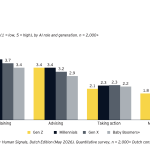
The acceptance of agentic AI in customer contact plummets as soon as AI acts independently. And empathy is desired less often than expected.
-
Meta launches a fully autonomous AI agent in WhatsApp. What does this mean for contact centers and CCaaS providers?