
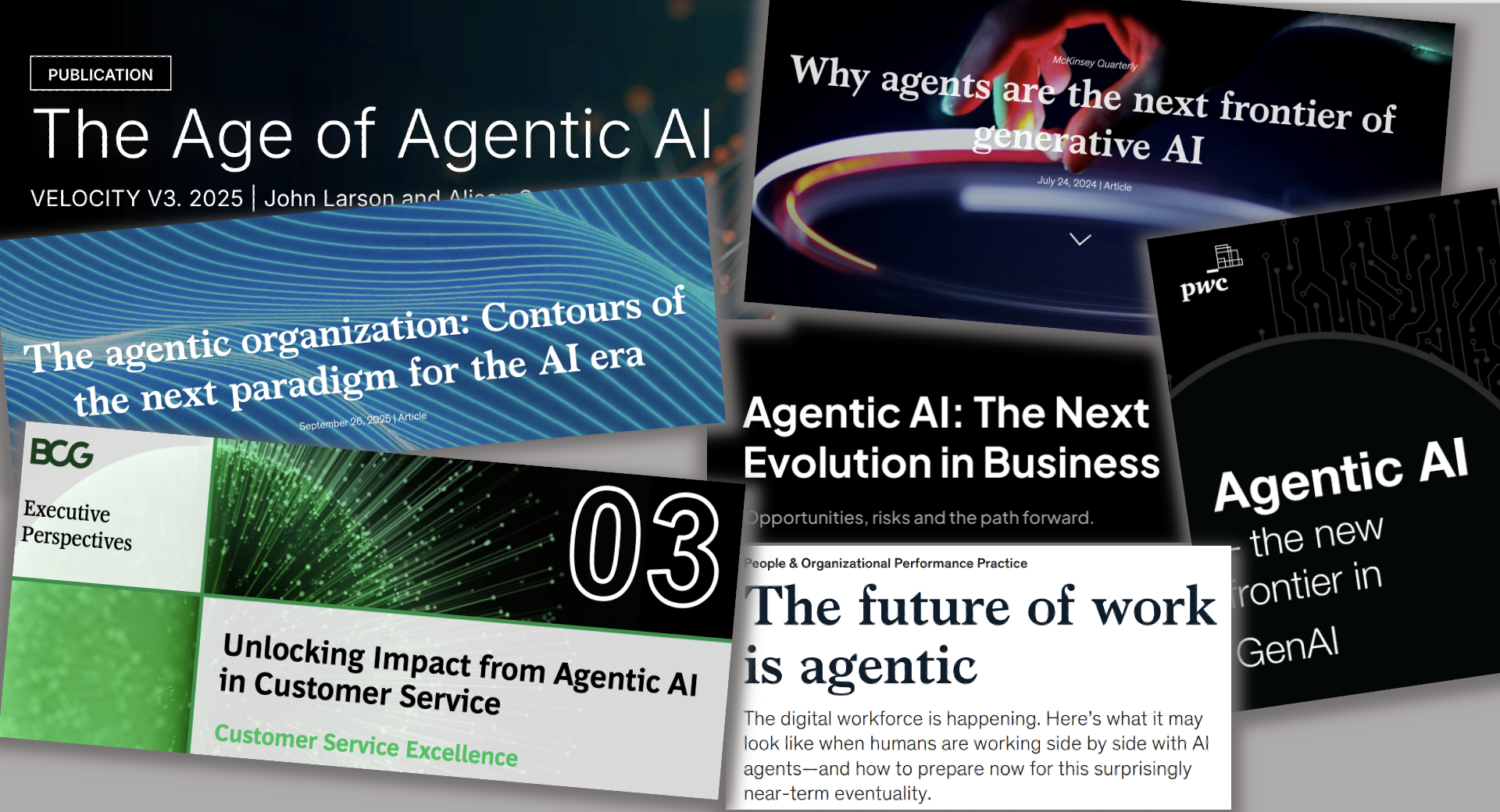
 Agentic AI has been in the starting blocks for a while now and, in addition to unprecedented potential, also has everything it takes to become the new headache for the contact center.
While the use of GenAI in customer contact is still limited to a small number of specific applications, the large consultancies are busy preparing the boardroom for the next hype. next frontier, The next evolution, the agentic organizationAgentic AI is being promoted as the next big thing, not only for businesses in general, but also specifically for customer experience.
In “Future of CX Belongs to AI Agents and Intelligent Orchestration.” Erik Linask (Editor-in-chief of IT trade publication TMCnet) believes that agentic AI represents a truly new step in customer contact. Instead of communicating on behalf of an organization, bots will perform actions. According to Linask, agentic AI is a solution to the promise companies have long made to customers but haven't kept: providing seamless service.
Prediction: growth, but also many failures
Market analysts also predict explosive growth for AI agents in CX. Gartner predicts that AI agents will reach 100% of the CX market in 2029. 80% of typical customer interactions will be handled autonomously. At the same time, Gartner predicts that more than 40% of agentic AI projects will be discontinued by the end of 2027.
This contradiction is a good way to create unrest in the market: we all have to take a turn, but some of us will not make it.
To make matters worse, some vendors are engaging in what Gartner calls "agent washing": rebranding existing products, such as AI assistants, RPA, and chatbots, without offering true agentic capabilities. Gartner estimates that only about 130 of the thousands of agentic AI vendors are "genuine."
As always with new technology, there are leaders and laggards in agentic AI, and the large middle group has yet to emerge. Gartner predicts that by 2028, at least 15% of daily work decisions will be made autonomously by agentic AI, compared to 0% in 2024.
From copilot to autopilot
Insurer Allianz Research recently published an analysis. Allianz Research calls agentic AI the next big technological wave, which is also specifically relevant for customer service. AI can not only act as a support system but also take over the helm: from co-pilot to autopilot. According to Allianz, this also means that agentic AI can take over human tasks to a greater extent than GenAI. While many organizations will continue to opt for AI deployments where humans and AI work together for the time being, Allianz points out that the technology is rapidly moving towards autonomous AI applications.
In addition, agentic AI has more 'substitution potential' – meaning AI takes over a large portion of tasks – than generative AI. Allianz analysts therefore advocate for more attention to 'reskillingand 'upskilling' for workers who are being displaced. They also suggest the introduction of AI Displacement Insurance (AIDI).
Myths surrounding agentic AI
Jarrod Davis, who considers himself a contact center provocateur, also seems skeptical. This is remarkable, because he works at Cognigy. He states in amyth-busting article' on ICMI While agentic AI implementations can be relatively fast, that doesn't make them simpler. Structure is required to account for and implement the limited autonomy (including how to handle edge cases). He argues that agentic solutions shouldn't be viewed as script-based applications, but as agents that require training, oversight, and governance.
Prompt & pray
Prompt-based AI agents (he calls this "prompt & pray") pose a risk, Davis says. "They may look elegant in a demo, but they succumb to enterprise complexity. A tangle of text fields doesn't have the power to fully address the demands of high-volume, regulated environments. Enterprises still need deterministic flows, system integrations, and monitoring to handle compliance, security, and edge cases. Without these elements, prompt-based systems can drift, quickly hit a wall, and fail at scale," Davis says.
Davis also points to the risk of automating legacy processes. "The most successful results were achieved when teams completely redesigned workflows to align them with AI and human collaboration."
Davis quotes IBM's Joanne Wright: “Before you adopt new technology, you have to decide what you're not going to do anymore.”
The biggest myth is that AI will immediately reduce costs. "Organizations implementing agentic AI initially see opportunities for cost savings, but also an increase in TCO due to investments in infrastructure, integration, and training," says Davis. Agentic, for example, entails recurring costs for monitoring and new releases.
Completely unprepared for the risks
Reid Blackman is the author of the book "Ethical Machines" and the founder and CEO of Virtue, a consultancy focusing on ethical risks related to AI. Blackman argues that organizations being completely unprepared for the risks of agentic AIOne of the key points he makes in a piece on the Harvard Business Review is that organizations need to remain aware of where they are on the complexity curve of agentic AI.
"No one knows exactly how all this (agentic AI, ed.) will play out, but regardless of the details, leaders are considering the very real possibility of large-scale organizational disruption. It's an exciting time," says Blackman.
Current AI applications and systems can also pose challenges. Issues like AI hallucinations, deepfakes, the risk of job losses, intellectual property violations, discriminatory output, privacy violations, and the black-box nature of AI all converge with agentic AI. Blackman therefore warns of a cumulative series of risks.
Risks and complexity are increasing rapidly
Blackman explains this accumulation as follows. Working with an LLM is relatively simple: a prompt leads to an output. In that situation, risks and scope are defined, there's usually a human in the loop, and the process can easily be stopped.
But linking an LLM to a database of resumes makes things considerably more complicated. When an LLM is connected to multiple databases and the internet, the risk of anomalous, incorrect, or biased output increases rapidly.
When such a system is allowed to perform digital actions, it's called multi-model agentic AI. If a multi-model agentic AI system is allowed to communicate with other multi-model agentic AI solutions within an organization, you have an internal multi-model multi-agentic AI platform. And when that platform is allowed to communicate with AI agents outside the organization, what Blackman calls "a dizzying tangle of unpredictable risks" arises.
Human in the loop becomes meaningless
According to Blackman, conducting sound risk analyses is definitely not yet possible for the last three options; the first two already pose considerable challenges. This is partly due to the multitude of interaction nodes, but also to the ability of a human in the loop to meaningfully determine the impact of a complex system's output. Let alone the ability to make sound decisions before implementing such complex systems.
Real-time monitoring of these types of systems, a monumental task, still needs to be developed, as do effective intervention methods. Black calls this an ethical nightmare, especially as AI continues to evolve from limited tools to sophisticated multi-agentic systems operating at speeds and scales beyond human oversight.
Image: Gemini/AI
Scenario: When Agentic AI Goes Wrong BCG presents a position paper with various (anonymous) examples of use cases. One of these is the proactive and end-to-end rebooking of a flight based on anticipating changing weather conditions. An AI agent could rebook the flight to the next day based on what it knows about the customer, such as the time and preferred seat. A hotel could also be booked for the overnight stay. If the rebooking is successful, the AI agent informs the passenger by phone. This scenario could work out well, but other outcomes are also possible (which BCG does not describe):
- the AI agent can reschedule the flight, but does not know that the customer has an important appointment the next day and therefore cannot travel;
- the customer does not give permission to book a hotel or change a ticket;
- an automated phone call to the passenger leads to confusion or panic because the message is unclear and has the wrong timing;
- The customer wants an explanation and the customer service employee does not know how the decision was made.

What does this mean for the future of CX and customer contact?
For CX and customer contact, the scenarios Black outlines pose enormous challenges, incomparable to the current form of "human in the loop" (such as reviewing an AI-generated conversation summary). The speed and unpredictability of (un)desired outcomes that AI agents may produce will present new challenges in customer service that far exceed "computer says no."
Contact centers that "don't do AI" will sooner or later face challenges from organizations or consumers that "do." This could involve successfully integrating with third-party AI agents or responding to the negative effects of third-party AI agents (or multi-model, multi-agentic AI platforms).
We must also consider AI agents that perform uncontrollable or harmful actions on behalf of companies or consumers. For example, an AI agent's hallucination could lead to the automatic sending of thousands of incorrect invoices or misleading contract amendments. In such a scenario, managers not only run the risk of only discovering after the fact that systems have made decisions that impact thousands of customers, but the black box nature also makes it virtually impossible to determine why a customer received a particular answer or solution.
Practical questions for the think tank
Agentic AI can make entire customer contact processes obsolete, but simultaneously creates new workloads. The transition from narrow AI to multi-agentic platforms isn't an incremental improvement, but an extreme leap in complexity. CX specialists and contact center managers should therefore look beyond their current AI roadmap or AI horizon. Practical questions to consider: which processes should never be run autonomously, in our opinion? How do we prevent loss of control? How do we prepare our employees for collaboration with AI agents who may be more capable and authorized than they are?
(Ziptone/Erik Bouwer)
For those who want to read more about Agentic AI in customer service: an illuminating white paper from BCG: Unlocking Impact from Agentic AI in Customer Service, September 2025


Also interesting
-
The FNV is aiming for an hourly wage of 16 euros; the union is being overtaken on the left by GroenLinks-PvdA, SP, and NSC, which are in favor of…
-
Because the solution offered by AI seems perfect, I miss options that I would otherwise have found through search results…
-

Cognigy, a leader in AI-powered customer service solutions, has announced Agentic AI, purpose-built for large-scale contact centers.