
 Organizations using AI chatbots must always offer people the option of speaking with a real customer service representative. This is the call from the Netherlands Authority for Consumers and Markets (ACM) and the Dutch Data Protection Authority (Autoriteit Persoonsgegevens). Both organizations also suggest increased oversight and are pushing for additional legislation.
Aleid Wolfsen (chairman of the Dutch Data Protection Authority) and Martijn Ridderbos (board member of the Netherlands Authority for Consumers and Markets) have a detailed vision document drawn up and share their opinion today in the FD.
They are pushing for additional legislation stipulating that consumers must always have the option of speaking to a human being if they want to contact an organization.
They give the example of a customer who first has to chat with a chatbot to get a phone number; after a while, when a phone number is provided, it turns out to be a speech bot on the other end of the line.
ACM and AP: signals about chatbots
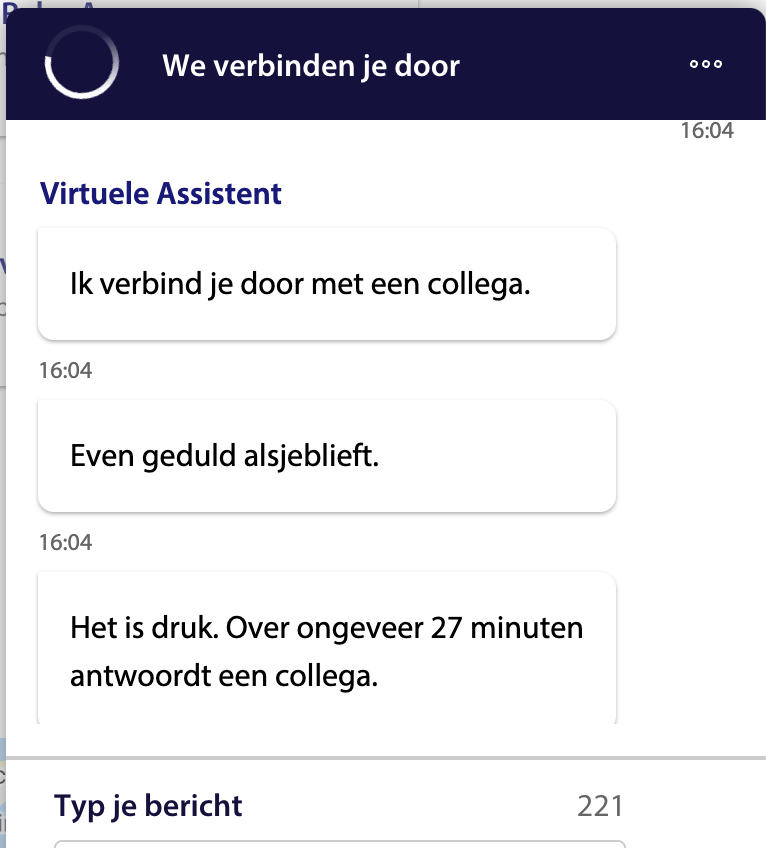 "You're looking for the contact details of a customer service representative, a real person, but they're nowhere to be found. Ultimately, your search ends without an answer. This happens to a growing number of people." Well-designed chatbots, with their availability and speed, contribute to better service. However, the AP and ACM have recently received a growing number of reports indicating that people sometimes only receive help via a chatbot, and are not being helped that way.
The signals show that chatbots sometimes don't provide good or even incorrect answers, or they simply pander to people. Furthermore, it's unclear to people whether they're interacting with a chatbot or an employee. And they fail to contact an employee when needed.
Call to organizations and adjustment of legislation
"Due to the growth in chatbot use, we expect the problems to worsen rapidly," according to the Netherlands Authority for Consumers and Markets (ACM) and the Dutch Data Protection Authority (AP). Both regulators therefore urge organizations to maintain control over the information provided by chatbots—by establishing quality standards, regularly checking answers with, for example, human random checks—and to be transparent with users that they are interacting with an automated system.
Furthermore, according to the Netherlands Authority for Consumers and Markets (ACM) and the Dutch Data Protection Authority (AP), human contact must always be possible to ensure the accessibility of services. They will focus on the responsible use of chatbots in the coming period, but they will also ask the legislature to implement changes in the legislative framework to clarify these requirements and thus prevent problems. Both authors point out that legislation and regulations already exist regarding how businesses and consumers can interact, but they doubt whether these regulations go far enough.
Customer Service Federation endorses call from ACM and AP
The Customer Service Federation (KSF) endorses the Netherlands Authority for Consumers and Markets (ACM) and the Dutch Data Protection Authority (AP)'s call for access to human interaction and greater transparency in the use of AI chatbots. The trade association is also eager to collaborate with regulators on clear standards for the responsible use of AI in customer contact. The KSF is currently also developing its own guidelines for the ethically responsible use of AI in customer contact.
"Human contact remains essential, but it's certainly not always better. The starting point must be that customers are genuinely helped," says Roel Masselink, director of KSF. "Technology and people aren't opposites: they actually reinforce each other. Chatbots and AI offer opportunities for accessibility, speed, and efficiency. But if customers get stuck, there should always be easy access to a representative."
The trade association shares the concerns of the Netherlands Authority for Consumers and Markets (ACM) and the Dutch Data Protection Authority (AP), but points out that more regulations don't automatically lead to better customer service. "Regulations tend to become an end in themselves," says Masselink. "What really helps is transparency and smart collaboration between people and technology. It should be about whether the customer is being served effectively."
(KSF, AP, ACM)


Also interesting
-
With the ACM's DSA check, you can check online which rules from the Digital Services Act (DSA) apply to your...
-

Complaints concerned “unwanted recruitment, poor customer service, unclear costs and problems with cancelling emergency services”.
-

In 2024, the ACM received ten percent more reports about unwanted and misleading telephone canvassing and problems with online stores.